
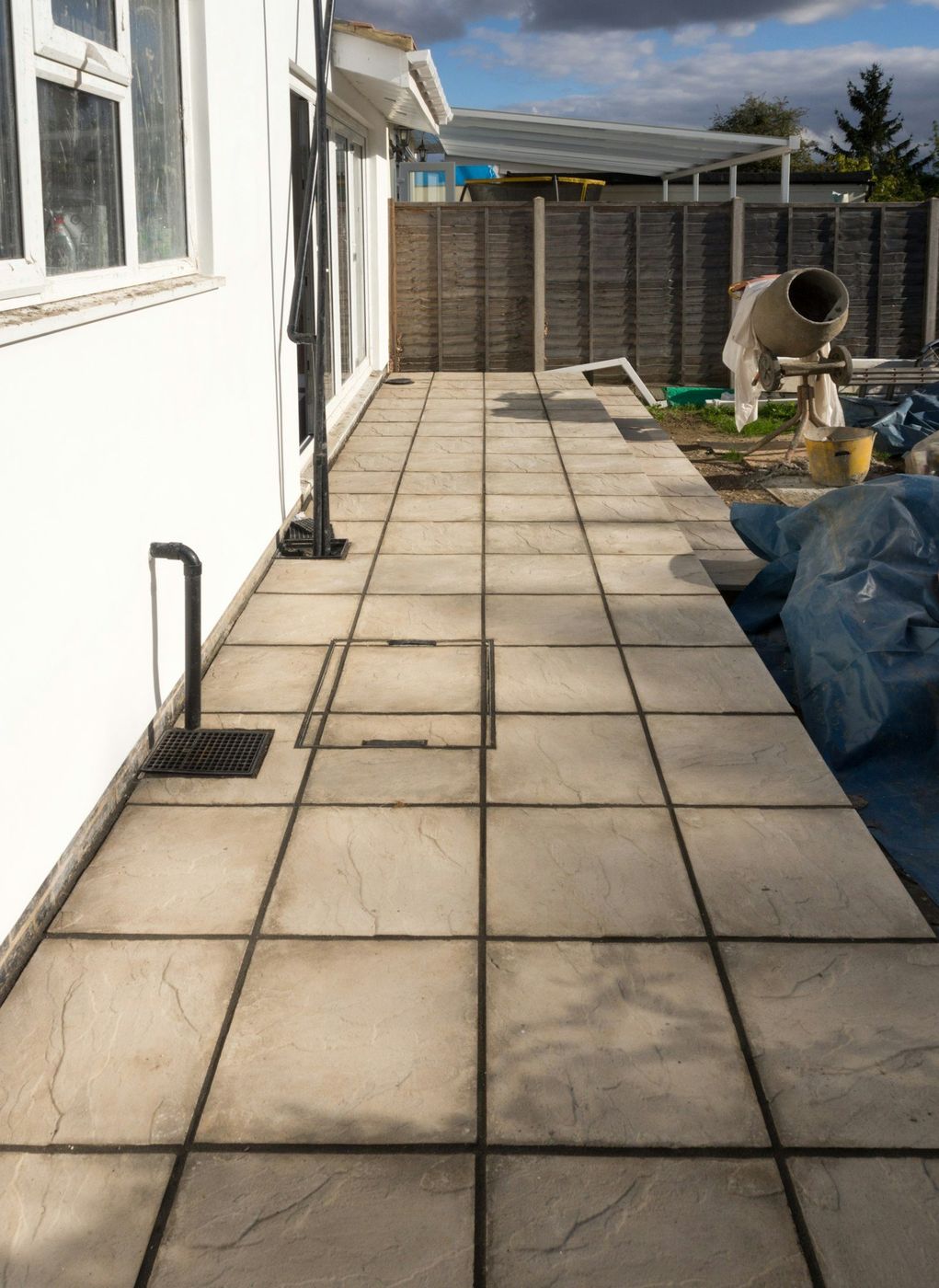
A topping is a wearing surface with a life of its own, so the first thing we price is how many years you need out of it.
The first question we ask on an overlay call has nothing to do with the slab. It's how long you plan to be in the house. That sounds like a sales question. It isn't. A bonded topping is a wearing surface with a lifespan of its own, and the right thickness, the right system, and the right amount of prep all move depending on whether this has to look good for two more springs or twenty.
Get that backwards and you either overspend on a patio somebody else will enjoy, or you economize on a surface you'll be redoing while you still live there. We've watched both happen in Southglenn and Willow Creek, sometimes a few blocks apart in the same summer.
Worth being blunt about what a topping is. It's a new wearing layer bonded to concrete you already own. It carries no structural load of its own, adds nothing to the thickness that counts, and will not hold together a slab that's coming apart from underneath. What it gives you is a fresh, even, colored surface without a dumpster in the drive and without the week of disruption a tear-out brings with it.
That's worth real money in the right situation and nothing at all in the wrong one. The whole value question comes down to how many good years the concrete beneath it has left, because a topping cannot outlive its host. Sound slab, worn face, decent base under it: excellent value, easy recommendation. Settled panel and cracks that open and close with the seasons: you'd be financing a repeat performance.
| Your horizon | What we'd put down | Why |
|---|---|---|
| Selling within a year | Clean, patch, and a thin color coat or a simple skim | You want a tidy, honest surface. Paying for a system built to outlive the closing is money you never see again |
| Three to five years | A quarter-inch polymer-modified topping with a broom or knockdown texture | Enough thickness to take real traffic, without funding decades you won't be around for |
| Ten years or longer | Full prep, thicker placement, integral color, and a joint plan carried all the way through | This is where skimping on prep hurts. The problems that surface in year six all trace back to one morning |
| A rental you intend to hold | Durability ahead of looks. Heavier texture, tougher sealer, a forgiving color | It has to survive tenants and snow shovels nobody is going to supervise |
| A slab you'll replace when the driveway goes | Spot repair and a good wash, not a topping | Bonding new material to concrete that already has a tear-out date is paying twice for the same square feet |
People assume they're paying for material. They're paying for the morning. Opening the old surface so a topping has something to grab is the biggest single line on the job: shot blasting or grinding across every square foot, chasing and filling what needs it, then vacuuming until the slab is genuinely clean instead of mostly clean. Low bids get low in exactly that spot, and hollow-sounding patches two summers later are the receipt.
After prep, the levers are thickness, whether color runs through the material or gets broadcast into it, how much hand detailing the edges and steps take, and access. A backyard behind a gate means every bag walks in. Slope corrections cost more than flat work, since depth changes as you go and somebody is working rails instead of a squeegee.
Two years or twenty, the answer changes. Free estimates and a straight read on the slab. Call (303) 569-4046.
A quarter inch of topping has almost no mass. It takes the temperature of whatever it's sitting on and surrenders its water to whatever is blowing across it, which makes weather a much bigger factor than on a full-depth pour. We want mild air, a slab that isn't baking, and no wind stripping moisture off the surface before the material sets. A thunderstorm two hours after placement handles us.
Late April into early October is the season, and the shoulder weeks are the good part of it. Then the first winter decides the next ten. No deicing chemicals whatsoever, sand only, plastic shovel. Meltwater standing in a low spot through a February freeze will find any weakness in the bond, and thin material has far less to give than a slab does.
Still unsure about something?
Call the crew at (303) 569-4046 and we will talk it through.

Get a free, no-obligation estimate from a crew that knows Colorado soil, Colorado weather, and how to finish concrete that lasts.
Accessibility
Adjust the site to fit how you read and browse. Your choices are saved on this device.