
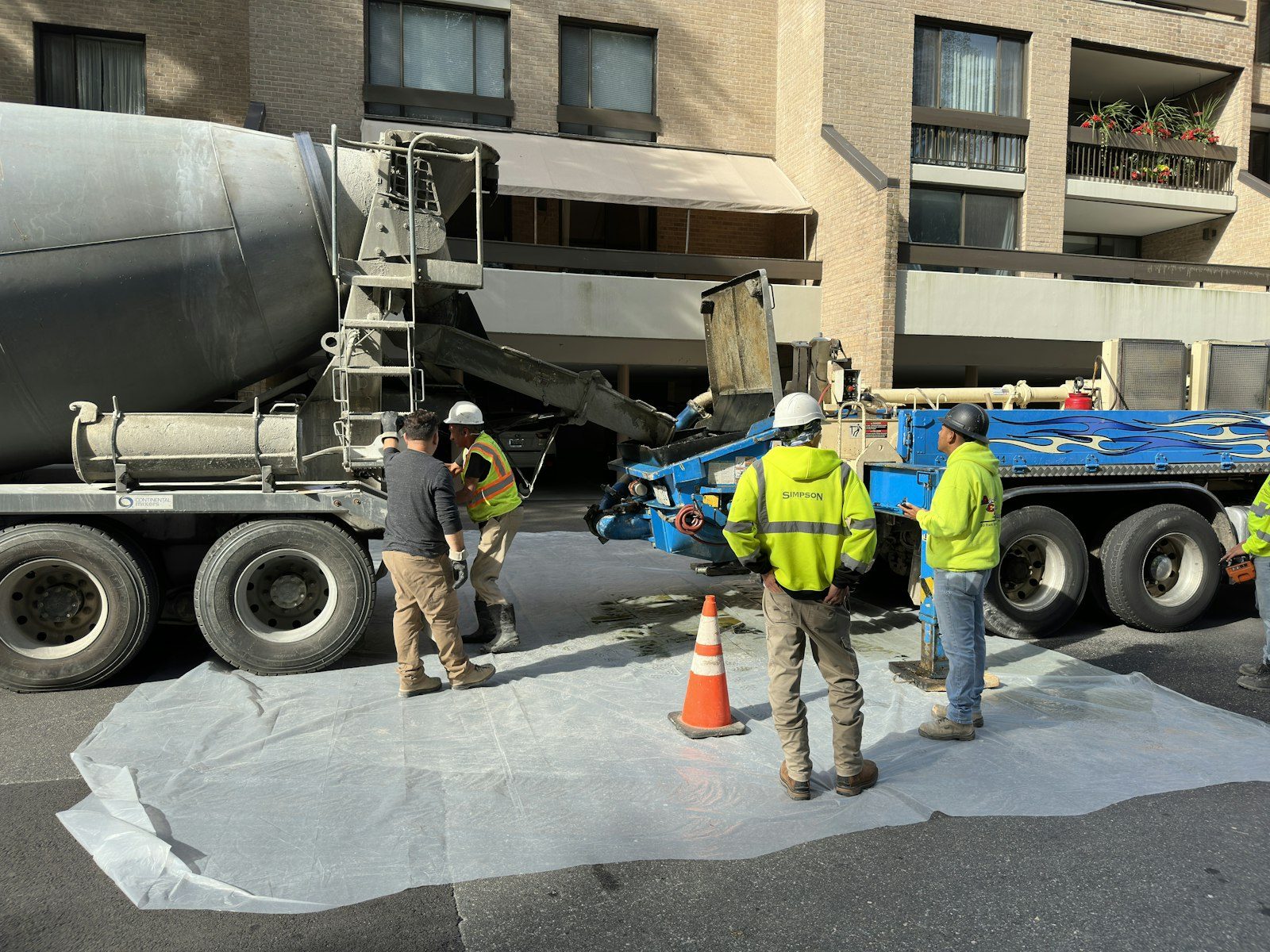
The court gets decided in the four hours between the last truck and the last pass of the broom.
Concrete gives you one window. Once the last truck pulls away, the clock runs on bleed water, set time, and the exact moment each finishing step has to happen, and none of it waits for anybody. On a driveway a small mistake in that window means a slightly rough patch. On a basketball court it means a dead spot you'll feel on every dribble for twenty years.
That's why we treat court pours differently from the rest of our flatwork. More hands on site, a plan written before the first truck backs in, and a crew that's watching the surface rather than the clock. Courts are going into back yards all over Piney Creek and Homestead, and the difference between one that plays true and one that doesn't happens on a single morning.
Base sets the ceiling on flatness. You cannot float out a low spot in the subgrade, so we grade the aggregate to the same tolerance we want in the finished surface and compact it in lifts. A laser goes on it repeatedly, not once. Any place a machine tracked through after grading gets reworked.
Then the pitch. A court has to shed water or it holds puddles and grows algae in the shade, but too much slope and the ball rolls away from you all afternoon. We take it in one direction only, gently, so the surface is a single tilted plane rather than a crown or a valley. One plane. That's the whole idea, and it's what makes a bounce predictable anywhere on the court.
Steel goes in on chairs, at the depth the design calls for. Hoop footing gets dug and formed before pour day, sized for the pole and the twisting force a backboard puts on it, and isolated from the slab so the two can move separately. Sleeve or anchor bolts get set to the manufacturer's template, checked twice, because that template is not something you fix later with a hammer.
| Step | When it happens | What it costs you if it's late |
|---|---|---|
| Strike off to grade | As each section is placed | High and low areas you can no longer fix with a float |
| Bull float | Immediately behind the screed | Aggregate left proud at the surface and a rough plane to work from |
| Wait out the bleed water | However long it takes, and no shortcuts | Working water back into the surface, which means dusting and scaling later |
| Straightedge and check the plane | Right as the bleed water leaves | The last chance to correct flatness. After this you live with it. |
| Float and finish | Once the surface holds a footprint | A closed, slick surface that plays fast and gets dangerous when wet |
| Broom or light texture | Just before the surface hardens off | No traction, or a texture so deep it eats the ball's true bounce |
| Saw the control joints | Same day, as soon as it will support the saw | Random cracks going wherever they please, straight across the key |
We place a court in strips and keep the concrete moving, because a cold joint in the middle of a playing surface is a permanent line. Screed follows the pour, bull float follows the screed, and one person does nothing but watch the plane with a straightedge and call out where it needs another pass.
Then comes the part that looks like standing around. Bleed water rises and it has to leave on its own. Touch the surface early and you work that water back into the paste at the top, which weakens exactly the layer a ball bounces off. So we wait, and we watch, and on a windy afternoon at this elevation that wait can be short and the crew has to be ready to move fast.
Finishing is a judgment call. Too smooth and the court is slick when it's damp. Too rough and it chews the ball and skins knees. We aim for a light, even texture with enough grip for quick footwork and not so much that the bounce goes dull. Saw cuts follow the same day, laid out on a square grid that we align with the lines so a seam never lands where somebody is dribbling hard.
Send us the dimensions of your usable flat area. We'll tell you what fits and where the hoop should stand.
Still unsure about something?
Call the crew at (303) 569-4046 and we will talk it through.
Get a free, no-obligation estimate from a crew that knows Colorado soil, Colorado weather, and how to finish concrete that lasts.
Accessibility
Adjust the site to fit how you read and browse. Your choices are saved on this device.