
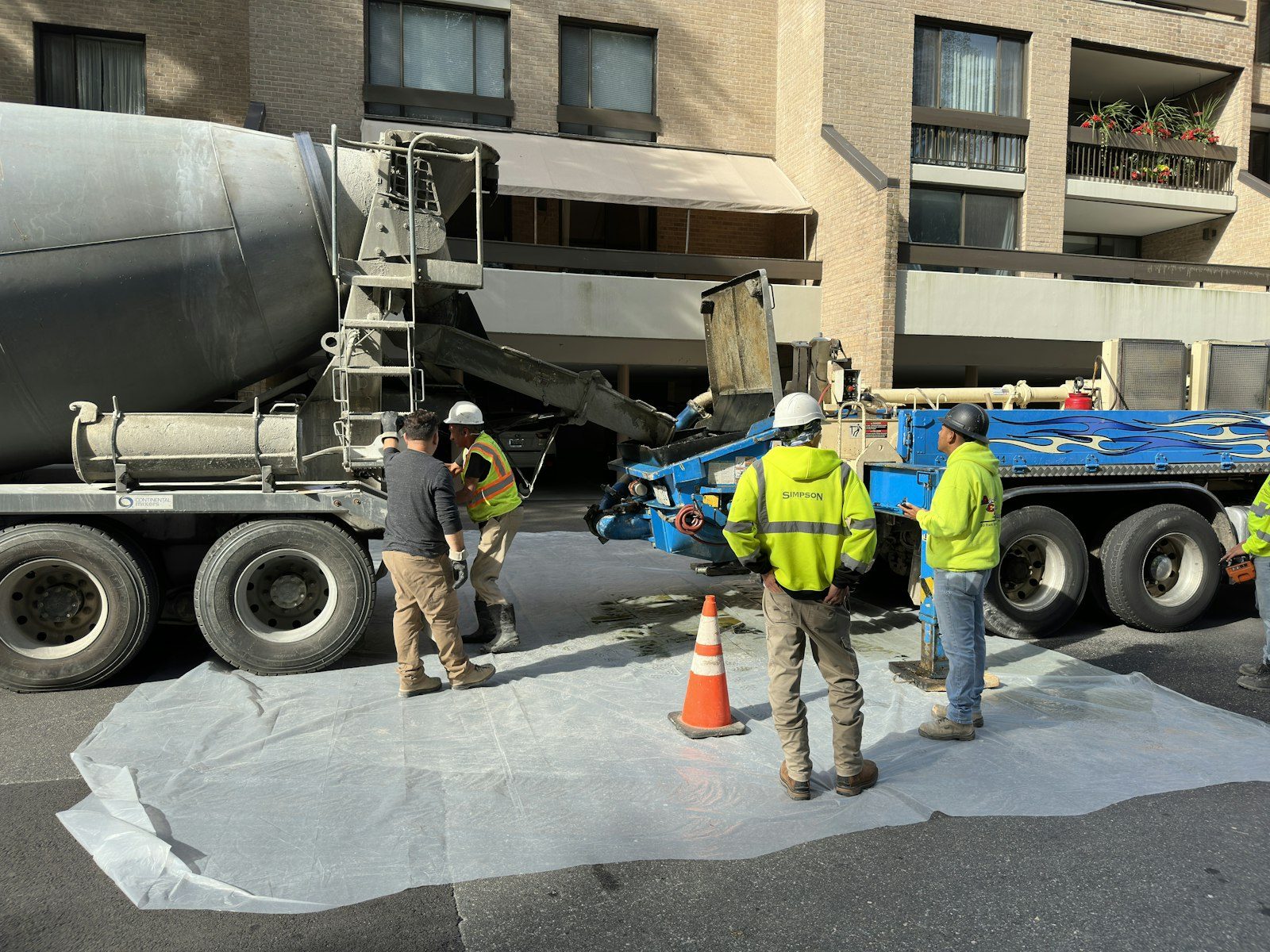
The slab under the color coat decides everything. Build it flat, build it stable, and the court plays right for twenty years.
The first fork in the road is concrete or asphalt, and around here the answer is less balanced than the industry likes to pretend. Asphalt costs less to install and it will play fine for a few years. Then it starts moving. Our freeze cycles and the ground under most of this county are hard on a flexible surface, and once cracks appear in an asphalt court they come back through every color coat you put over them.
The second fork is more interesting: how many courts, and when. That's the conversation we usually end up having with HOA boards, club owners, and property managers around Castle Rock, from community amenity areas in Crystal Valley and Cobblestone Ranch to private clubs and apartment sites. Build two now or four later. There's a right answer, and it depends on your site more than your budget.
A pickleball court is a big, thin, flat thing sitting on ground that moves seasonally. Everything you feel while playing traces back to how well that movement was managed. Which means the money belongs underground: a compacted aggregate base at real depth, drainage that carries water away from the pad rather than under it, and steel through the slab so the panels stay in one plane.
We pour court slabs with reinforcement carried across the full pad and joints planned around play. Where a court can be built as a single monolithic pour with control cuts placed outside the primary play zone, we do that. Ball response changes over a joint, and a player will notice it even if they can't say why. So the joint layout is a playing decision, not just a concrete one.
Playing lines run twenty by forty-four feet, but nobody wants to play on a pad that size. Room to run out a lob matters, so we plan a minimum pad of thirty by sixty and prefer thirty-four by sixty-four for a comfortable single court. Multi-court layouts share run-out between courts, which is the reason two courts cost far less than twice one.
Orientation is free and permanent, so get it right. Courts run north to south so the low sun sits off to the side instead of directly in a server's eyes, and up here the low afternoon glare is genuinely blinding if you get it backward. If four courts are the eventual plan, pour the pad for four now even if you only stripe and net two. Adding slab later means a cold joint through the middle of the complex, and that joint will always be visible and always be the first thing to crack.
| Build | The case for it | The catch |
|---|---|---|
| Reinforced concrete slab with acrylic coating | Stable, flat, holds its geometry through freeze cycles | Highest day-one cost of the standard options |
| Post-tensioned concrete | Best crack control available on moving ground | Specialty work, longer lead time, higher cost |
| Asphalt with acrylic coating | Cheapest to install, plays acceptably at first | Softens in summer heat, cracks reappear through every recoat |
| Modular tile over a concrete slab | Forgiving underfoot, drains fast, panels can be swapped | Still needs the slab underneath, so it adds cost rather than replacing it |
| Converting an existing tennis slab | Uses concrete you already own | Only if that slab is flat, sound, and draining correctly |
Send us the area you have to work with. We'll lay out both options on your site and show you what the phasing really costs.
Two separate schedules have to line up. The concrete wants warm, settled conditions, and the acrylic surfacing needs a dry stretch with temperatures in a workable range and no overnight cold snap. So the sweet spot is a slab poured in late spring or early summer, followed by coating once the concrete has cured properly, which is typically a month out at minimum.
Pouring in September usually means coating waits until the following spring. That's fine. A bare cured slab survives a winter without complaint, and some clients like knowing the concrete has been through a freeze before color goes down. What doesn't work is rushing coating onto green concrete. Moisture still leaving the slab will lift the coating, and you'll be redoing it inside a season.
Still unsure about something?
Call the crew at (303) 569-4046 and we will talk it through.
Get a free, no-obligation estimate from a crew that knows Colorado soil, Colorado weather, and how to finish concrete that lasts.
Accessibility
Adjust the site to fit how you read and browse. Your choices are saved on this device.