
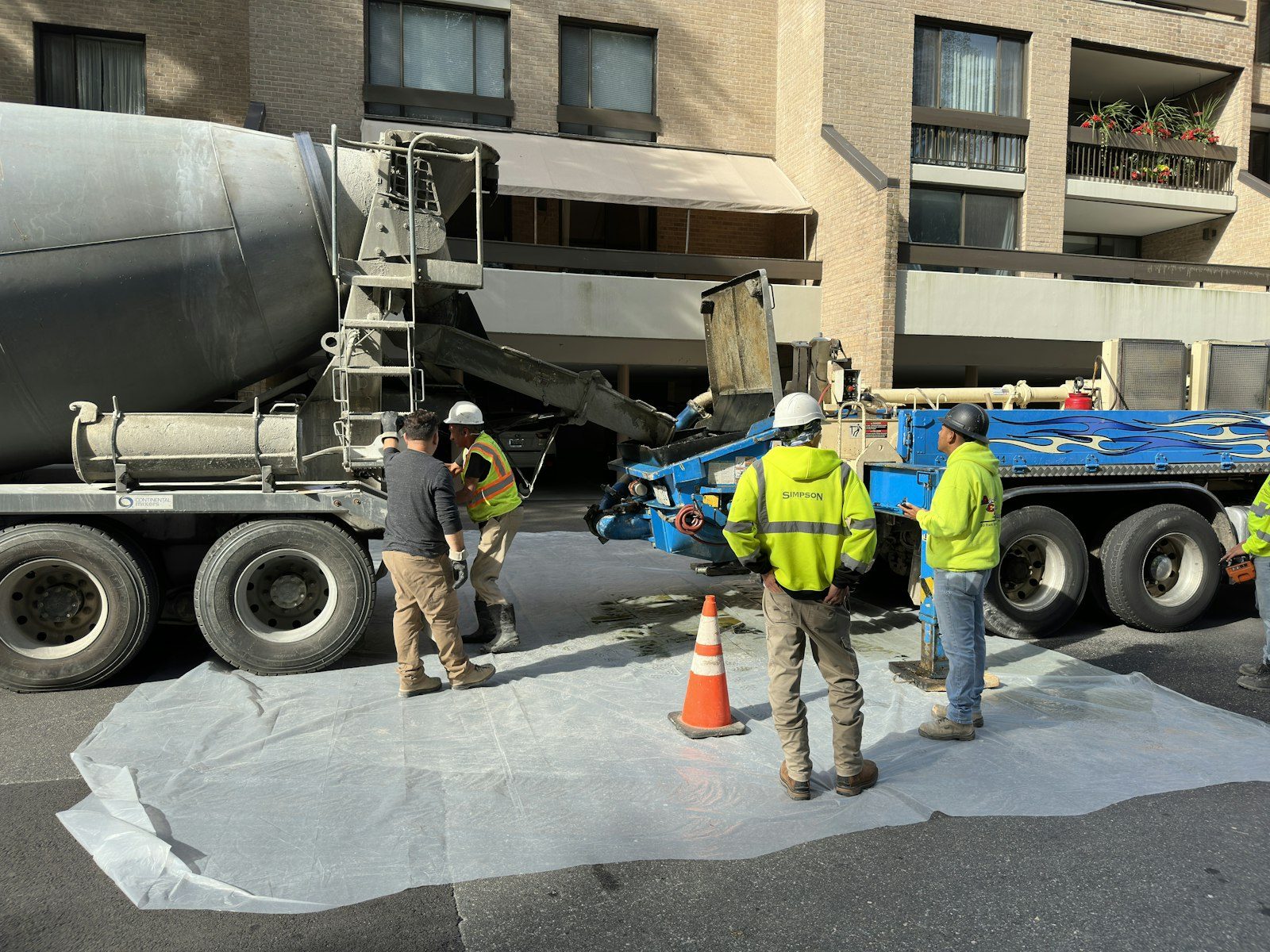
The cheapest concrete on the job until the machine sitting on it has to be moved.
An equipment pad reads like the smallest line on a quote. Little square, a couple of yards, poured in an afternoon. Then a generator gets set and the conduit stub is four inches off the cabinet knockout. Or a compressor starts walking across the surface in year two. Or the whole thing tips because nobody bothered compacting underneath it. Suddenly the cheap concrete is the expensive concrete, because relocating a machine costs multiples of what pouring the pad ever did.
So that's how we talk about these. Not what the slab costs today, but what a wrong one costs the day the equipment arrives and the year after. Vibration, level tolerance, penetrations, and clearance are the four things that decide whether a pad was a good buy, and none of them appear anywhere on a square foot price.
We got called out to a place where the standby unit had been sitting crooked for two years. The pad wasn't bad concrete. It was good concrete on eight inches of loose dirt that somebody raked flat and called a base. Everything expensive about that repair happened above ground, in the disconnect and the gas line, not in the slab.Our crew lead, after the walkthrough
Vibration comes first. A condenser hums. A reciprocating compressor punches. Anything with a rotating or reciprocating mass wants mass underneath it and isolation around it, which means a thicker section, sometimes an isolation joint separating the pad from adjacent slabs and structures so the buzzing doesn't travel into a wall or a bedroom floor.
Second, load. Feet under equipment concentrate weight far more sharply than the total shipping weight suggests, and that drives thickness plus what goes underneath. Third, penetrations. Every conduit, gas line, drain, or refrigerant chase gets located off the manufacturer's drawing and sleeved before the pour, because coring afterward through the exact spot the steel occupies is a bad afternoon. Fourth, tolerance. Some gear ships with a level requirement in its manual, and meeting a tight one changes how we screed and finish.
| Equipment | What the pad has to do | Detail that gets missed |
|---|---|---|
| AC condenser or heat pump | Stay level, drain away, sit above snow and splash | Line set and electrical routing planned before the pour |
| Standby generator | Carry a concentrated load, hold level tolerance, host multiple penetrations | Gas line and transfer switch conduit stubbed to the exact cabinet layout |
| Air compressor or shop machinery | Add mass, absorb vibration, isolate from surrounding slab | Anchor bolt pattern set from the machine drawing, not the catalog page |
| Utility transformer or service cabinet | Meet the utility's published dimensions and clearances exactly | Conduit stub-up window and grounding provisions |
| Pool or spa mechanical | Drain, resist chemical splash, keep equipment off wet ground | Slope and a clear route for backwash and condensate |
| Dumpster or fork traffic pad | Take point loads from truck forks and wheel impact | Thickness and joint placement away from where the truck sets down |
Newer homes out in Sapphire Pointe, Cobblestone Ranch, and Crystal Valley call about generators and heat pump upgrades, where the builder never planned a spot and the side yard runs narrow. Manufacturer clearance rules plus the neighbor's fence make placement the hard part; the concrete is easy once we know where it goes.
Founders Village and Plum Creek bring replacement work. Older mechanical sat on precast blocks or bare gravel for decades and has settled, so when the unit gets swapped the installer refuses to set new equipment on the old base. Metzler Ranch and The Meadows split between the two. Commercially we pour compressor pads in shops and transformer bases where the utility hands us dimensions that are not negotiable.
Send the installation drawing. We'll build the pad to the manufacturer's dimensions and have it cured before the truck shows up.
The scheduling mistake we see most is ordering equipment first and concrete second. Concrete needs time. A pad poured on Friday is not a pad you set a generator on Monday, and rushing that step is how anchor bolts end up loose in green concrete. Give us lead time ahead of your delivery window and the whole install goes quietly.
Season matters less on these than on big flatwork, since a small pour is easy to protect. Winter pads happen constantly, because furnaces and standby units fail in the cold and nobody wants to wait for May. Warm batch water, chloride-free accelerator, blankets, and a base checked for frost before anything gets placed. Small pours cool fast in a Castle Rock January, so we cover them, check them, and tell you straight about the extra day it adds.
Still unsure about something?
Call the crew at (303) 569-4046 and we will talk it through.

Get a free, no-obligation estimate from a crew that knows Colorado soil, Colorado weather, and how to finish concrete that lasts.
Accessibility
Adjust the site to fit how you read and browse. Your choices are saved on this device.