
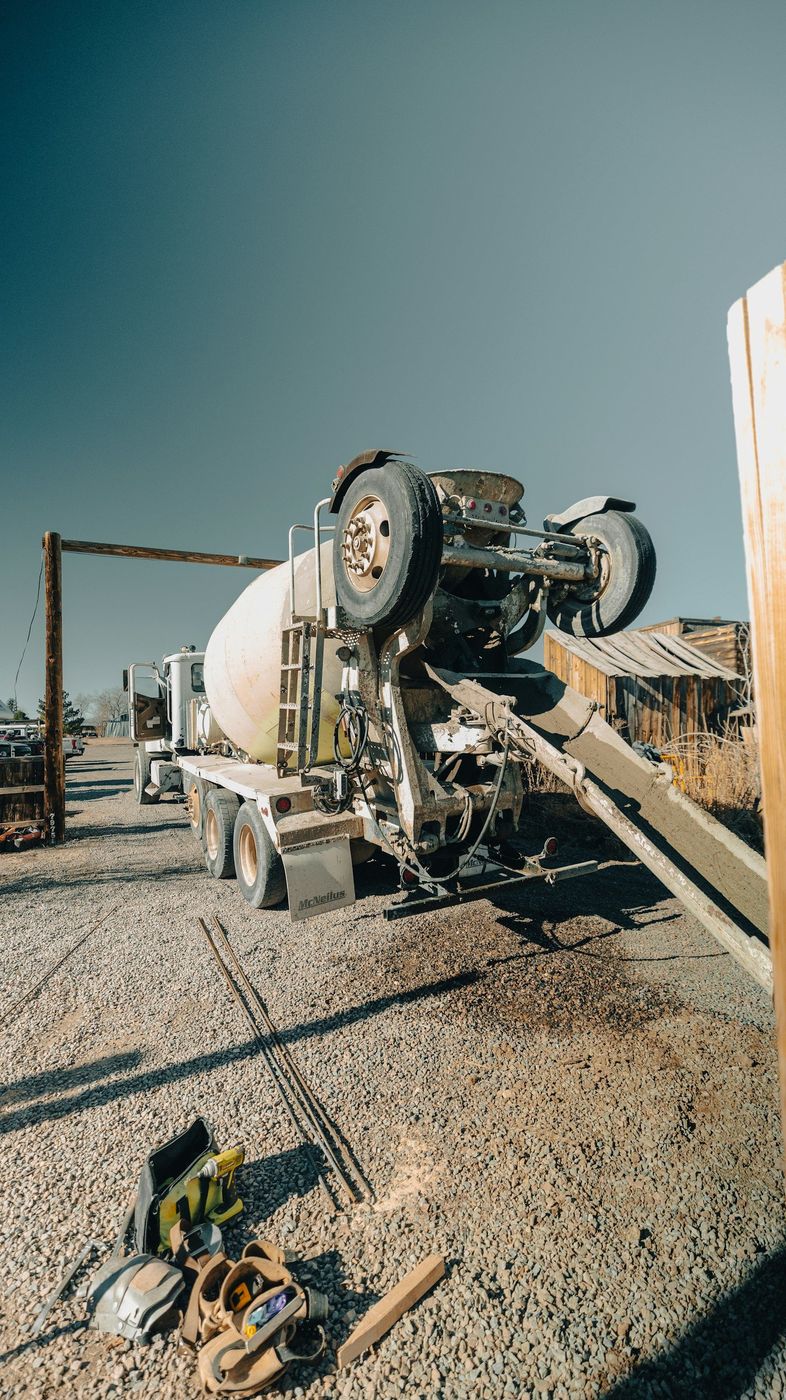
Tandem axles put a lot of weight into a very small footprint, and the slab has to answer for it.
Second week of November. Four inches of heavy snow came in overnight, it's melting by noon, and the trailer is sitting where it always sits, on ground that was firm in September and is now soup. Back the tow rig in and you'll leave ruts deep enough to lose a boot in. That's the week people finally call about a pad.
Fair enough. Gravel and native dirt work fine eight months a year, then quit exactly when you need them. Spring is worse than fall, since snowmelt keeps the top foot of soil saturated for weeks while a loaded rig presses on four small patches of rubber. Concrete solves it, but only if it was built for the load. Plenty of pads are just fat sidewalks with an RV on top.
A car spreads maybe a ton over four tires and drives off every morning. A fifth wheel parks in October and doesn't move until May, several tons pinned over two axle positions with a landing gear foot the size of a dinner plate under the nose. That's not driveway loading. That's a point load holding still through every freeze-thaw of the season.
Static weight is what people underestimate. Soil under a permanently loaded footprint compresses in ways it never does under traffic that comes and goes, and any soft pocket down there gets found. Add stabilizer jacks punching down at four more spots and you've got six concentrated loads on a slab somebody poured four inches thick because that's what the driveway got.
Measure the rig, then add ten feet. Everyone builds a pad that fits the trailer exactly and then finds there's nowhere to stand while cranking the jack, nowhere for the chocks, and nowhere for the truck during hitch-up. Ten extra feet turns a wrestling match into a five-minute job.
The apron is the other piece. Where the pad meets the drive, that transition takes the full weight of the rig twice a season, at an angle, with tires climbing. We form the joint deliberately: doweled, thickened, and cut so the two slabs move independently instead of one shearing off the other. Side yards in Lagae Ranch and BellaMesa often have room to make this simple. Established streets in Castle Pines North usually need a longer talk about grade first.
| What you're parking | What we pour | Reasoning |
|---|---|---|
| Small utility trailer, seasonal | 4 inches, mesh at mid-depth, compacted base | Light and it moves often. Standard flatwork handles it. |
| Single-axle travel trailer | 5 inches with bar on chairs | One axle means every pound rides two contact patches. |
| Tandem-axle travel trailer | 6 inches, steel on a tightened grid | Two axles close together load a narrow band of slab hard. |
| Fifth wheel or Class A motorhome | 6 inches minimum, thickened at the landing gear | The nose weight alone will punch a thin slab over one winter. |
| Boat plus the truck that pulls it | 5 to 6 inches with an extended apron | Two vehicles, one surface, and the tongue jack sits where nobody planned for it. |
| The approach off the driveway | Match the pad depth, doweled into the existing slab | Load hits here at an angle. First thing to crack if you cheap out. |
Give us the length of the rig and the side yard you're working with. We'll sketch the layout before you commit to anything.
Best case, you pour in a shoulder season and lose nothing. Late April into early June, or September through mid-October. The rig is out traveling or already put away, the ground is workable, and there's enough mild weather left to reach full strength before a hard freeze.
Fall is our busiest stretch for pads, for an obvious reason: people just spent a season backing into their own mud. Call in September and you're usually parked on new concrete before real winter arrives. Call in January and we'll be straight with you. Cold placement works with heated water, a non-chloride accelerator, and blankets held on for days, but a pad still needs its full 28 days before taking that weight, and frozen subgrade is where we stop.
One habit worth picking up: rinse the frame before the rig comes home in late winter. Road chemicals ride in underneath and drip on the slab all night, and magnesium chloride will pit a young surface faster than weather ever does.
Every failed pad we tear out has the same crack, running right across where the front axle sat. Four inches, wire mesh lying flat in the dirt, no thickened edge. The concrete didn't fail. Nobody ever asked it to carry that.What the crew sees on site
Still unsure about something?
Call the crew at (303) 569-4046 and we will talk it through.

Get a free, no-obligation estimate from a crew that knows Colorado soil, Colorado weather, and how to finish concrete that lasts.
Accessibility
Adjust the site to fit how you read and browse. Your choices are saved on this device.