
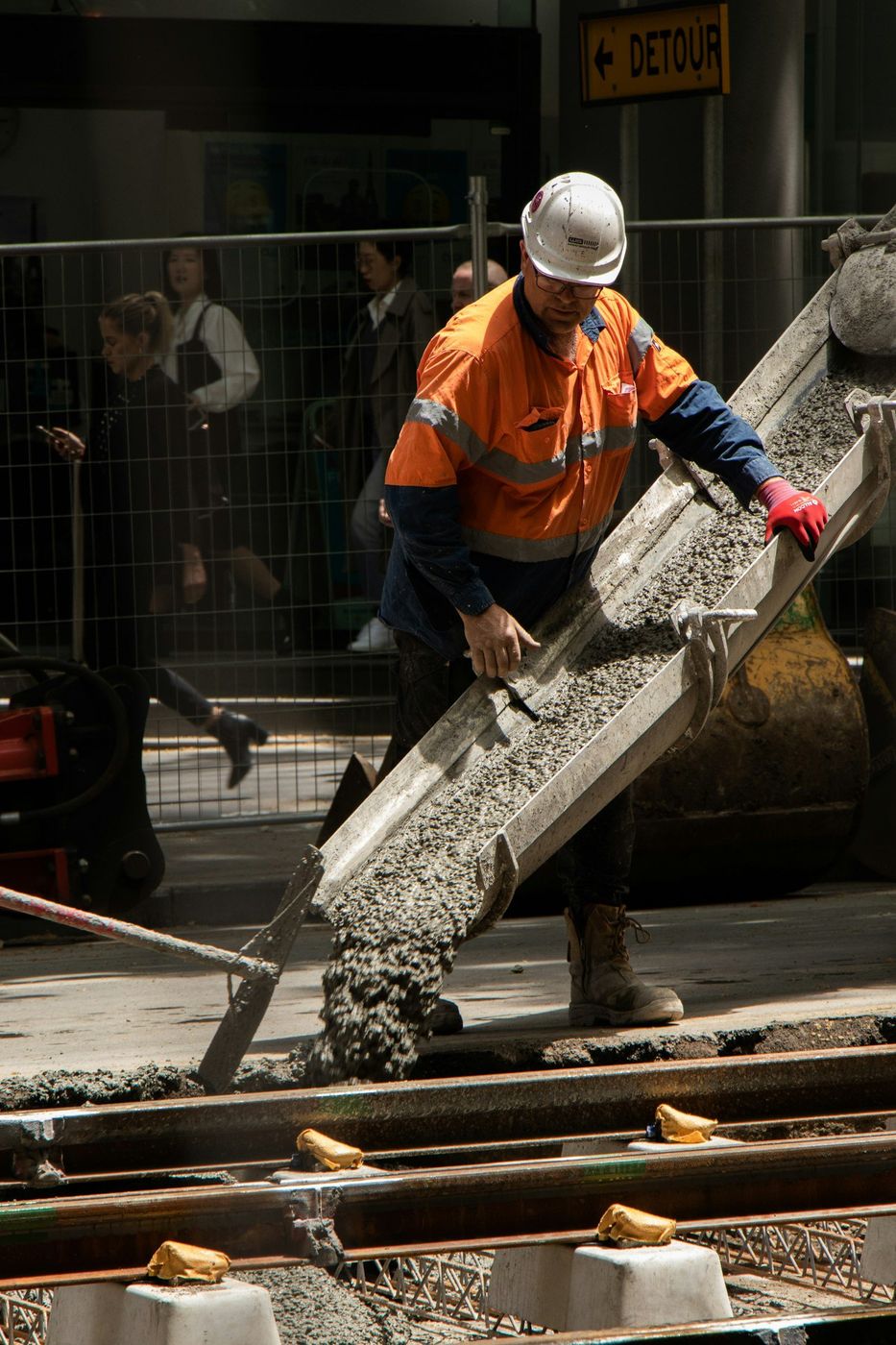
Built for the February morning when a frozen container and a hydraulic fork meet a tired slab.
February is when trash enclosures give up. A container that froze to the pad overnight gets yanked free at six in the morning, the truck's forks are carrying the whole load on two contact points, and yesterday's melt has refrozen into a lip at the gate that the driver has to bump over. Do that four times a month for eight winters and you get exactly what we get called about: a cracked, dished, spalling pad with gate posts that no longer line up.
We build and replace enclosure pads for commercial buildings, HOA amenity properties, and multi-building communities across the south metro. It's the least glamorous concrete on any site and one of the most punished. At 6,450 feet the freeze-thaw cycling out here runs constantly from November through March, and a pad that stays wet is a pad that comes apart from the surface down.
Water is the whole story. Snow blows into the enclosure and melts under the container. Leaking bags add their own liquid. Somebody pressure washes the pad in November and it never fully dries. All of it sits on a surface that's shaded by the enclosure walls most of the day, so it refreezes every night and thaws every afternoon.
That cycling attacks any concrete that wasn't made to handle it. Air-entrained mix is not optional here. Those microscopic air voids give freezing water somewhere to expand into, and a pad poured without them starts flaking within a few winters no matter how thick it is.
Then there's the truck. A front-load unit drives the pad with the container in the air, which shifts weight onto the front axle in a way an ordinary parking stall never sees, and the drop at the end of the cycle sends a shock into the same square yard of concrete every single week. Rear-load containers roll, which is gentler, though the wheel tracks eventually rut a thin slab all the same.
Around Castle Pines North and the amenity properties near Daniels Gate, the enclosures we replace most often are the ones tucked into a low corner where the site naturally drains. Convenient for screening. Terrible for concrete.
| Season | How it goes | Worth knowing |
|---|---|---|
| Late spring | Ground has dried from snowmelt, compaction goes well, easy scheduling | Our busiest booking window. Get on the calendar early. |
| Summer | Fast placement, early starts, afternoon storms are the variable | We cover fresh work and will push a pour rather than finish in rain. |
| Early fall | The best of the year for this work | Cool nights, long cure runway, container back in service before real cold. |
| Late fall | Still workable, weather windows narrow | We watch for the first hard freeze and blanket anything young. |
| Deep winter | Possible with heated water, accelerator, and insulated blankets | Frozen subgrade is a hard stop. We'll set a temporary container location instead. |
A pad has to be strong and it also has to be shaped. Slope matters because liquid needs to leave the enclosure in a controlled direction, usually toward a landscape area or a drain your jurisdiction allows, never toward a building or a storm inlet if your municipality restricts it. Check with your local authority on containment requirements before scope is set, because this varies and we'd rather build to your rules than to a general assumption.
The apron out front matters as much as the pad inside. That's where the truck's front wheels sit during the lift and where the forks come down, and an apron poured too short or too thin is why so many pads crack in a line right at the gate. We extend the reinforced section far enough forward that the entire lifting cycle happens on concrete we designed for it.
Bollards, gate posts, and enclosure walls get footings that reach below frost depth. Posts set in a shallow puck of concrete inside the slab will heave, and once the gate stops latching, drivers stop closing it. Small detail. It's the one residents notice first.
Last, joints. We lay them out so they land where the panels want to crack anyway, and we keep them out of the wheel path where we can, because a joint under repeated fork impact is where deterioration starts.
Send photos of the gate area and the wheel tracks. We'll tell you whether it's a surface issue or the base underneath.
Still unsure about something?
Call the crew at (303) 569-4046 and we will talk it through.

Get a free, no-obligation estimate from a crew that knows Colorado soil, Colorado weather, and how to finish concrete that lasts.
Accessibility
Adjust the site to fit how you read and browse. Your choices are saved on this device.