
A flowline is a drainage structure that happens to look like trim.
Nobody on your property thinks about curb. They use it constantly. Delivery drivers bump it backing to a door, plow operators ride the face of it every storm, landscape crews run a mower wheel along it forty times a season, and every inch of runoff on the site eventually travels the gutter pan to an inlet. It's the hardest-working concrete you own and the piece that gets specified last.
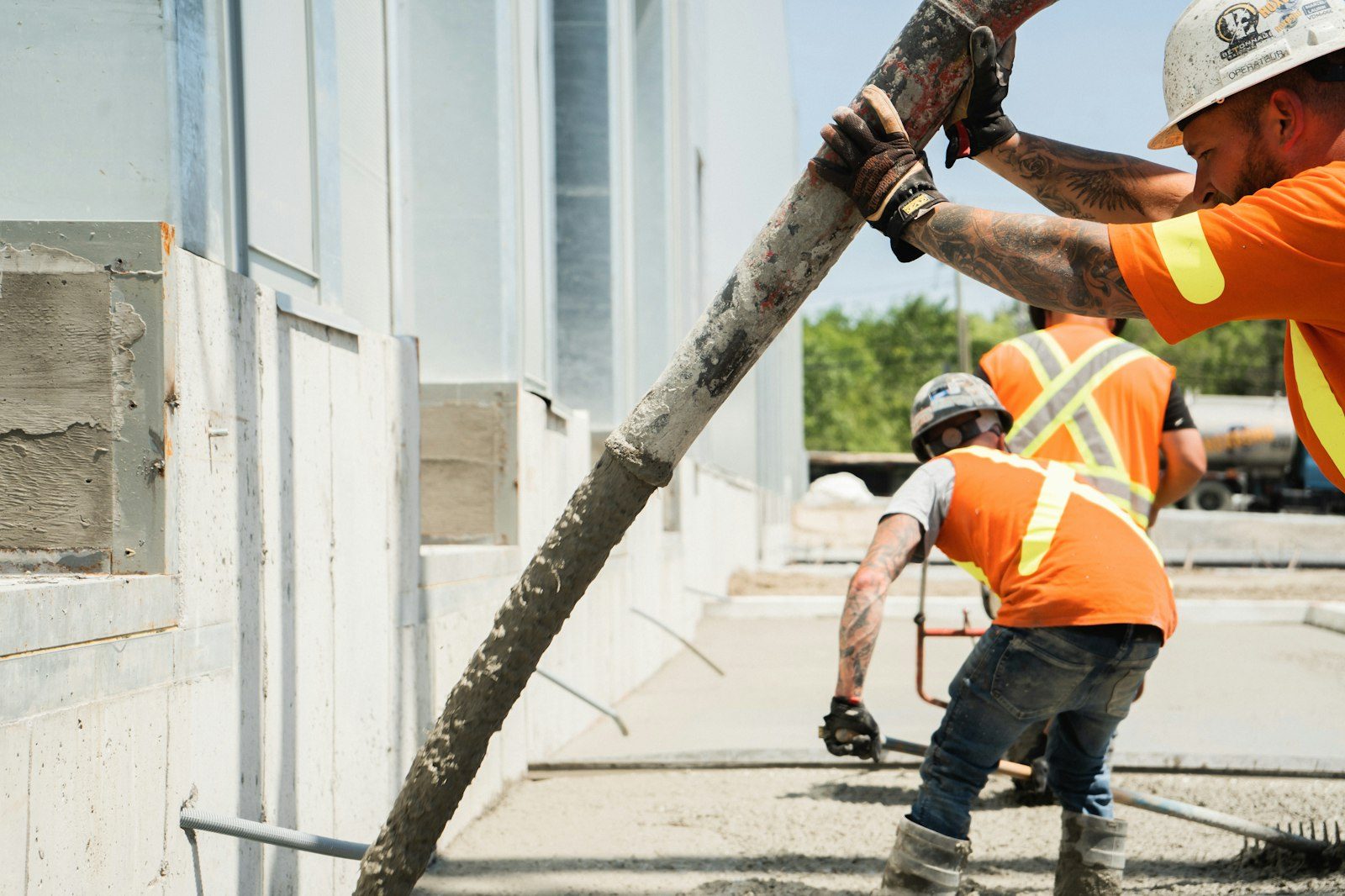
We pour curb and gutter for commercial sites, HOA-owned streets, and amenity properties around the south metro. Machine-extruded where the runs are long and the radius is generous, formed by hand where a driveway apron, an inlet throat, or a tight island says the machine won't do it right. Both get the same base. Both get the same mix. The difference is method, not quality.
Start with the plow. A steel edge dropped a half inch low takes the top off a curb face in one pass, and once the paste is gone the aggregate underneath starts letting go every freeze. That's why the mix matters more on curb than on almost anything else we pour. Air-entrained, 4,000 PSI, finished tight, and given a real cure instead of a quick hose-down.
Then the tires. Trash trucks and box trucks climb the pan when they're squaring up to a dock or a dumpster gate. A gutter poured thin, or poured without the curb and pan placed monolithically, cracks right at that joint. We run curb and pan as one piece for exactly this reason.
The mowers and string trimmers are the quiet ones. Repeated wheel contact on a sharp lip chips it over years, so on HOA-managed frontage in Castle Pines North and along the newer streets near BellaMesa and Lagae Ranch we'll talk through a rolled or battered profile where residents and crews cross it constantly. It sheds a mower wheel instead of catching it.
And under all of that, water. A flowline that holds a true grade moves runoff to the inlet and dries out. One that dips holds a puddle, and at 6,450 feet that puddle freezes and thaws over and over from November through March until the pan spalls. Grade is not cosmetic on a gutter. It's the whole job.
| Method | Where it belongs | Trade-off |
|---|---|---|
| Slipform machine | Long straight runs and wide radii on streets, drive aisles, and lot perimeters | Fast and consistent. Needs room to travel and a clean, well-compacted grade to ride. |
| Hand-formed | Aprons, inlet throats, tight islands, ADA transitions, short tie-ins | Slower and more labor. It's the only way to get complex geometry right. |
| Mixed on one job | Most commercial sites, honestly | We extrude the long stuff and hand-form the ends. Finishes are blended so the seam doesn't read. |
| Rolled or battered profile | Frontage residents and mowers cross constantly | Less protective against vehicle intrusion. Much friendlier to daily use. |
| Vertical face profile | Loading areas, fire lanes, and anywhere you want trucks to stay off the landscape | Takes plow abuse on the nose. Also the profile that actually stops a tire. |
Curb work is almost always partial. A section spalled at the plow line, a pan that sank next to an inlet, a face somebody clipped with a trailer. We saw full panels at the joints, break out clean, rebuild the base, and tie the new grade to both neighbors so water doesn't stall at the seam. Feathering a patch onto a broken edge is how you get two failures instead of one.
Timing works like the rest of our flatwork. April through October is the comfortable stretch, and early fall is the sweet spot because the pan gets a long cure with no scorching afternoon crust. Winter runs are doable with heated water, non-chloride accelerator, and blankets over the fresh edge overnight, and we won't place on frozen ground under any deadline. What we do more often in January is a temporary asphalt wedge to kill a trip hazard, then the real concrete when the ground opens up.
Traffic control is part of the price. Cones, signs, a flagger where a drive aisle narrows, and enough barricade to keep a resident from walking a green pan. Most sections are open to vehicles within a week and to foot traffic sooner.
Send a photo of the puddle and the nearest inlet. We'll tell you whether it's a grade problem or a settlement problem.
Still unsure about something?
Call the crew at (303) 569-4046 and we will talk it through.

Get a free, no-obligation estimate from a crew that knows Colorado soil, Colorado weather, and how to finish concrete that lasts.
Accessibility
Adjust the site to fit how you read and browse. Your choices are saved on this device.