
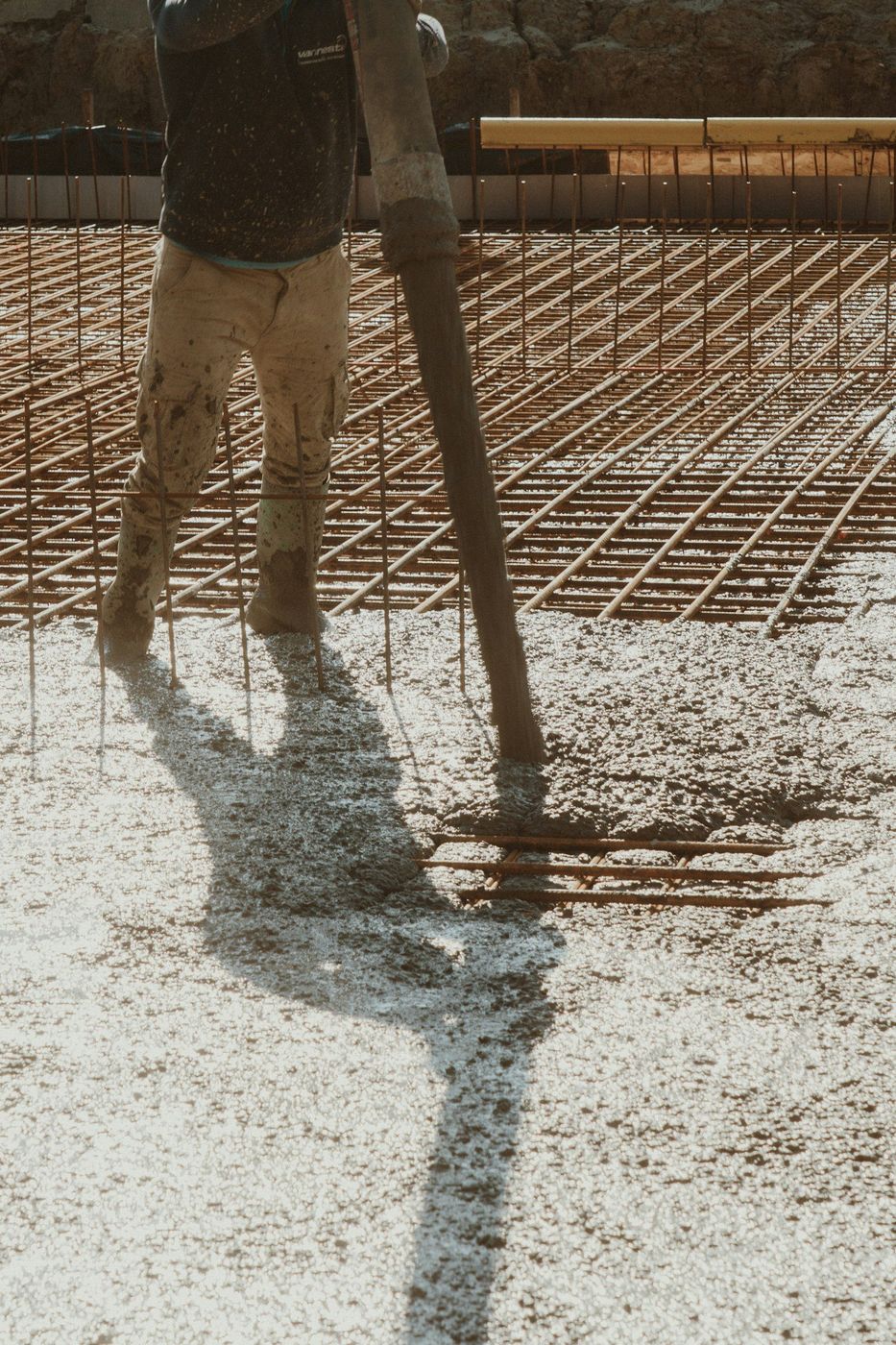
One long day indoors with no weather to blame and no chance to do it again.
Floor day inside a shell starts in the dark and does not stop. The pump or the chute holds a fixed position, placement runs in strips from the far wall back toward the door, and the crew works the surface in waves behind it: screed, bull float, wait, power float, wait, trowel, wait, trowel again. The waiting is the job. Concrete decides when the next pass happens, not the foreman, and the whole day is spent reading a surface and being ready the minute it opens up.
We pour interior slabs for distribution buildings, contractor shops, equipment buildings, and oversized private garages across Aurora. From the door those pours look calm. They are calm because everything that could have gone sideways got settled a week earlier.
We place in strips, not in one moving blob, because a strip gives the crew a straight working edge and a predictable amount of surface to manage. First truck goes to the far corner. The concrete gets spread, vibrated where it needs it, and struck to grade with a laser screed. Behind that, bull floats knock down the ridges and close the surface.
Then everybody waits. Bleed water has to come up and leave before any finishing machine touches the slab, and troweling early traps that water in the top layer, which is exactly how a floor ends up dusting in one bay and not another. The foreman is watching for the surface to lose its sheen and support a boot print of a certain depth. That is the signal.
Power floating opens the window. Then a series of trowel passes tightens the surface, each one with the blades set a little steeper, and the floor goes from gray and open to hard and closed. Saw cuts follow the same day, often late, because joints cut a day late are joints the slab already decided for itself. Then curing, and nobody walks on it.
| Trade | Finished before we place | Waits until after |
|---|---|---|
| Underslab plumbing | Sleeves, drains, and cleanouts set to final elevation and tested | Fixture setting and trim work |
| Electrical | In-slab conduit, floor boxes, and stub-ups located and tied down | Panel work and anything that puts a lift on a green slab |
| Steel and structure | Column bases grouted and the isolation detail around each one established | Welding or grinding that throws slag onto a fresh surface |
| Overhead doors and dock equipment | Pit elevations and threshold heights confirmed in writing | Door installation, leveler setting, bumper anchors |
| Racking and mezzanine | Anchor layout shared so no joint lands under a base plate | Anchoring, which waits for the slab to reach strength |
| Temporary heat and enclosure | Heaters, fuel, and the building closed up for a cold-month pour | Nothing. Heat stays on until we call the cure finished. |
Send us the slab area, the equipment that will run on it, and the date. We will work backward and tell you what has to happen when.
Indoors does not mean weatherproof. A shell with the dock openings still open is a wind tunnel, and wind across a fresh floor pulls surface moisture out faster than the slab can replace it. Cold is worse. Concrete placed into a fifteen-degree building gains strength so slowly that the finishing window stretches into the night, and a slab that freezes before it sets is a slab that comes back out.
So for a winter pour we want the building buttoned up, temporary heat running before we arrive, ground thawed, and fuel enough to hold temperature through the cure. That is a real cost, and it is smaller than the cost of a failed floor.
Summer brings the opposite problem in an uninsulated metal building, where the interior can run hotter than outside and the mix sets fast. We start early and add retarder. Work on service and shop buildings tends to run year-round on both sides of the city, from the newer commercial serving Southshore and Tallyn's Reach to the older shops closer to Sterling Hills and Murphy Creek.
The best thing that can happen on a floor day is boredom. If somebody is running around, it means a decision got left for pour morning that should have been made last Tuesday.Our crew lead, after the walkthrough
Still unsure about something?
Call the crew at (303) 569-4046 and we will talk it through.

Get a free, no-obligation estimate from a crew that knows Colorado soil, Colorado weather, and how to finish concrete that lasts.
Accessibility
Adjust the site to fit how you read and browse. Your choices are saved on this device.