
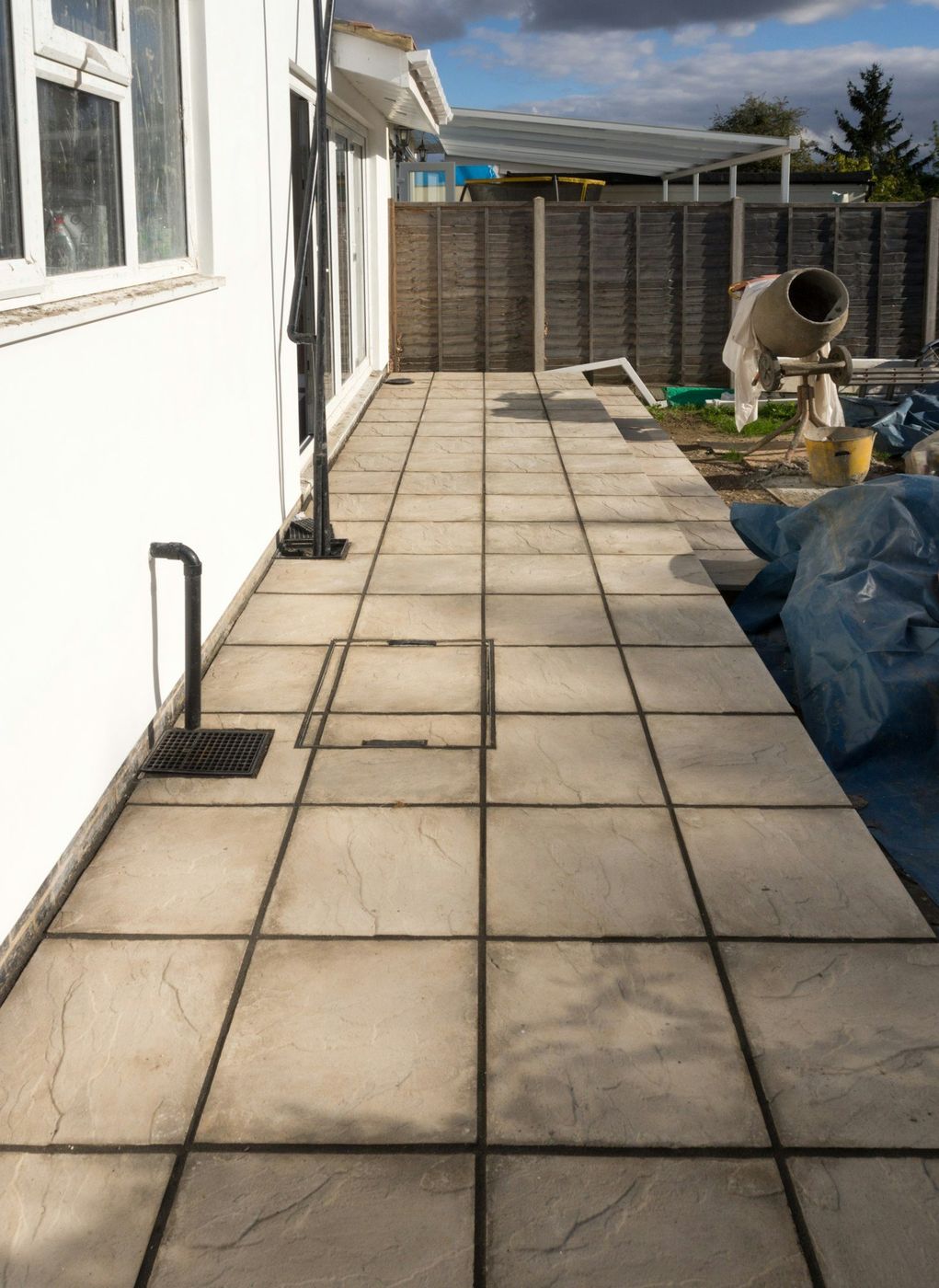
Priced by the edges more than the area, because the edges are where a pool deck is won or lost.
Two backyards, two decks, nearly identical square footage, and the quotes come back looking nothing alike. That surprises people until we walk the outline together. A pool deck is priced by its perimeter at least as much as by its area, and the perimeter is where the difficulty lives: the joint at the coping, the step to a lower terrace, the curve wrapping a spa, the drains.
So rather than quote a rate per foot, we break the number into what each piece buys. A deck isn't a patio that happens to sit beside water. It's a wet, chemically loaded, barefoot surface at 5,471 feet with a rigid concrete vessel attached to one side, and each of those conditions costs something to build for.
Open field is fast. A crew screeds a big rectangle in a fraction of the time it takes to form a scalloped edge around a free-form pool, and material cost per foot barely moves either way. Hours go into everything that isn't flat and straight: radius forms bent and staked, a spa surround with a step, a raised planter edge.
Then the coping line, which is the most important foot of concrete on the property. Deck and shell are two separate structures. Ground shifts, temperatures swing, and the two respond differently, so they need an isolation joint or something has to give. It's always the deck, and it always cracks parallel to the water about a foot back. That joint costs almost nothing, and it's why half the deck repairs we look at were avoidable.
Drains are the third driver. Where the yard falls away on every side we build the slope into the pour and there's nothing to buy. Where the pool sits low or the house is downhill, we're setting drains and running pipe to daylight. Grade decides that, not preference.
| What you're paying for | What it buys | Room to trim |
|---|---|---|
| Base and slab | Compacted base, air-entrained mix, steel inside the concrete | None. It decides whether the deck exists in ten years. |
| Perimeter and shape | Forming for curves, steps, and a spa surround | Simplify the outline. Long arcs beat tight scallops. |
| The coping joint | A clean break so shell and deck move independently | Nothing here either. Skipping it is a false economy. |
| Drainage | Slope in the pour, plus drains where grade can't do the work | A yard that falls away on all sides may need no drains |
| Finish | Broom, salt, exposed aggregate, or a stamped texture | Broom near the water, decorative on the lounging side |
| Sealer | Chlorine resistance, UV protection, grit that keeps working | Stretch coverage toward the splash zone if money is tight |
| Access | Getting concrete into a fenced yard by buggy, pump, or barrow | Open the widest gate and clear the path before pour day |
The build is one number. The next fifteen years are another, and today's choices set them. A broom-finished deck wants a penetrating sealer occasionally and little else, since the traction is physically in the concrete and can't wear off. A stamped deck wants a film-forming sealer with grit in it every two to three years, and up here that interval is firm, because our sun breaks coatings down faster than any label expects.
Splash-out is the other slow expense. One edge of the deck takes chlorinated water every afternoon of the season, and over years that etches an unsealed surface until it feels chalky. Rinsing during heavy swim weeks helps more than people think. Winter is simpler: plastic-bladed shovel, sand for traction, no chloride ice melt at all.
We pour decks from late spring into early fall, and May is the smart booking, since the slab cures and gets sealed before anybody swims. Everybody calls in June. Newer backyards in Southshore and Saddle Rock usually have the grade and the access to keep this simple. Older yards around Sterling Hills and Murphy Creek more often start with a drain and a gate conversation.
Send a photo of the pool and the yard behind it. We'll tell you which line items your site forces and which ones are genuinely your call.
Homeowners look at the square footage and assume that's the job. Then we stake the forms and they watch two people spend a full day bending radius around the shallow end. The flat middle takes an hour. The pretty curve takes the day. That's the whole pricing story.What the crew sees on site
Still unsure about something?
Call the crew at (303) 569-4046 and we will talk it through.
Get a free, no-obligation estimate from a crew that knows Colorado soil, Colorado weather, and how to finish concrete that lasts.
Accessibility
Adjust the site to fit how you read and browse. Your choices are saved on this device.