
Three kinds of Aurora back yard, three completely different problems at the bottom of a post.
The pergola conversation always starts above ground. Cedar or steel, how deep the shade slats run, whether it ties to the house or stands on its own. Then somebody asks what holds it down and the answer depends almost entirely on what kind of property we're standing on.
A brand new lot in Southshore hands us bare graded dirt, no landscaping in the way, and a homeowner who can still change the patio layout. An established yard around Saddle Rock or Tallyn's Reach hands us mature trees, a full irrigation system, and a patio poured long before anyone thought about posts. And a walkout lot hands us a terrace sitting on backfill that was never intended to carry a structure. Same six posts. Three different jobs underneath.
On a new build this is the easy version and the cheapest you'll ever get. Nothing to protect, machine access straight through, and the option to set piers before the patio pours so the concrete comes up around a base that's already right. If a pergola is anywhere in your five-year plan and the yard is still dirt, put the bearing in now.
An established yard is a different exercise. The auger has to reach the hole without flattening a bed, sprinkler mains cross right where the layout wants a post, and a mature tree's roots are both obstacle and reason for care. We hand dig near anything sensitive and plan one access path instead of wandering. Coring an existing patio is entirely doable, it just has consequences for how the finished thing looks.
Then the raised terrace behind a walkout. That ground is backfill, placed to fill a hole rather than carry a load, and it keeps settling for years. Piers there reach through the fill to undisturbed material, which usually means a deeper hole than the surface suggests. It's also where cheap footings fail fastest, since a block set on backfill has nothing under it but time.
| Where the post comes down | How we reach real bearing | The part that catches people out |
|---|---|---|
| Open turf, no hardscape yet | Drill straight to depth, set base hardware, backfill and compact | Nothing. Do it in this order and everything after is simpler |
| An existing poured patio in good shape | Core the slab, drill through, pour the pier, then patch around the base | The patch ring will never perfectly match a weathered slab. Plan for it visually |
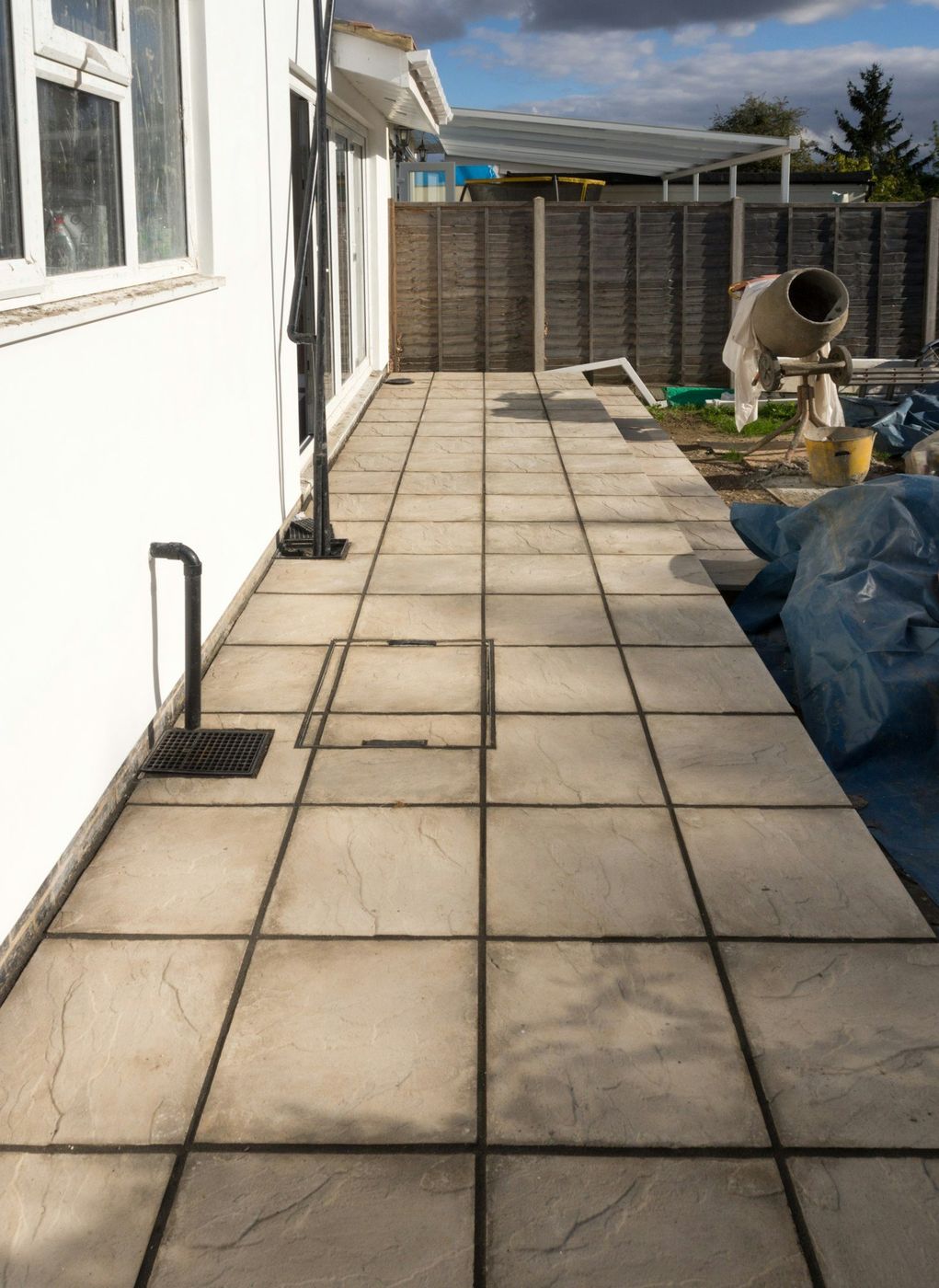
| A paver patio | Pull pavers at each post, drill and pour, then reset the pavers around the base | Pavers are the easiest surface to work through, and the sand bed still isn't bearing |
| A raised terrace over backfill | Reach past the fill to undisturbed material, which is deeper than it looks | Anything set in the fill itself will settle, no matter how big the pad is |
| Attached at the house on one edge | Piers on the outboard posts, with the house side carried by a properly flashed ledger | The ledger connection is a water detail as much as a structural one |
| Over a deck | Piers under the framing, sized for the new load rather than the deck's original plan | Deck footings were sized for a deck. A roof changes the arithmetic |
Send us the plan or the kit spec sheet. We'll lay out the piers, size them, and quote it. The visit is free.
Drilling season runs from thaw into late fall, with early autumn our favorite for backyard work: open ground, dry soil, and enough calendar left to set the structure and use it before the weather turns. Winter is possible under the usual protocol, thawing rather than fighting the ground, warm mix water, insulated tops, holes covered overnight. It costs more and follows weather windows, and most people setting a pergola aren't in that much of a hurry.
Here's the detail that decides how the whole thing ages, and it has nothing to do with concrete. Wood posts must never sit flat on the pier. A standoff base holds end grain up off the surface so water drains and air moves, and that one piece of hardware is why a pergola is solid at year twenty instead of soft at the bottom by year eight. Keep mulch, planters, and sprinkler spray off the bases and you've done everything maintenance asks.
Still unsure about something?
Call the crew at (303) 569-4046 and we will talk it through.

Get a free, no-obligation estimate from a crew that knows Colorado soil, Colorado weather, and how to finish concrete that lasts.
Accessibility
Adjust the site to fit how you read and browse. Your choices are saved on this device.