
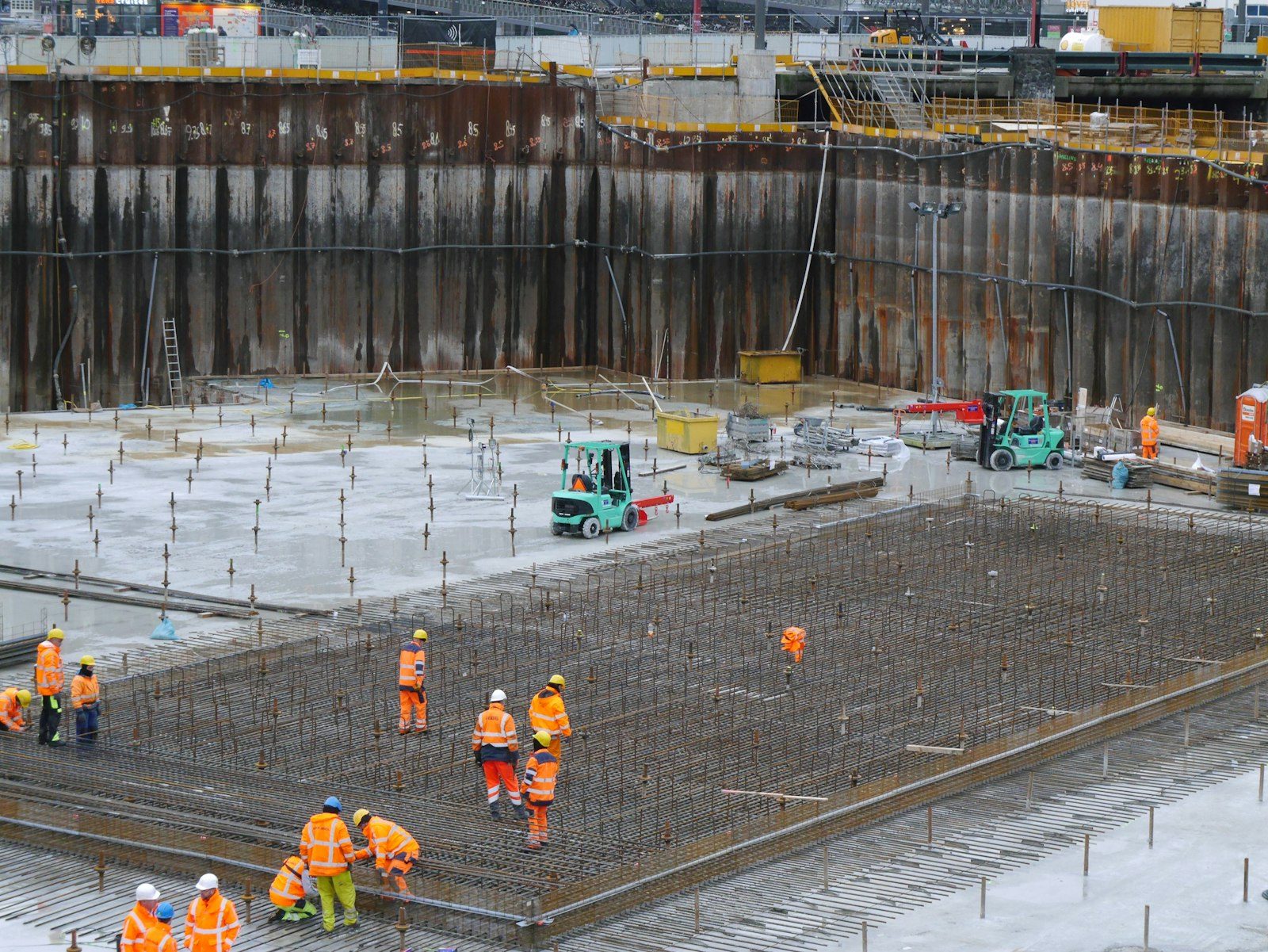
You get two choices with ground that moves: reach past it, or build something that can shrug and keep going.
Almost every bearing question we get asked in this city comes down to the same fork in the road. Do you spend money going deep enough that seasonal soil movement stops mattering, or do you spend it on a structure loose enough to ride the movement out? Both answers are legitimate. They are not interchangeable, and picking the wrong one is how a two year old deck ends up with a step that nobody can walk down without looking.
We drill, form, and pour bearing for decks, covered porches, garages, shops, sheds, and the light structures that hang off the back of a house. Our engineer sizes it, our crew puts it in, and nobody in that chain gets paid more for talking you into extra holes.
| What you are supporting | Reaching past it | Living with it |
|---|---|---|
| Deck ledgered to the house | Piers to steady bearing so the deck and the house rise and fall together | Cut it loose. A freestanding deck on adjustable posts can be trued up in an afternoon |
| Covered porch or roofed patio | Deep bearing, no shortcuts. The roof ties into the house | There is no version of this that tolerates movement. A roof telegraphs everything |
| Detached shed under a few hundred square feet | Footings at the bearing points, below frost, confirmed with the building department | Skids on a compacted gravel bed, releveled when the door starts binding |
| Shop, garage, or anything you will heat | Continuous footings or piers under the whole perimeter | Not worth attempting. Slab, walls, and door all have to stay in one plane |
| Seat walls and garden edging | Footing below frost where it meets a patio or a walk | Dry-laid units you can pull and reset without a saw |
People ask whether adding supports is a cheaper way to solve a bearing problem than drilling deeper. Sometimes. Usually not here. Each extra hole brings its own layout, its own steel, its own concrete, and its own inspection, and a shallow footing on active clay is still a shallow footing whether there are four of them or twelve. Depth is what buys you out of the argument, because the soil down there is not paying attention to the weather.
The other half of the arithmetic sits above ground. Wider spacing means a heavier beam. Tighter spacing means a lighter beam and more holes. The cheapest package is usually somewhere in the middle, and where that lands depends on what the framing plan already calls for, what the drill can reach, and how much bearing we find. We run that math before quoting rather than defaulting to a spacing we like.
We will look at the structure, the ground, and the framing plan, then tell you which one your project actually needs. (303) 569-4046.
Everybody knows a footing has to sit below frost, confirmed with the building department wherever you are, and that gets treated like the whole answer. It is not. Frost is one depth. The zone where clay picks up and loses moisture through the seasons is a different one, and on this ground it can run deeper than the frost line does. A support that clears frost and still sits inside the active zone will lift in a wet spring anyway. That is why so many deck posts around here rise, and why they usually come partway back down by September.
The neighborhood you are in changes what we expect to find. Around The Ranch and Quail Creek, the structures we are supporting are often older than the current homeowner, sitting on whatever passed for a footing at the time. Out in Legacy Ridge and Bradburn, the houses are newer but the back yards frequently sit over deep backfill from the original excavation, which never compacted the way undisturbed ground did. Different problems, same fix: get through the soft, moving material to something that will hold still.
September through November is the sweet spot. The clay is at its driest, holes stand open without caving, and a drill rig crosses a lawn without leaving ruts you will still see next July. Spring is the opposite: saturated ground, sidewalls that slump, and a rig that sinks. We work through spring anyway, we just plan the access differently and expect the yard to need more repair.
Winter is fine for the drilling and fine for the concrete, with conditions. We do not place on frozen bearing, so if the top of the ground is locked up we cut through it and get down to material that is not. Hot water in the mix, a non-chloride accelerator, insulation over anything exposed. What we avoid is leaving a hole open through a freeze. Drill and pour the same day, every time, because a hole that spends a night open collects water, ice, and whatever the neighbor's dog decides to investigate.
Still unsure about something?
Call the crew at (303) 569-4046 and we will talk it through.
Get a free, no-obligation estimate from a crew that knows Colorado soil, Colorado weather, and how to finish concrete that lasts.
Accessibility
Adjust the site to fit how you read and browse. Your choices are saved on this device.