
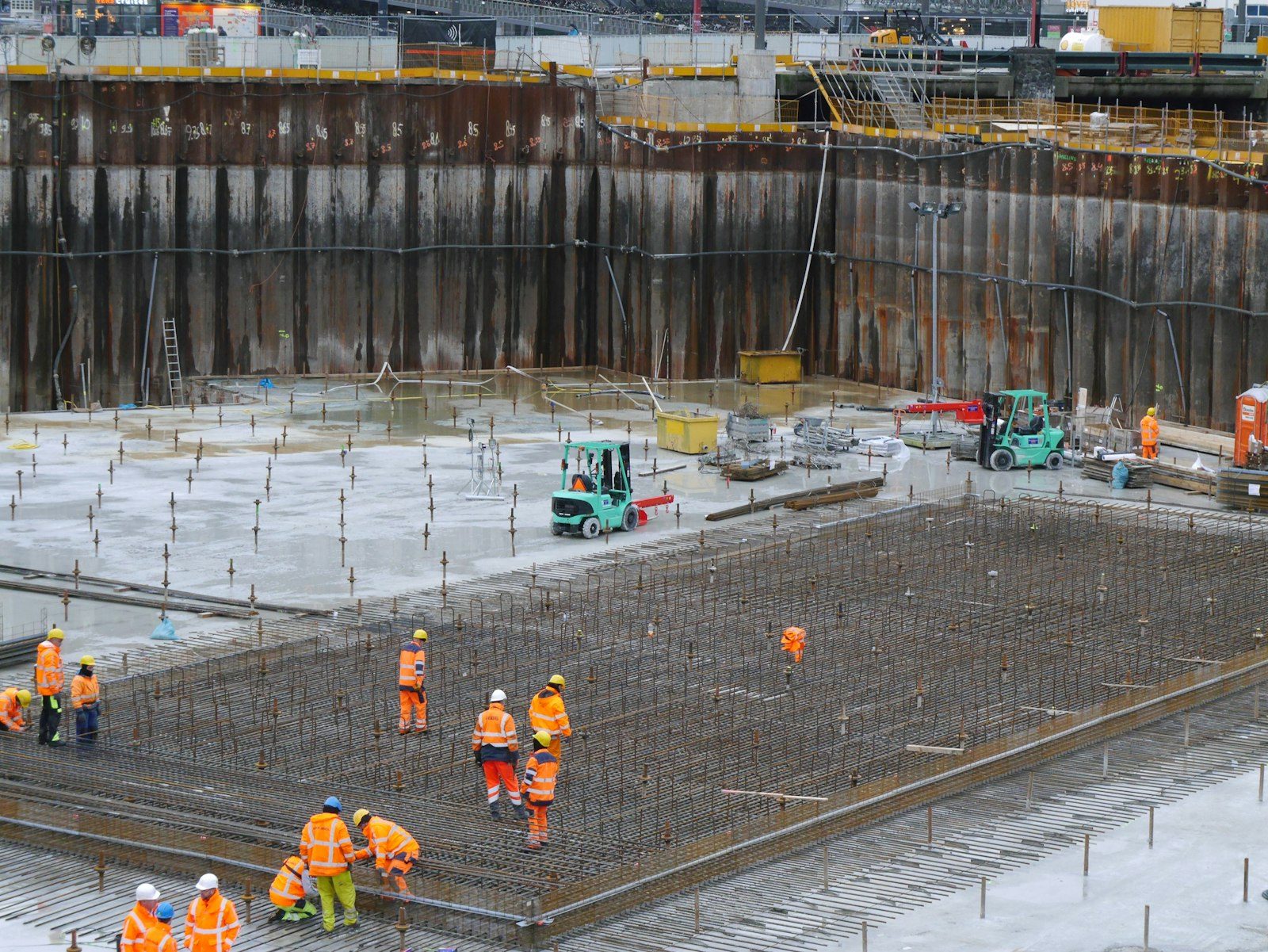
Before we cut a single panel, we find out what somebody else buried under it.
The first sign your sidewalk job has started is not a saw. It is paint. Orange, yellow, blue, and green lines appear across the parkway strip a few days ahead of the crew, and every one of them marks something a utility company would very much like us not to hit. That strip between the curb and the walk is the busiest four feet of ground on your property, and almost none of what is down there is visible until we open it.
So a sidewalk job is mostly a soil and drainage job with a concrete finish on the end of it. What we find under the old panels decides the depth we dig, the base we build, and occasionally whether the panel can be replaced at all without somebody else moving a line first.
Every job in the right-of-way starts with a locate request, and we place it ourselves rather than leaving it on you. Locators come out and mark the public utilities they own. What they do not mark is anything private: the irrigation lateral you or a previous owner ran, the low-voltage lighting cable, the gas line feeding a fire pit in the back, the old sprinkler valve box nobody has opened in a decade. Those we find with a shovel, carefully, because they are unmarked and they are almost always shallower than the public stuff.
The parkway strip also tends to hold history. Under a mid-century walk we routinely turn up a layer of the previous walk, or brick, or a bed of ash and cinders that somebody used as fill because it was free. None of that compacts, none of it drains the way road base does, and all of it comes out.
| What we hit | How often | What it changes |
|---|---|---|
| Water service and the shutoff lid | Almost every frontage | The lid finishes flush and stays operable, so the panel gets formed around it rather than over it |
| Irrigation lateral crossing the strip | Very common, rarely deep enough | We cut, sleeve, and reconnect below the base. Left alone it gets crushed by the compactor |
| Gas or telecom parallel to the walk | Occasional, usually marked | Hand digging over the line, no machine inside the tolerance zone |
| Tree roots from the parkway planting | Frequent on older frontages | Selective pruning, a root barrier, sometimes shifting the panel instead of cutting a structural root |
| Buried previous sidewalk or brick | More often than you would think | It all comes out. Nothing that will not compact stays under a new slab |
| Loose trench backfill from an old repair | Common on newer frontages | Overexcavate and rebuild in lifts. That trench is exactly where the next panel would settle |
A public walk has to be usable by somebody in a wheelchair, and that turns slope from a preference into a spec. Cross slope, the tilt from one side of the walk to the other, stays gentle: roughly a quarter inch of fall per foot is the working limit, and we build a hair under it so finishing tolerance does not push a panel over. Running slope follows the street grade in most residential situations.
Then there is the vertical part. A change in level at a joint is what catches a toe and what shows up in a complaint, so we hold panel-to-panel differences tight and bevel any temporary tie-in. Cities inspect this work and rules vary by jurisdiction, so we confirm what applies at your address rather than assume. The paperwork and the inspection scheduling are ours.
Send a photo and the address. We will tell you how many panels are really involved and what the permitting side looks like before you commit to anything.
Sidewalks fail from below far more often than from above. The panel that heaved did it because the ground under it holds water and then freezes. So the base is not a cushion, it is a drainage layer: clean road base, compacted in lifts, thick enough that meltwater has somewhere to sit other than directly against the concrete. Where a frontage collects runoff from a driveway or a downspout, we deal with that first. No slab thickness wins an argument with standing water. Older frontages around Quail Creek and The Ranch tend to hide buried surprises. Newer ones near Bradburn and Legacy Ridge hide loose trench backfill instead.
Timing is straightforward. April through October is prime. Winter panel replacement works with heated water, non-chloride accelerators, and blankets, and it is sometimes the right call when a lifted panel is a real hazard. We do not pour on frozen subgrade, though, no matter who is asking.
Still unsure about something?
Call the crew at (303) 569-4046 and we will talk it through.
Get a free, no-obligation estimate from a crew that knows Colorado soil, Colorado weather, and how to finish concrete that lasts.
Accessibility
Adjust the site to fit how you read and browse. Your choices are saved on this device.