
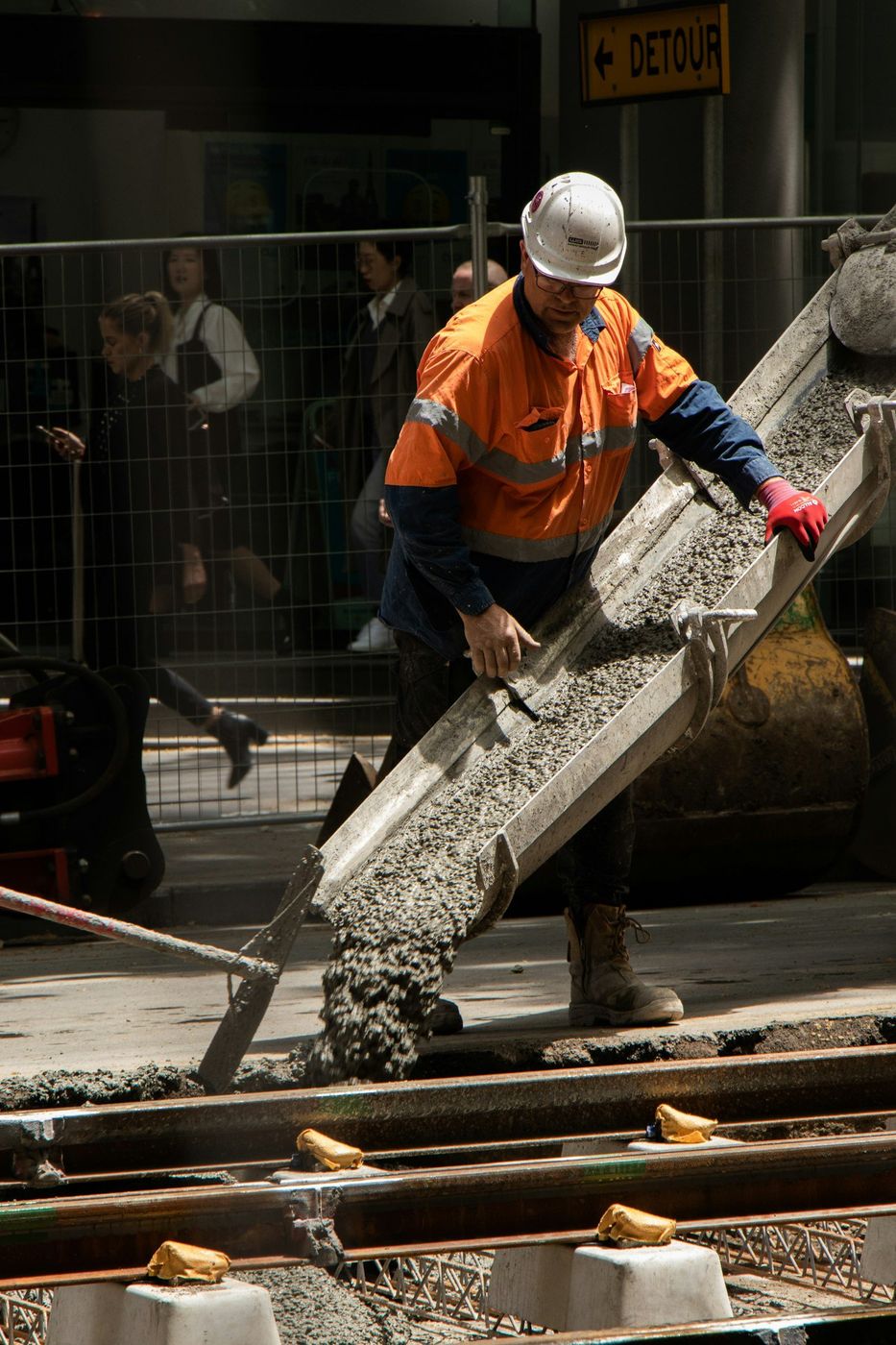
A wall is not one busy day. It's four of them, and the order they happen in decides everything.
Ask what happens the day a retaining wall gets built and the honest answer is that the day everybody pictures, the one with the truck and the chute, is maybe a quarter of the work. Before it there's a trench, a footing, a mat of steel, and a set of forms braced hard enough to argue with several tons of wet concrete. After it comes the part that decides whether the wall is still straight in fifteen years: the drain, the rock, the fabric, and dirt put back in careful layers by people who know how close a machine is allowed to get.
We build walls across Thornton, holding up patios and side yards on the older properties around Quail Valley and squaring off the graded slopes behind newer homes in North Creek Farms. Here's what the days actually look like.
We start early, and the first hour is entirely checking. Are the forms still where we left them after a night of wind. Is the steel tied, spaced, and held off the faces so concrete can wrap it. Are the bracing and the kickers snug. Is the batter set, that slight lean back into the hill that makes the wall work with gravity rather than against it. Is the layout of the weeps marked so nobody buries them.
The footing usually went in on an earlier day, with a keyway formed into its top and dowels standing up out of it, so the wall has something to lock into instead of just sitting on a flat shelf. Once the trucks start, the wall gets filled in lifts rather than in one dump, and each lift gets vibrated enough to consolidate and not so much that the mix segregates. That's a feel thing. The sound changes when a lift is done.
Then the top gets screeded, tooled, and left alone. Forms come off when the concrete says so, not when the calendar does, and in cold weather that's later than people expect.
| Where you are behind the wall | What's allowed there | Why we hold that line |
|---|---|---|
| The strip right against the back face | Hand tamper only, in thin layers | A ride-on machine can shove a young wall out of plumb before any of the soil is helping hold it |
| The drain rock column | Placed, leveled, and left alone under filter fabric | Compact fines into clean rock and the drain stops being a drain and becomes a dam |
| The middle of the backfill zone | Walk-behind plate, shallow lifts, every lift run | Deep lifts look compacted on top and stay loose underneath, which shows up as a sinkhole in the lawn |
| Geogrid layers on a segmental wall | Pulled taut, staked, and covered before anything drives on it | Grid only works in tension. Wrinkled or dragged out of place, it's landscape fabric |
| Beyond the reinforced zone | Ride-on equipment is fine out there | Far enough back that the machine's weight isn't pressing on the wall through the soil |
| Over the top of the wall | Nothing until the concrete has strength and the bracing plan says so | Dumping a bucket of wet clay against green concrete is an impact load nobody designed for |
We'll measure the grade change, look at where the water comes from, and lay out what the days would look like on your property. (303) 569-4046.
Soil pushes sideways. Wet soil pushes considerably harder, because water adds weight and strips away the friction that lets a slope hold itself together. Everything behind a wall exists so the wall never has to argue with saturated ground.
The back face gets a coating, then a column of clean angular rock runs the height of the wall, wrapped in filter fabric so fines can't migrate in and clog it. Perforated pipe sits at the bottom, sloped to somewhere it can actually discharge, and weeps run through the face as the backup for the day the pipe outlet gets blocked by a root or a nest. Yes, weeps drip after a storm. That's the wall doing its job in public.
Season matters at both ends of this. Late spring through fall is the natural window: the trench holds its shape, the backfill compacts, and there's time for the ground to settle before winter. Late fall pours are workable with warm mix water, an accelerator without chloride in it, and blankets, though we won't place on frozen bearing and we won't backfill with frozen clods. Frozen material stacks instead of compacting, and every void it leaves reappears in April as a low spot behind your new wall.
Still unsure about something?
Call the crew at (303) 569-4046 and we will talk it through.

Get a free, no-obligation estimate from a crew that knows Colorado soil, Colorado weather, and how to finish concrete that lasts.
Accessibility
Adjust the site to fit how you read and browse. Your choices are saved on this device.