
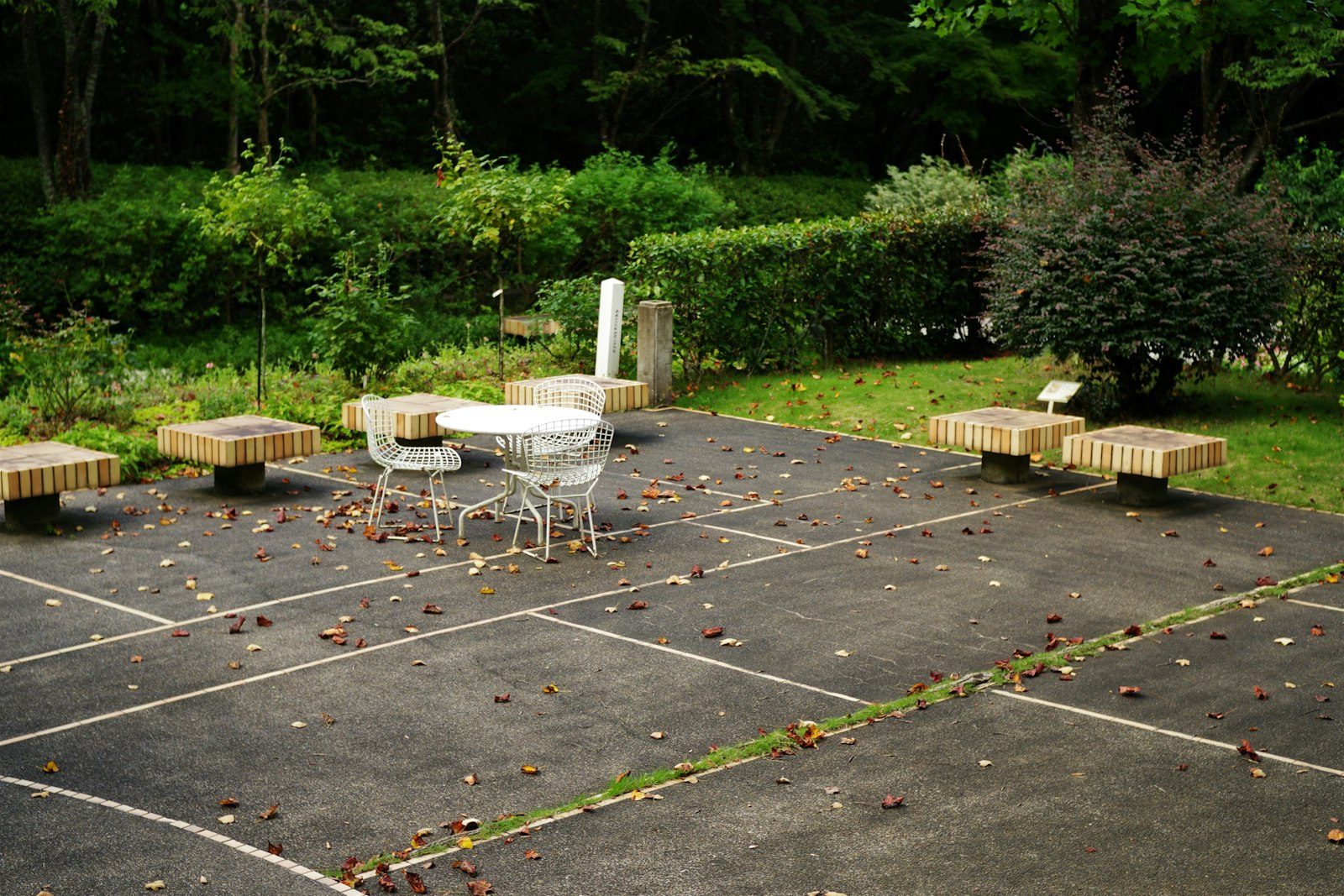
Wet feet, chlorinated splash, and a hundred freeze-thaw cycles a year. A pool deck is the hardest-working concrete on the property.
Nearly every pool deck conversation comes down to a few either-or calls, and people usually show up having agonized over the wrong ones. Color and pattern get all the attention. Meanwhile the choices that decide whether you still like the deck in five years are drainage, texture, and how the concrete meets the coping.
So that's where we start. Where does the water go when four people climb out at once? What does this surface feel like under a bare foot at noon in July? And is the joint at the pool edge built to move, or is it going to blow apart the first winter? Settle those three and you can have whatever color you want.
Texture first. A pool deck has to grip a wet bare foot without taking skin off a kid's knee, which rules out both ends of the range. A hard steel-troweled surface is a slide. Heavy exposed aggregate is a cheese grater. Fine broom or a light knockdown sits in the middle, and that's where we land. Heat is the other half of the call: the sun up here is fierce, so a light deck stays walkable in August while a dark one has everybody hopping.
Second, the coping joint. Deck and shell are separate structures moving at different rates, and the correct way to join them is to not join them. A compressible expansion joint runs under the coping all the way around, cleaned and re-caulked as it ages. Pour tight against coping and freeze-thaw pulls that edge apart.
Third, drainage, which gets its own table below. Most pools we deck sit in Hunters Glen and Quail Valley, where yards are large and water has somewhere to go. Newer lots around North Creek Farms run tighter, pushing those jobs toward a perimeter drain. Older Eastlake properties are the wild card, since pool and deck often went in decades apart.
| Approach | Where it wins | What it asks of you |
|---|---|---|
| Sheet flow out to the lawn | Open yards with somewhere downhill to send water | Grade discipline everywhere. One flat spot buys a permanent puddle. |
| Perimeter deck drain | Tight lots, raised decks, anything ringed by wall or house | Cleaning it out. A drain packed with leaves is worse than no drain. |
| Sheet flow toward one low corner | Decks where the yard already falls a single direction | Somewhere for that water to land, usually a drywell or a swale |
| Drain on the house side, sheet flow elsewhere | Most of the decks we actually build | A bit more cost up front, and the drain still needs attention |
| Slot drain across a walkway | Where a path crosses the low line and can't be tilted | Precise setting. A slot drain sitting proud is a stubbed toe. |
| No drainage plan at all | Nowhere. Not one property. | Standing water, algae, February ice, and a call to us in year three |
Three things age a pool deck here and they work as a team. Splash-out carries pool chemistry onto concrete, where it dries and concentrates rather than rinsing off. UV at 5,351 feet is harder on color and sealer than people expect, so a stained deck wants a fresh coat every couple of years. And freeze-thaw attacks any surface that's saturated when the temperature drops, which describes a pool deck in October perfectly.
The answer isn't exotic. Air-entrained mix, real drainage, a sealer that soaks in instead of sitting on top, and no deicing salt on the deck ever. Not the first winter, not the tenth. If a path across the deck ices over, throw sand.
On timing, we like decks from late spring through early fall. When the pool is new, the deck usually follows after the shell has cured and the plumbing has been proven under pressure. Winter pours are possible with heated water and blankets, but a deck is a wide flat surface with a lot of finishing time built into it, and cold shortens the window to finish it well. We'd rather wait a month than hand you something we rushed.
Send photos of the coping edge and the lowest corner. Those two spots usually tell us whether you're overlaying or replacing.
You can read how a deck was built by standing on it after everybody swims. If the wet footprints dry off in ten minutes, somebody got the grade right. If there's a puddle still sitting there at dinner, that's where the algae shows up in July and where the ice forms in November.Our crew lead, after the walkthrough
Still unsure about something?
Call the crew at (303) 569-4046 and we will talk it through.
Get a free, no-obligation estimate from a crew that knows Colorado soil, Colorado weather, and how to finish concrete that lasts.
Accessibility
Adjust the site to fit how you read and browse. Your choices are saved on this device.