
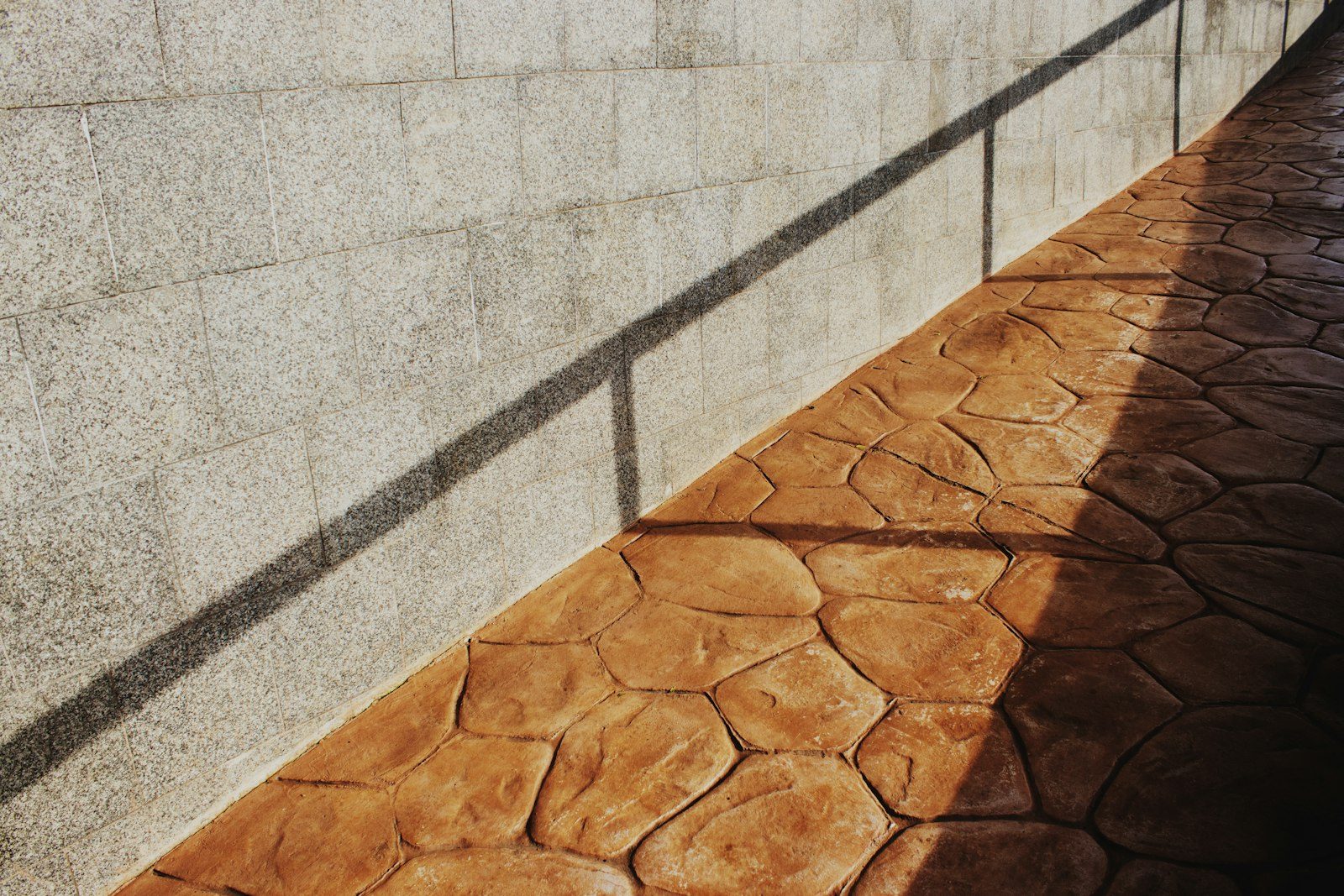
You can spot a bad layout from the sidewalk without knowing a thing about concrete.
Scoring is cheap next to almost everything else we do. A saw, a chalk line, and a crew that knows where the cuts belong, and a plain gray slab starts reading like tile or cut stone. That's the appeal, and it's real.
It's also the decorative work that goes wrong most publicly. A stamped patio that fades is a private disappointment in a back yard. A scored front walk with the pattern running out of square is on display, and you'll notice it every time you come up the path. So this page is about what a poor job looks like from the curb, because the tells are visible from the sidewalk and once you know them you can't unsee them.
Start with the corners. A grid meeting the slab edge with a two-inch sliver on one side and a full square on the other was laid out from the wrong end. Most common mistake in the trade, and entirely avoidable: measure the slab, divide it, start from the middle, and the leftover splits evenly at both edges.
Next, look at whether the pattern argues with the house. Lines running at an angle nobody chose. A diamond grid squeezed onto a walk that's already narrow. Squares sized for an open patio crammed onto a small landing. Pattern scale is a judgment call, and the wrong call reads as busy from the street even to somebody who couldn't tell you why.
Then look for a straight, slightly wider, slightly rougher line crossing the pretty pattern at a random spot. That's a control joint sawed with no thought given to the decorative layout. It should have been absorbed into the grid. Instead it's a scar, and it will be there as long as the slab is.
| What you see | What went wrong | Whether it can be fixed |
|---|---|---|
| A sliver of a square at one edge, a full one at the other | Layout started from a corner rather than the center of the slab | Not really. New lines can rebalance it a little, but the old cuts stay |
| A wide, rough line crossing the pattern at random | A control joint sawed with no reference to the decorative layout | Yes. We add lines that pick the joint up and fold it into the grid |
| Lines that wander slightly on a long run | Cut freehand without a straightedge or a chalked guide | Hard. A wandering kerf can be widened straight, but it always reads heavier |
| A pattern in the middle with nothing near the house | The crew stopped where the furniture sat and called it finished | Yes, and this is the easy one. Extend the layout out to the edges |
| Grooves gone dark and noticeably wider than they were | Shallow cuts, no sealer in the lines, and freeze-thaw working the shoulders | Clean them, dress the edges back straight, then seal. Or fill them |
| A crack running parallel to a score line an inch away | The score was too shallow to control anything, so the slab cracked beside it | Route and fill the crack, then rethink depth on any future cutting |
That angle shows a layout problem better than anything up close. Send it over and we'll say what's fixable. (303) 569-4046.
People think scoring is a saw job. It's a layout job with a saw at the end of it. On a front walk we'll chalk the whole pattern out and have the homeowner come stand on it before a blade ever turns.Our crew lead, after the walkthrough
Here's the technical heart of it, and it separates a pattern that lasts from one that starts coming apart in year four. A control joint has to be cut roughly a quarter of the slab depth to actually steer where concrete cracks. On a four-inch slab that's an inch. A decorative score line is shallower, typically an eighth to a quarter inch, because its job is to be seen rather than to control anything.
Those two lines can share a path, and often they should. What they can't do is get confused with each other. Cut every decorative line a full inch deep and you've chopped the slab into a grid of small weak panels. Cut your control joints an eighth of an inch deep because they're part of the pattern and the concrete will crack wherever it feels like, usually an inch off the line you cut.
Timing is the other half. Green cutting, done within hours of the pour using a soft-cut saw, gives the cleanest edge and the least ravelling. Dry cutting an existing slab works fine and it's most of what we do, though the edges want a light chamfer afterward so a shovel doesn't chip them. Around Eastlake we're nearly always on concrete poured decades ago, cut dry, cleaned out, and sealed.
Still unsure about something?
Call the crew at (303) 569-4046 and we will talk it through.

Get a free, no-obligation estimate from a crew that knows Colorado soil, Colorado weather, and how to finish concrete that lasts.
Accessibility
Adjust the site to fit how you read and browse. Your choices are saved on this device.