
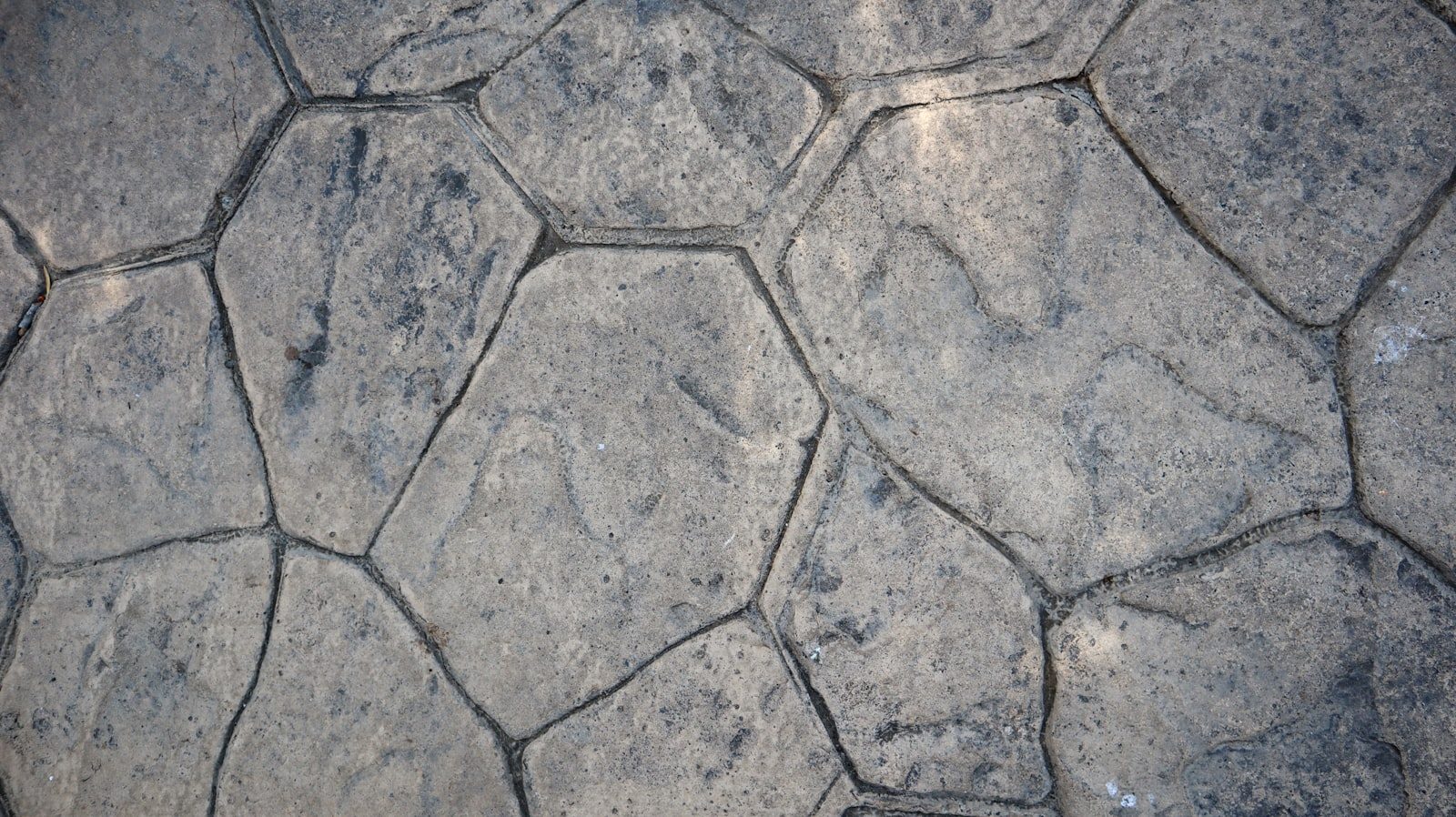
The mats go on in the last two hours. The three days before them decide how long the pattern lasts.
Everybody shops the pattern first. Ashlar slate, cut fieldstone, wood plank, an old running bond brick for a front walk. That's the part you look at every day, so fair enough. But the mats go on in the last two hours of a three or four day job, and almost nothing that goes wrong with a stamped patio later traces back to which mat we used.
It traces back to what we put under it. Thornton sits on Adams County clay, and clay changes volume as its moisture changes, so a decorative slab here is only as good as the dirt work below the steel. We dig, we haul off soft ground, we bring road base in and compact it in lifts, and we look hard at where roof water and sprinkler spray land. Then we talk pattern.
We dig every stamped job before we price the fun part. Around Eastlake the lots are older and the ground has been disturbed more than once, so we hit buried slab, mixed fill, and the occasional forgotten sprinkler main. North Creek Farms and the newer streets north of there hand us a different problem: builder fill that got placed fast, plus trench spoil from the utility runs that never saw a compactor.
Neither is a disaster. Both change the plan. Soft ground gets dug out and replaced rather than covered over, because a stamped patio on loose fill telegraphs every settlement crack straight through a surface you paid extra for. Quail Valley and Hunters Glen sit in between, where we usually pull out a patio poured over two inches of screened sand that somebody called a base.
| What we find | Why it matters under a stamped slab | What we do about it |
|---|---|---|
| Soft, wet clay a foot down | It compresses under load and keeps moving with the seasons, and a pattern shows every bit of that | Overdig, haul it off, replace with road base in compacted lifts |
| A utility trench crossing the footprint | The trench settles at a different rate than the ground beside it, so a crack lands right along the line | Recompact the trench on its own, run steel across it, plan a joint nearby |
| Old slab buried under a few inches of dirt | A hard shelf under part of the pour and soft ground under the rest is how you get a stepped crack | It comes out. All of it, not just the part in the way |
| Downspouts or sprinklers hitting the footprint | Roof water and daily overspray keep one corner of the subgrade from ever drying out | Extend the line, cap or move the heads, then slope the finish grade away |
| Ground falling back toward the house | Water runs to the foundation and parks under the new patio | Regrade during excavation. A pretty slab draining the wrong way is a liability |
We'll open a test hole at the estimate and tell you what the base will take. No pattern books required. (303) 569-4046.
Here's the connection people miss. A stamped surface gives out at the low points first, in the grout lines and the joints, and low points only matter if water sits in them. Get the slope right and snowmelt leaves. Get it wrong and every groove is a small reservoir that freezes overnight and thaws by noon, November into March.
At 5,351 feet the sun handles the other half. Clear skies most of the year, and the release color that gives a pattern its depth lives in the top fraction of an inch. Sealer is the wear layer taking that dose for you. Let it go four or five years and you're not resealing anymore, you're recoloring first. Add whatever comes off the tires in January, since magnesium chloride works on any surface freezing has already loosened, and you have the whole case for sand, a plastic blade, and no ice melt the first winter.
Late April to mid October is the honest window, and inside it we'd take the back half of September every time: the slab stays workable long enough to press a full pattern, the nights are cool, and there's a long runway before hard freeze. Spring is fine once the subgrade dries enough to take a compactor, since wet Adams County clay will not compact and a soggy April pushes the whole calendar right.
July and August we start at first light, because a hot slab stiffens under the mats quicker than a crew can cross it, and shallow pattern at the far end of a patio is the tell. Rain landing on concrete we're still finishing beats extra water into the paste, which reads months later as a weak, dusty top layer. Winter pours happen with heated mix water, a non-chloride accelerator, and blankets, never on frozen ground, and the sealer waits for warm dry weather in spring.
Still unsure about something?
Call the crew at (303) 569-4046 and we will talk it through.

Get a free, no-obligation estimate from a crew that knows Colorado soil, Colorado weather, and how to finish concrete that lasts.
Accessibility
Adjust the site to fit how you read and browse. Your choices are saved on this device.