
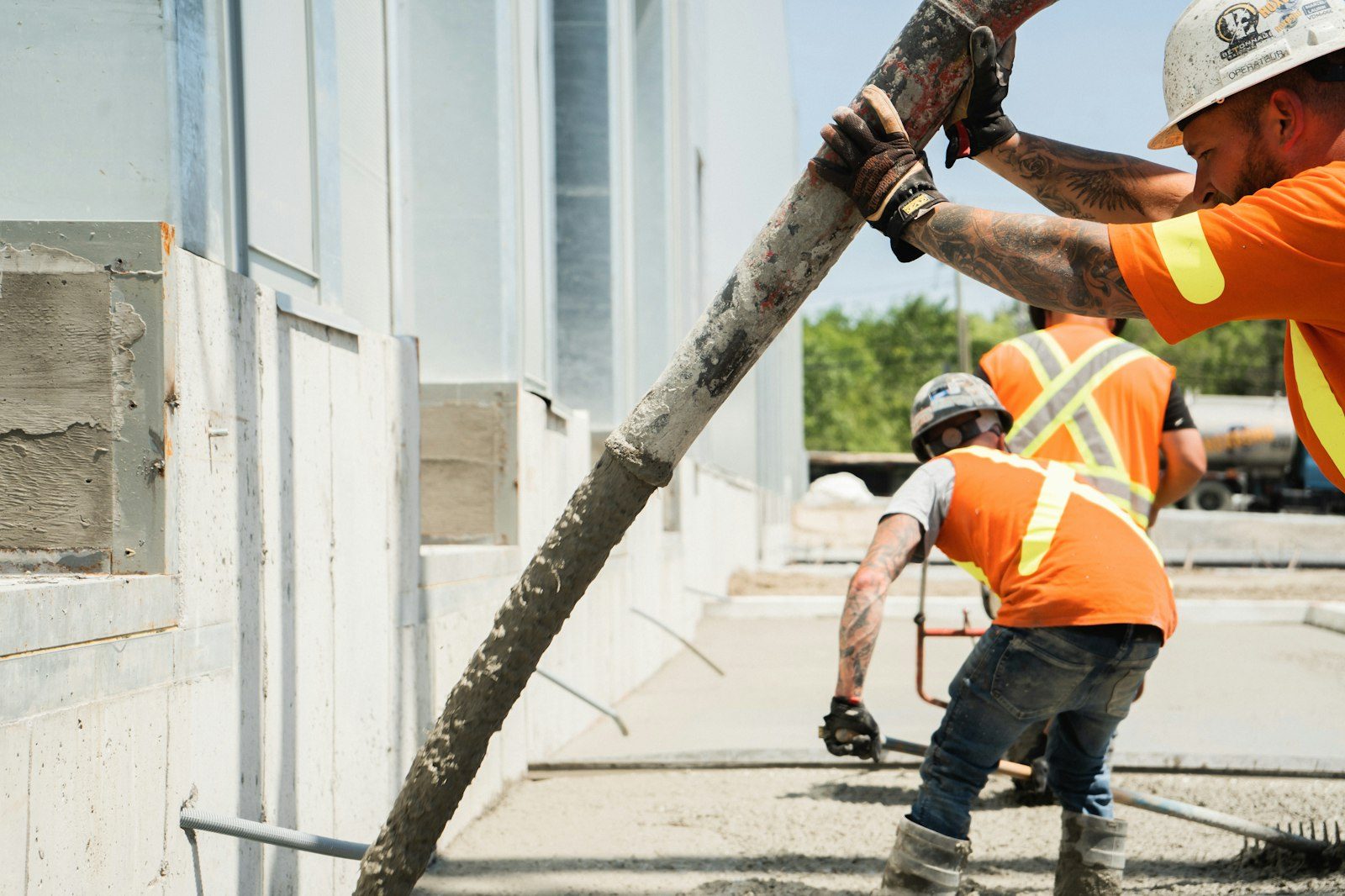
Built around what you'll actually do at the water's edge: feeding fish, working a net, and draining the whole thing every few springs.
A pond quits being a design project roughly a week after it fills. After that it's a thing you use. You feed fish before work, you pull leaves out with a net every October, you kneel on the edge to lift a pump, and every few springs you drain it and scrub the whole basin. Hardly anybody designs for that, and it shows.
So we build around the chores. Somewhere to stand that isn't slick. A shelf at a depth you can reach without going in after it. A floor shaped to actually drain rather than leave two inches you have to bail with a bucket. Concrete makes that possible, because you're shaping a structure instead of draping a liner across a hole and hoping the folds land somewhere useful.
Start at the edge, since that's where you'll spend your time. A coping you can kneel on, textured so wet shoes stay put, with the water level set close enough that you can reach in. On a formal pond we cast a wide flat cap. On a naturalistic one we set boulders on a poured ledge so they can never shift into the water.
Depth and shape come next. Fish want a section deep enough to hold cooler water through August and to keep from freezing solid in January, which at this elevation with our clear cold nights is a genuine design input rather than a footnote. Plants want shallow shelves. Both want a floor that falls toward one low point where a pump can pull the last few inches.
Access matters more than anybody expects. Skimmers, pumps, and filters get serviced constantly, so the plumbing and the vault belong where you can reach them from dry ground. Better to cast an access lid into a deck now than to climb in every spring for twenty years.
We build these across the city. Yards in Hunters Glen and Quail Valley have room for a real pond with a stream feeding it. Eastlake lots usually come with mature planting already, so the pond gets tucked into what's there. Newer construction around North Creek Farms tends to want something formal and compact off the patio.
| What you want from it | Depth and shape it needs | What that changes in the build |
|---|---|---|
| Koi you keep year round | A deep section, steeper walls, real volume | More shell, more steel, and a bottom drain plumbed before the pour |
| Goldfish and marginal plants | Shallow shelves plus one deeper pocket | Shelves cast at set depths, simple in concrete and awkward under a liner |
| Ornamental water, no fish | Shallow throughout and level to the eye | The rim has to be dead level, because the waterline shows every error |
| A stream or waterfall feeding it | A head pool and a course with drops | Waterstops at every construction joint, since that's where streams leak |
| Birds and wildlife | A gently sloping beach edge | Textured slope for footing, and a poured ledge so stone can't slide in |
| Something to watch from the kitchen | Placed for the sight line, not the yard | Grade and drainage worked out before a single form goes up |
Concrete holds water when three things go right. The mix is dense and air-entrained. Every construction joint gets a waterstop cast into it. And the shell is wet-cured, seven days at minimum, kept damp the entire time.
That last one is where our conditions bite. The air here is dry and the sun is strong, so a green shell surrenders moisture faster than crews from wetter places expect. Concrete that dries too quickly shrinks, and shrinkage in a pond wall is a leak with a schedule. So we cover it, we soak it, and we don't hurry. Nobody has ever regretted a slow cure.
Winter is the other force. Ice expands, and a basin with vertical walls gives that sheet nowhere to go but into the concrete. We taper walls slightly and plan on a de-icer or aerator holding a hole open, which also keeps a fish pond exchanging gas through a hard freeze. Never chip at ice with fish underneath. The shock does more harm than the cold.
Season is straightforward. Shells go in from late spring through early fall. Cold-weather work is possible with heated water and blankets, but a pond needs a long wet cure, and keeping a shell damp and above freezing in December is a fight nobody wins cheaply.
Tell us how far it drops in a week and whether it stops falling at a certain depth. That one answer usually points straight at the leak.
Ponds get neglected when the edge is uncomfortable. Put a flat lip at kneeling height along one side and people actually clean the thing. Leave it off and by the third summer you're looking at green water and hearing that nobody has the time for it.Straight from the crew
Still unsure about something?
Call the crew at (303) 569-4046 and we will talk it through.

Get a free, no-obligation estimate from a crew that knows Colorado soil, Colorado weather, and how to finish concrete that lasts.
Accessibility
Adjust the site to fit how you read and browse. Your choices are saved on this device.