
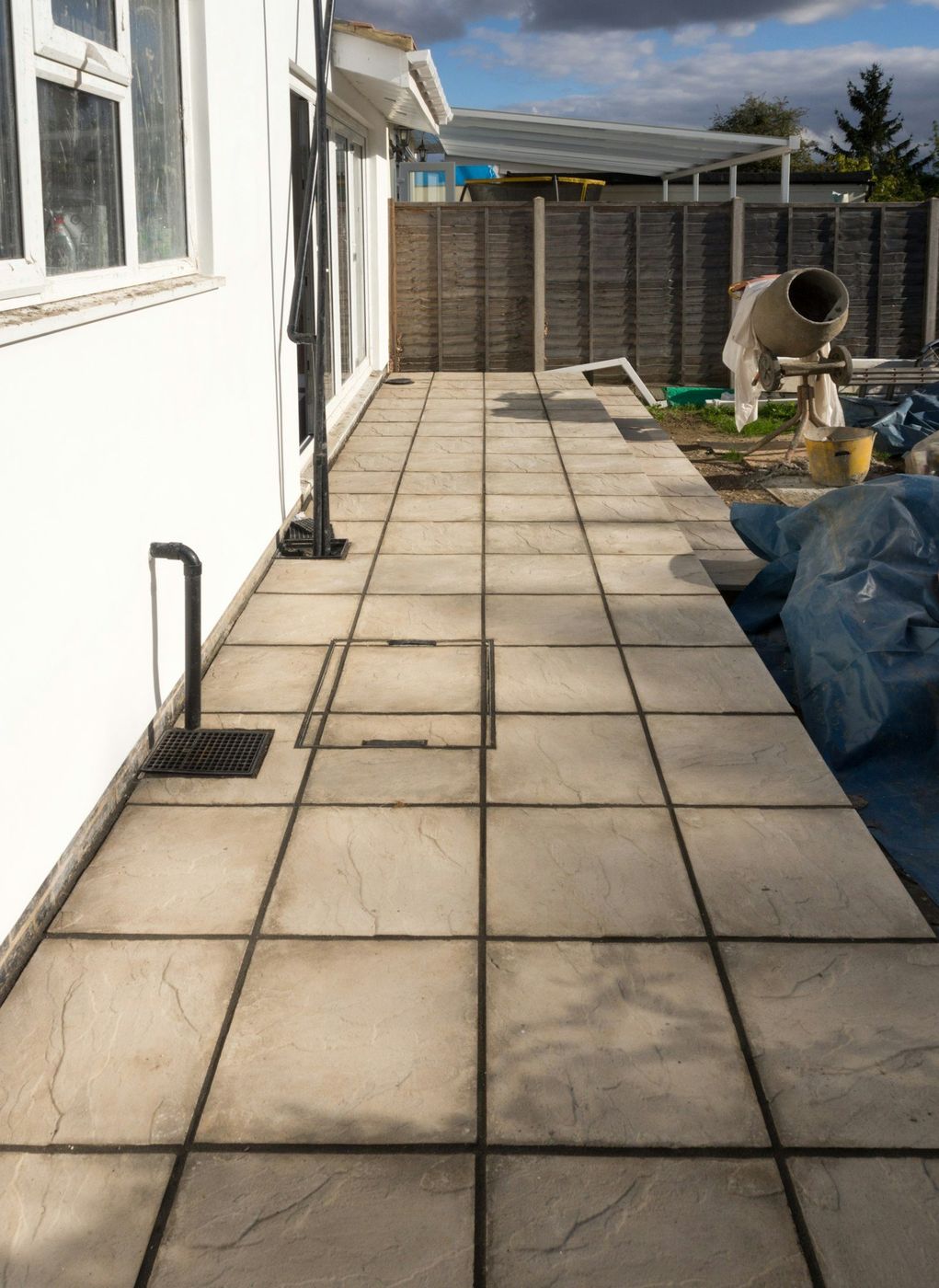
A topping is only worth pouring when the dirt, the base, and the drainage beneath the old slab are already holding up their end.
Every overlay question is really a soil question. You're asking us to bond a new wearing surface onto concrete that's already sitting out there, and that concrete is only as steady as the base beneath it and the several feet of Douglas County ground beneath that. If the dirt is moving, the slab is moving, and a topping simply comes along for the ride.
So the first thing we do on these calls is ignore the surface entirely. Where does roof water land. Has the slab tilted back toward the house. Has one panel dropped below its neighbor. Twenty minutes of that decides the project, and the color conversation waits until we know there's something worth topping.
Concrete tells you about the soil under it if you know where to look. Panels flush at every joint mean the ground beneath is behaving the same way everywhere. A lip at one joint means half the slab went somewhere the other half didn't. Cracks parallel to the house tend to be edge settlement. Cracks wandering diagonally across a panel usually came from a void.
We tap it too. Concrete sounds different over solid base than over air, and once you've heard both you can map a hollow in a minute with a hammer handle. A hollow means water has been washing fines out from underneath. Topping over that is a paint job on a leaky roof.
| What the ground is doing | Verdict | Reasoning |
|---|---|---|
| Slab high and dry, water runs away, joints all flush | Go ahead | Nothing below is pushing. A bonded surface moves only as much as the slab does, which is barely at all. |
| Downspout dumping at the slab edge, soil soft for a foot out | Fix the water first | Saturated ground under that corner is what dropped it. Topping first repeats the story in a nicer color. |
| One panel settled, everything else sound | Lift it, then overlay the whole surface | Foam or slurry brings the panel back to plane. Topping afterward keeps the finish continuous across the joint. |
| Hollow sound over a wide area, edges undermined | No overlay | Nothing is holding that concrete up. Adding weight to a bridge over open air is a countdown, not a repair. |
| Cracks that open and close with the seasons | Bond breaker at the crack, or replace | A moving crack telegraphs through any topping thin enough to still be called one. |
| Poured straight on clay, no gravel, but flat and stable for years | Overlay, with expectations said out loud | It has held this long. We'll top it and describe the risk plainly instead of guaranteeing what we can't. |
Once the ground checks out, everything rides on bond. We open the old surface mechanically, grinding or shot blasting until it has real tooth and no trace of sealer, curing compound, or paint. Then vacuum, wet it to a saturated surface-dry state, and scrub in a bonding slurry right ahead of the topping. Skip a link in that chain and the overlay comes off in sheets the first spring.
Thickness is the other limit. Micro-toppings live around an eighth of an inch and carry color and texture only. Stampable and self-leveling systems run a half inch to a couple of inches, which is thick enough to rebuild slope. Past two inches you're pouring a thin slab on an old one, and a thin slab with no base of its own is something we won't sell.
Sounds like an odd request. It answers more about your patio than a photo of the patio does.
Correcting drainage during an overlay is one of the better values in this trade, since you're already committed to resurfacing and the extra thickness at the low end costs material rather than a whole project. A Carriage Club patio pitched a quarter inch back toward the foundation can be walked out to positive fall using nothing but the topping. That slab was feeding water to the soil tipping it.
Exterior timing runs May through September, and we'd point you at the shoulder months inside that range. A quarter-inch topping has almost no mass, so it gains and loses heat fast, and a hot windy afternoon flashes the surface before it knits. Cold is worse. One freezing night on a young topping leaves a crumbling layer nobody can patch invisibly.
Still unsure about something?
Call the crew at (303) 569-4046 and we will talk it through.
Get a free, no-obligation estimate from a crew that knows Colorado soil, Colorado weather, and how to finish concrete that lasts.
Accessibility
Adjust the site to fit how you read and browse. Your choices are saved on this device.