
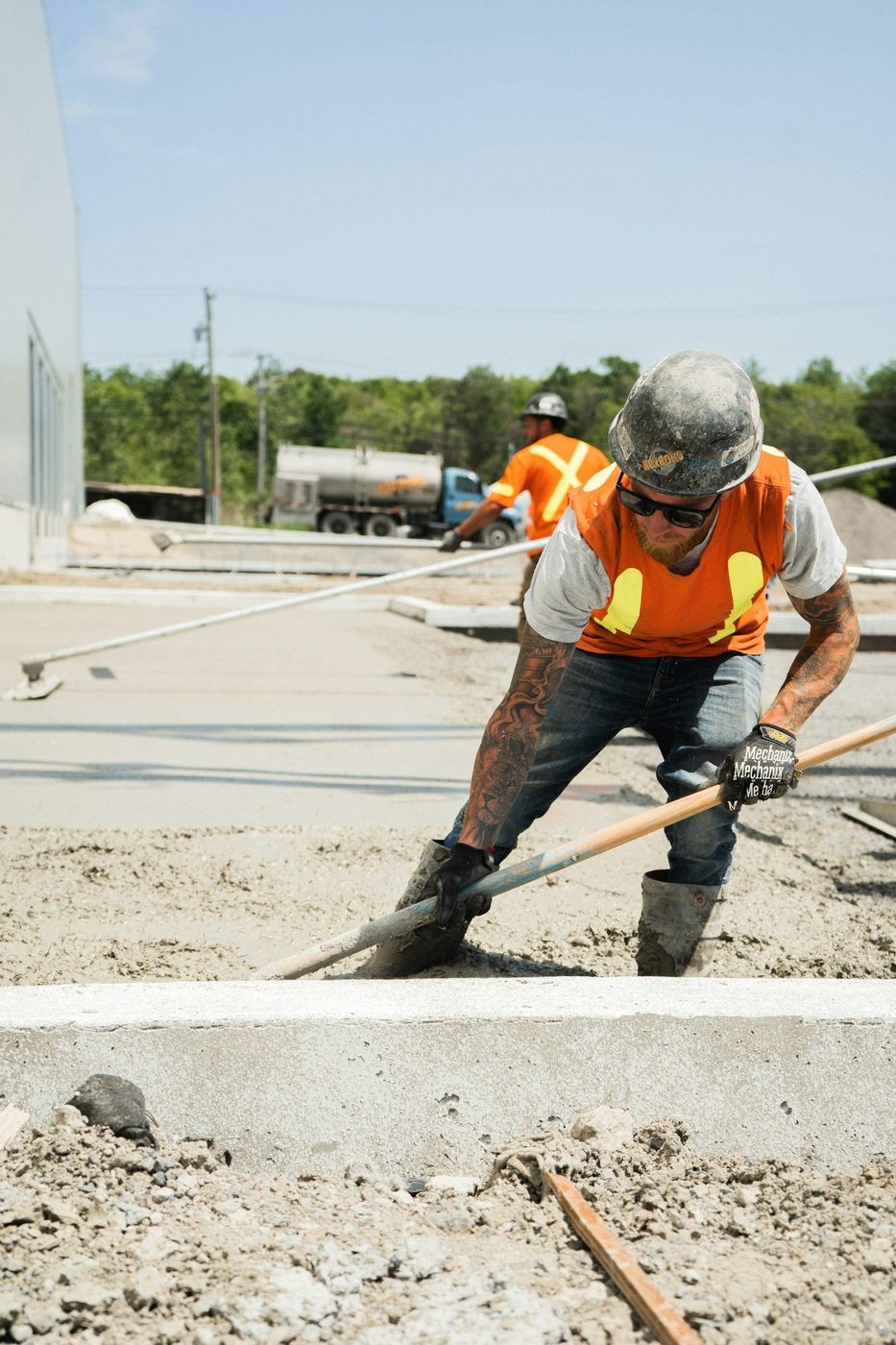
The clock on a dock pour starts the afternoon before, when the last trailer of the day pulls off the apron.
Littleton isn't a distribution town and we're not going to write like it is. What's here is a rear service court behind a Southbridge retail row, a grocery or bulk retail building with one or two real dock positions, flex bays out past Columbine, and a lot of older downtown buildings where receiving happens through a single grade-level door off the back. The concrete problem is the same at all of them: a small area of slab takes a truck's entire weight in the same spot, over and over, and nobody can afford to have that door closed for a week.
So this page is a walkthrough of the day itself. What happens the afternoon before, what the crew does in what order, and when your receiving actually reopens. Owners rarely get to watch this work, and the sequence is where the quality lives.
By the time the last delivery leaves, we want the layout marked, the saw cuts made at the limits of the work, and everything that has to come off the apron off it. Bumpers unbolted if they're in the way. Bollards cut or protected. Anything the building owns in the demo zone gets moved by your people, not discovered by our operator at six the next morning.
Then elevations, one last time. The approach has to relate to the building floor and to the leveler, and getting that relationship wrong is the one dock mistake you cannot finesse later. So we shoot the finished floor, the pit if there is one, and the yard where the new slab ties in, then write those numbers on the forms.
Last thing that evening: the material call. Mix confirmed, first truck timed to arrive after the crew has base ready rather than before, and a staging plan that doesn't block whatever else moves through your property in the morning. On a tight downtown site that takes more thought than the pour does.
Placement on a dock apron is a short, intense window. The slab is thick, so yardage adds up fast on a small footprint, and the whole thing goes down as one piece. A cold joint running through the strip where trailer tandems track is a crack waiting for a reason. We set crew size to the volume and we don't start unless we can finish.
Finishing wants a broom texture, not a slick trowel. An apron gets wet, gets snow, and gets a forklift that needs traction crossing the threshold. Along the dock face we detail the edge heavier, since that's where trailers break concrete off over the years.
Then joints, same day, cut before the slab can crack on its own schedule. Then cure, then the part owners care about: the dates. Foot traffic and light carts within a couple of days. Passenger vehicles at a week. Loaded trailers and landing gear at twenty eight days, when the concrete has reached design strength. That last date is the one people push on and the one we hold.
| Who | When we need them | What stalls without them |
|---|---|---|
| Your receiving manager | Two weeks out, then the afternoon before | Delivery windows, which we can't reschedule for you |
| Dock equipment supplier | Before forms go up | Pit dimensions and embed locations for the leveler |
| Electrician | Base day, before base is compacted | Conduit runs for lights, levelers, and door controls |
| Utility locate | A week out, marked and current | Everything. We don't excavate on an expired locate |
| Your snow or sweeping vendor | Notified before the pour, not after | They plow or salt fresh concrete and undo the work |
| Striping and bumper install | After the cure window | Nothing, unless they arrive early and drive on it |
Tell us your delivery windows and how many doors you have. We'll build the sequence around them and give you exact reopen dates.
On a one-door building the whole job is the calendar. We've done aprons where the trailer left at four, the old slab was in the truck by five thirty, and the crew was placing at seven the next morning. The concrete is not the hard part. Getting everybody to agree on which day nothing gets delivered is the hard part.Our crew lead, after the walkthrough
Still unsure about something?
Call the crew at (303) 569-4046 and we will talk it through.
Get a free, no-obligation estimate from a crew that knows Colorado soil, Colorado weather, and how to finish concrete that lasts.
Accessibility
Adjust the site to fit how you read and browse. Your choices are saved on this device.