
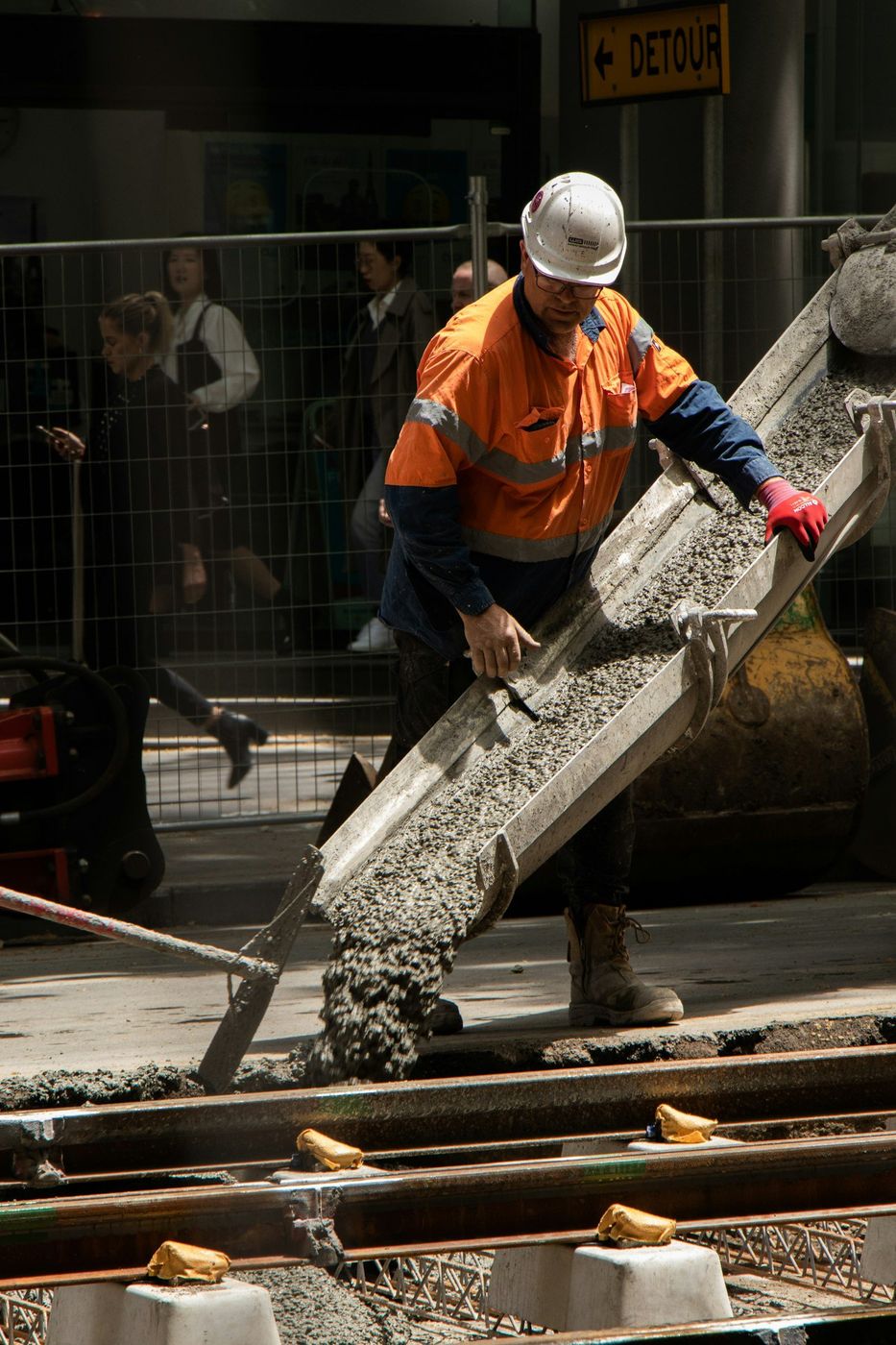
March is what breaks an enclosure pad. Everything that goes wrong the rest of the year is just setting it up.
Go stand in your trash enclosure on a warm afternoon in early March. Snow is piled outside the gate, half of it is running under the container, the low spot in the middle is holding an inch of gray water, and by nine that night all of it is ice again. Do that fifty or sixty times in a season and you have the reason enclosure pads fail faster than any other concrete on a commercial property.
It isn't the trash truck by itself. The truck is a big load, but a properly built pad shrugs that off. It's the truck landing on concrete that spent all winter soaking, freezing, and thawing in a shaded box with no drainage. We rebuild enclosure pads for retail centers, offices, and community properties around Littleton, and we build them for the melt as much as for the fork.
An enclosure is a three-sided box, usually shaded, usually at a low point because that's where nobody wanted to put parking. Snow gets plowed against it and stacked beside it. Whatever is in the container leaks. There's no sun to dry the slab and no wind moving through it. Concrete that stays saturated through a winter of freeze cycles loses surface, and once the surface roughens it holds even more water.
Then the truck arrives. Front-load forks come down on a slab that's been soaked and frozen for months, and the concrete that was fine in October starts spalling in April. Owners tend to blame the hauler. The hauler is only finding the weakness the winter created.
Which is why we treat drainage as the main design problem and thickness as the second one. A pad that sheds water dries out between storms and survives the cycle. A flat pad in a shaded box is a bathtub with a truck landing in it every week, and no amount of extra concrete makes that a good arrangement.
| Spot | What standing water does there | How we build it |
|---|---|---|
| Under the container | Soaks the slab constantly, never sees sun or wind | Continuous fall so nothing pools under the wheels |
| At the gate opening | Freezes into a ridge that gates catch and trucks hammer | Thickened edge, fall carried past the gate, no lip at the transition |
| The apron in front | Meltwater sheets back into the box every warm afternoon | Apron pitched away from the enclosure, not toward it |
| Against the enclosure walls | Undermines the footings and lifts the wall over winters | Slab isolated from the walls, backfill compacted, water routed out |
Send photos of the gate opening, the low spot, and where the truck wheels land. That's usually enough to tell you what you're facing.
The best window for an enclosure rebuild is May through September, and the reason is not just the placing temperature. A pad poured in June gets a full summer to reach strength and dry out before it ever sees a freeze cycle, and by the time February arrives the concrete is as hard as it's going to get. A pad poured in late October goes into its first winter young.
We do cold weather pads when a property has no choice, with heated mix water, non-chloride accelerator, and blankets down immediately. What we won't do is place on frozen ground, and an enclosure in a shaded corner is one of the last spots on a property to thaw. So if you're calling us in January about a pad that's coming apart, expect us to talk about a temporary fix and a spring date rather than promise something we'd have to hedge.
Summer has its own hazard, and it's the afternoon storm. Enclosures on the west side of a property out toward Ken Caryl get the foothill cells first. We start these early, pull the crew off the surface before the weather arrives, and keep plastic staged the whole time. Rain landing on a slab we're still finishing is the one event that costs you real years of surface life.
Every pad we tear out has the same two failures. Broken clean where the front wheels stop, and crumbled to gravel right at the gate line. You could pour the same slab twice as thick and get the same picture if the water still sits in there. Slope it, thicken it, and the same truck stops being a problem.What our crew lead tells homeowners
Still unsure about something?
Call the crew at (303) 569-4046 and we will talk it through.
Get a free, no-obligation estimate from a crew that knows Colorado soil, Colorado weather, and how to finish concrete that lasts.
Accessibility
Adjust the site to fit how you read and browse. Your choices are saved on this device.