
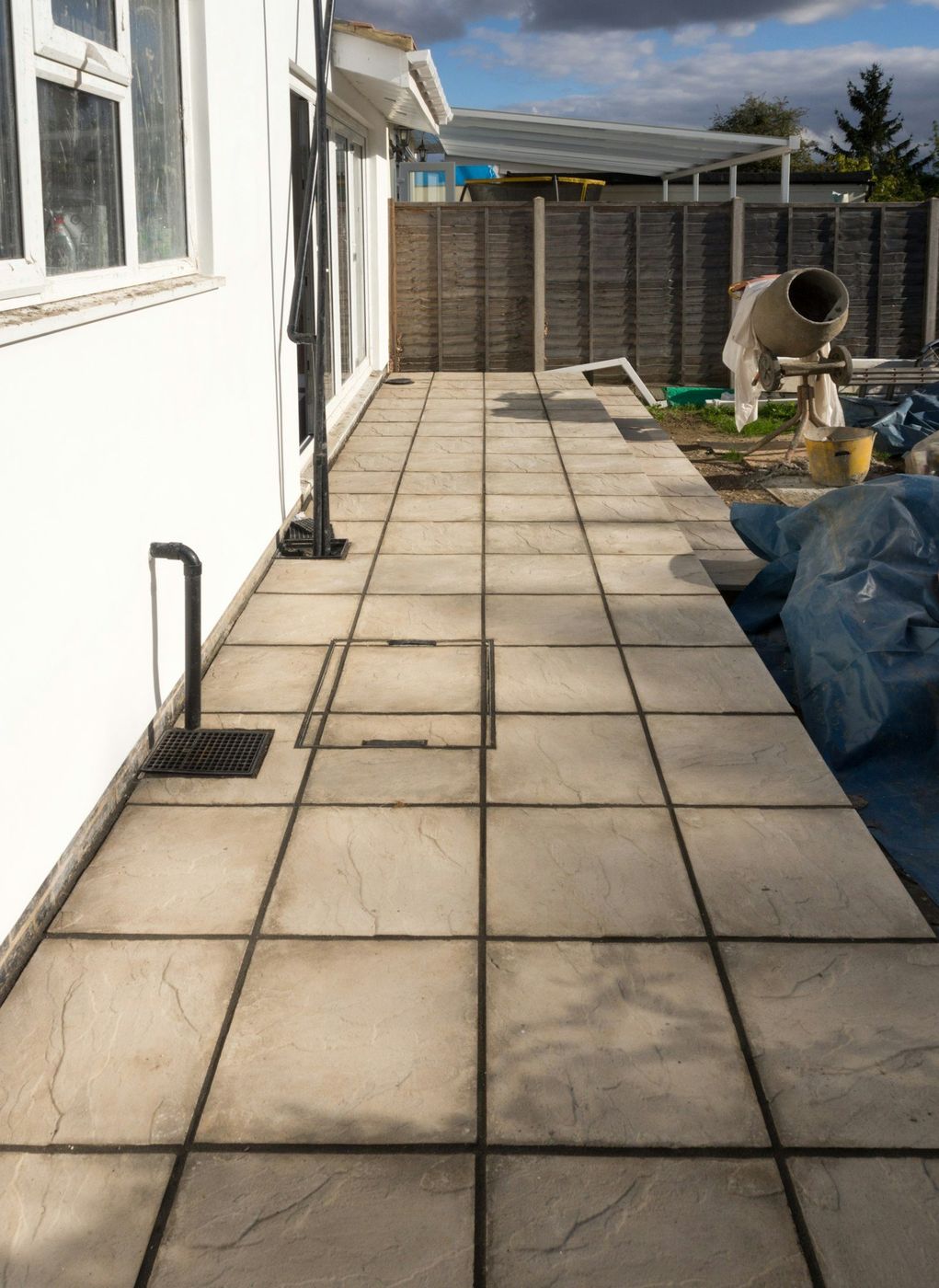
The dirt work nobody sees is the reason the patio lasts.
Every patio has two halves. The half you'll furnish, and the half we bury. In Larkspur the buried half does most of the work, because almost nobody out here owns a flat backyard. Lots in Bear Dance and Sage Port roll, tilt, and shed water, and a patio dropped onto that ground without real dirt work becomes a shallow dam behind the house. First it puddles. Then it heaves. Then it cracks along whatever line the water chose.
So we start below grade. Cut a level bench into the slope, or build the pad up with compacted road base. Pitch the finished slab so rain and snowmelt run away from the foundation instead of toward it. Sort out where the roof drains before the forms go up. Handle the underground half right and the top half, the part with the grill and the chairs, gets to just be concrete.
Two things move soil in this county: water and temperature. The clay swells when it's wet and shrinks when it's dry, and at 6,720 feet the frost works deep and the cold hangs around. A patio slab floats on all of that. It can't be anchored below frost the way a footing can, so its defense is a base that drains. Water that can't collect can't freeze into a lens, and a base that stays dry through March is a patio that stays flat through July.
That's why our patio quotes talk so much about gravel. Compacted road base under the whole slab, thickness matched to the site, with the subgrade shaped to move water through and out. Boring? Completely. It's also the whole ballgame.
| The site | The risk if we ignore it | How we build for it |
|---|---|---|
| Backyard slopes toward the house | Patio funnels snowmelt at the foundation | Regrade to reverse the fall, pitch the slab away, and give runoff a path around the edge |
| Heavy pine shade | Snow and ice camp on the slab for weeks after a storm | Air-entrained mix, positive drainage, and honest advice about shifting the patio into the sun |
| Yard drops away below a walkout | Slab edge settles as loose fill compresses | Build the pad up in compacted lifts, never dumped fill, and thicken the downhill edge |
| Roof drains discharge near the slab | Base saturates in every storm, frost lifts it every winter | Extend the downspouts well past the pour before the concrete ever arrives |
Get on the fall or spring schedule now. We'll walk the yard, flag the drainage, and quote it free.
High-altitude sun changes the math on outdoor space. A south-facing slab is a gift in October and a griddle in July, so we talk through how you'll use the thing before we size it. Morning coffee wants east. Summer dinners want afternoon shade, and on wooded lots in Perry Park the ponderosas will hand you that for free. If there's any chance of a hot tub someday, say so now; that corner gets poured at five to six inches instead of four, and nobody has to cut concrete later.
Bigger is usually right. Patio cost lives mostly in the mobilization, the base, and the crew day, so adding a hundred square feet while the forms are open costs far less than coming back for it in three years.
Patio season here is honest: mid-May through mid-October, with a bias toward fall. September pours cure slow and even, and the patio stands ready long before anyone wants to sit outside anyway. Summer works fine with an early start; the afternoon storm cycle is real, and rain landing on a half-finished surface is the one forecast we won't argue with. Cold-weather pours are possible with heated water and blankets, but for a patio there's rarely a reason to force it. Book the spring slot instead and spend the first cookout of the season on brand-new concrete.
Still unsure about something?
Call the crew at (303) 569-4046 and we will talk it through.

Get a free, no-obligation estimate from a crew that knows Colorado soil, Colorado weather, and how to finish concrete that lasts.
Accessibility
Adjust the site to fit how you read and browse. Your choices are saved on this device.