
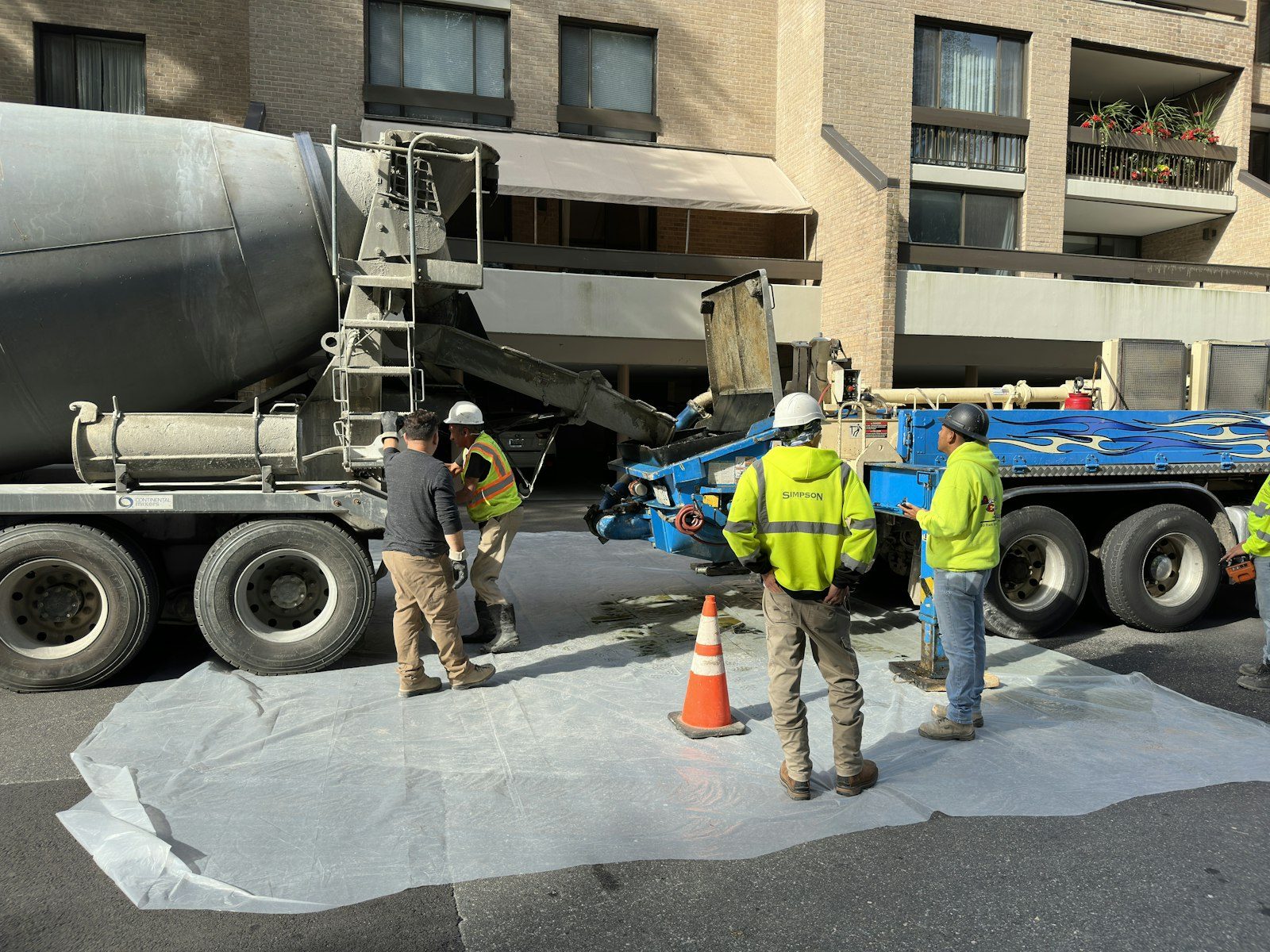
A road pour is a supply chain problem wearing work boots. Everything we do the week before exists to keep one truck from waiting.
Most people picture a concrete pour as the moment the chute swings out. It isn't. By the time the first truck rolls onto a road job, nearly every decision is locked and the crew is executing a plan set days earlier. Placement day is mostly discipline: keep the mix moving, keep the surface ahead of the finishers, refuse to let the schedule talk anyone into a shortcut.
We build access roads and service drives for commercial and industrial property around Lakewood. Yard drives at light industrial buildings toward Applewood, back-of-house routes behind retail near Belmar, maintenance access through the sloped ground on Green Mountain. Here's how one of those days runs, and what we do the week before so it can.
Crew shows up before the concrete does. First hour is walking the forms, checking string, pulling anything that shifted overnight, and confirming the steel is on chairs where it's supposed to be and hasn't been stepped flat. Somebody re-checks grade at the low points. Somebody else stages plastic, blankets, and cure in case the sky changes its mind, which around here it will.
First truck arrives and we take a slump before it discharges a yard. Every truck gets looked at. Placement starts at the far end of the segment so nobody drives on fresh work, and the mix goes down in a controlled advance rather than in piles that have to be dragged. Dragging concrete separates it, and separated concrete is a surface that dusts in three years.
Then it's a moving assembly line. Place, screed to grade, bull float, wait. The waiting is what visitors find strange. You can't finish concrete that's still bleeding, and a trowel forced into surface water seals that water in and wrecks the top. When the sheen goes off, edging and jointing happen fast, then a broom finish pulled one direction across the whole segment.
Cure goes on before anybody leaves. Saw cuts happen the same day, timed to the slab and not the clock, because cutting too early ravels the edge and cutting too late means the slab already chose its own crack. Last thing is barricades and a written date for when vehicles can return.
| Placement plan | How the day runs | When it's the right call |
|---|---|---|
| Full width, one continuous placement | Fastest per square foot, biggest crew, road closed end to end | New construction or a property that can give up the route for several days |
| Half width alternating | Two placements, tied together with dowels at the longitudinal joint | Active sites that need one lane open for deliveries or emergency access |
| Segment by segment along the length | Short daily pours with a construction joint at each stop | Long alignments, tight batch scheduling, or crews working around other trades |
Tell us what has to keep moving and which days are slowest. We'll build the placement plan around that and price it out in writing.
We watch three things on a road pour: temperature, wind, and what's building over the foothills. Heat is manageable with an early start and evaporation retarder. Wind is worse than heat, honestly, because a dry wind pulls moisture off the surface faster than bleed water can replace it, and that's how you get plastic shrinkage cracking on an otherwise perfect slab. And a Front Range afternoon can go from clear to hail in twenty minutes, which is why the plastic is on site before the concrete is.
Season-wise, late spring through October is the window, and the first half of fall is our favorite for road work: long days, mild afternoons, cool nights, and ground that's had a summer to dry out. Up on Green Mountain and the rockier western sites the season runs shorter, since that ground holds moisture and shade differently. We can place in cold weather using warmed mix water, a chloride-free accelerator, and blanket coverage, but strength gain slows and the first loaded truck waits longer. Better to plan for that than discover it in December.
Still unsure about something?
Call the crew at (303) 569-4046 and we will talk it through.
Get a free, no-obligation estimate from a crew that knows Colorado soil, Colorado weather, and how to finish concrete that lasts.
Accessibility
Adjust the site to fit how you read and browse. Your choices are saved on this device.