
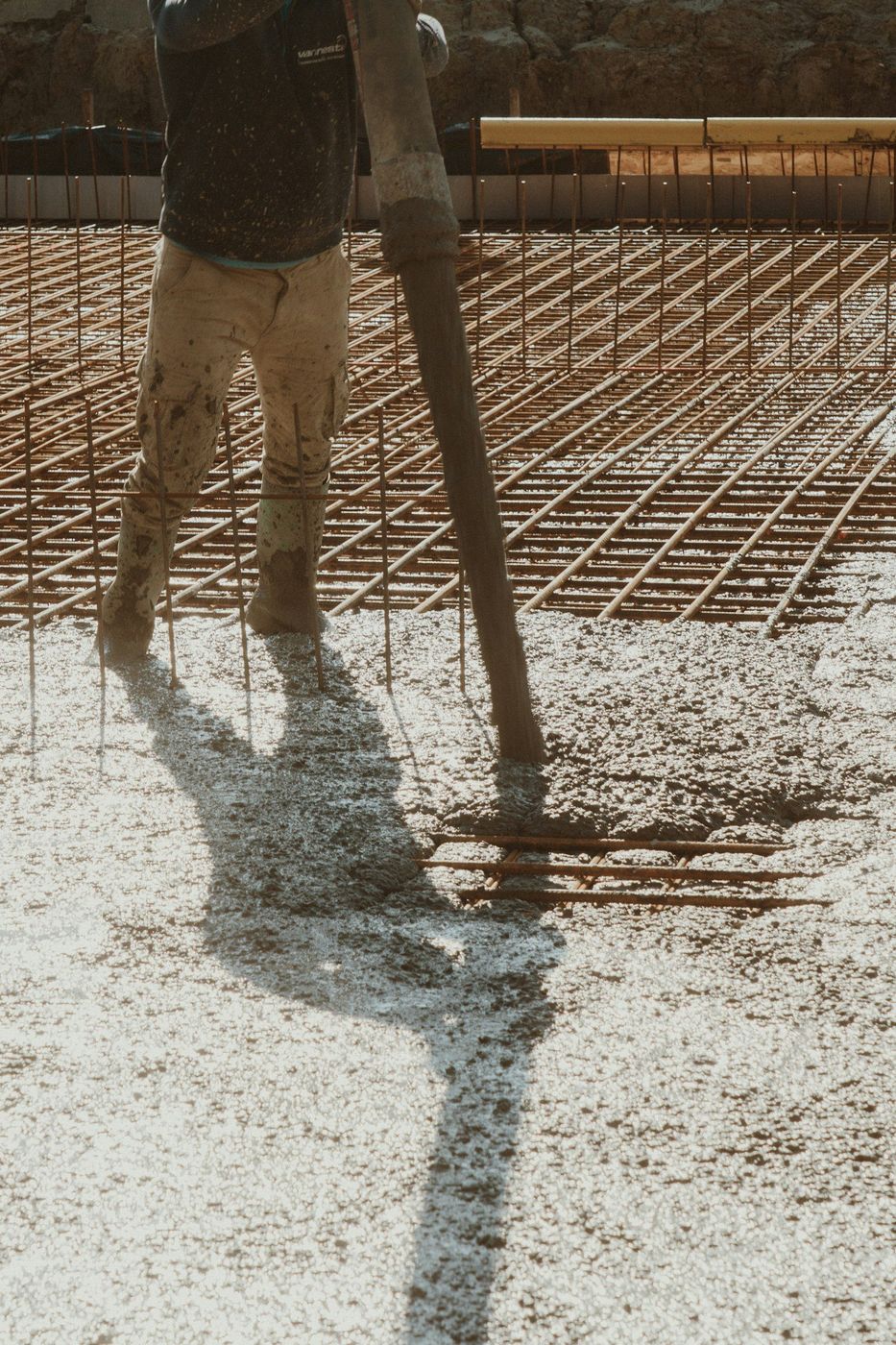
Two bids on the same slab can sit a third apart, and nearly all of that gap is buried below the surface you'll never see again.
When a property manager sends us three bids to compare, the spread is usually wider than anyone expected on what reads as identical scope. Same square footage. Same broom finish. Very different bottom lines. That gap almost never lives in the concrete, because every contractor in Jefferson County buys from the same batch plants at close to the same rate. It lives in everything that happens before the truck backs in.
We pour commercial flatwork all over Lakewood. Service walks, back-of-house aprons, delivery zones, courtyard slabs, and the connecting pieces nobody thinks about until one of them fails. Retail and office property around Belmar, light industrial toward Applewood, association-owned surfaces up on Green Mountain. This page is about where the money actually goes, so you can read a proposal instead of just comparing the last line.
Concrete is a commodity. A yard of 4,000 PSI air-entrained mix costs what it costs, and nobody has a secret rate. So when one number lands well under another, the difference is sitting in excavation depth, base, steel, thickness, and how much site work got quietly left off the page.
Base is the biggest lever by a wide margin. Digging to competent subgrade, hauling off the soft stuff, and compacting aggregate in lifts burns machine hours and truck hours, and the day after the pour none of it shows. A bidder who plans to scrape two inches and place on whatever is down there will always be cheaper. He'll be cheaper the second time too.
Steel is the second lever. Mesh costs less than bar, and on a walk nobody drives, mesh is fine by us. Under a delivery route it's a false economy, since mesh only works at mid-depth and rarely stays there. Third lever: thickness. One extra inch across a large slab is real money on bid day and cheap over twenty years.
| Driver | Which way it pushes | Why it earns its keep |
|---|---|---|
| Excavation depth and haul-off | Up, sometimes sharply | Soft material left in place is why slabs settle in patches instead of evenly |
| Base thickness and compaction | Up modestly | The layer holding your slab flat is the one nobody sees |
| Rebar on chairs rather than mesh | Up a little | Steel at mid-depth is what keeps a crack tight after it forms |
| Thickness matched to the heaviest vehicle | Up per inch | One delivery route quietly sets the spec for everything |
| Removal and disposal of the old surface | Varies widely | Reinforced slab breaks up slower than plain, and demo hours show it |
| Jointing layout and saw timing | Barely registers | Cheapest item on this list. Also the one most often done wrong. |
Send us the scopes. We'll tell you what one covers that the other skipped, whether or not you end up hiring us.
Commercial property gets held a long time and flatwork gets replaced on a cycle. So the useful question isn't what the slab costs this quarter. It's how many winters it buys before somebody writes the next check.
Winter is the collector here. Water works into the surface, freezes, expands, and pries the paste apart, and it repeats that dozens of times between November and April because our afternoon sun undoes almost every freeze. Air entrainment gives the water somewhere to go. Deicing chemicals speed everything up, magnesium chloride worst of all. Proper air content plus a first winter free of chemical buys years, and neither adds much on bid day.
Ground matters too, and in Lakewood it changes with where the property sits. Up on Green Mountain and along the foothill edges we hit rock and grade, so the effort goes into drainage and pulling a consistent bearing surface out of uneven material. Down on the flats near Belmar and Bear Creek it's clay, and the effort shifts to moisture control and base depth. Same written spec, different money underneath. We won't price flatwork off a satellite image for exactly that reason.
Best window runs April into October, September being the sweet spot: warm enough to finish clean, cool enough that the surface isn't setting ahead of the crew. Cold pours work with warmed water, an accelerator carrying no chloride, and insulated coverage. Frozen ground stops us, and so does any request to shorten a cure for a tenant opening.
Still unsure about something?
Call the crew at (303) 569-4046 and we will talk it through.

Get a free, no-obligation estimate from a crew that knows Colorado soil, Colorado weather, and how to finish concrete that lasts.
Accessibility
Adjust the site to fit how you read and browse. Your choices are saved on this device.