
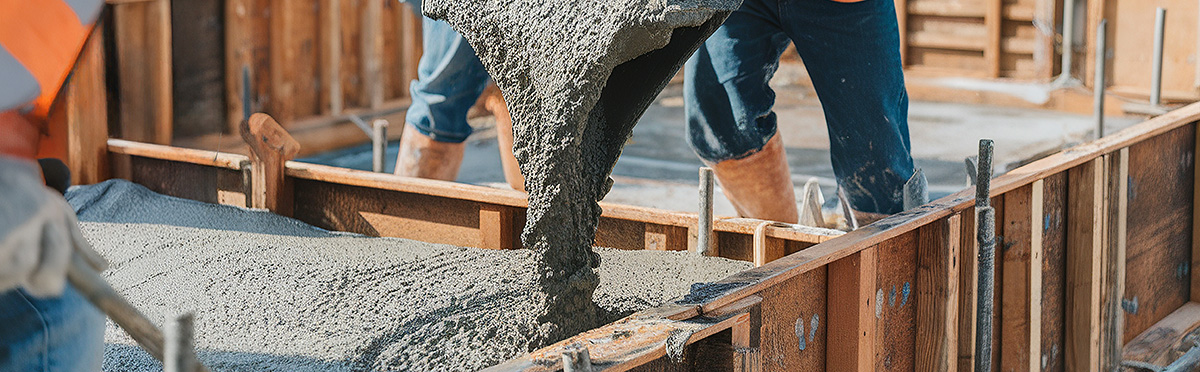
Saw a clean line, break it out, haul it off, and hand back a subgrade that's ready to build on.
People budget for the pour and treat demolition as a rounding error. Then the breaker hits a slab that turns out to be seven inches thick with rebar in it, and the rounding error becomes a real number. Removal is a weight-and-access business. What you pay for is tonnage moved, distance it has to travel, and how much of that trip has to happen by hand.
We quote it honestly and we quote it before the first cut. That means measuring square footage, probing the edge to find out how thick the thing really is, checking whether a truck and trailer can get within reach, and asking what goes back in the hole afterward. Get those four right and the number holds. Guess at them and everybody's unhappy by Thursday.
Thickness first. A four-inch residential walk breaks up fast and loads faster. A driveway that a previous owner had overlaid, or an old shop pad someone poured heavy, can be double that, and every extra inch is more tonnage on the trailer and more diesel to the recycler. Reinforcement changes the rhythm too. Welded wire mesh comes out in mats you can roll. A slab tied with steel on a two-foot grid has to be cut apart in sections before anything moves.
Then access. Front driveways in Northridge and Eastridge are the easy version: back the equipment in, load at the curb, done. A courtyard patio behind a gate is the other version, where a mini excavator either fits through a thirty-six-inch opening or the whole job becomes wheelbarrows and a walk-behind breaker. Same square footage, very different day. The last variable is what's buried alongside it. Gas service, irrigation mains, low-voltage lighting, and shallow downspout drains all live at demo depth, and finding them with a bucket is expensive for everyone.
| Driver | Toward the low end | Toward the high end |
|---|---|---|
| Slab thickness | Four inches, poured as a walk or a patio | Six inches and up, or an overlay on top of an older slab |
| Reinforcement | No steel, or light wire mesh | Rebar on a tight grid, which has to be cut before it loads |
| Access | Curb-side driveway, room to back a trailer in | Backyard through a gate, hand demo and wheelbarrow runs |
| What sits next to it | Open ground on all sides | House, pool coping, retaining wall, or finished landscape at the edge |
| Buried services | Nothing marked in the footprint | Gas line, irrigation main, or conduit crossing under the slab |
| Where the debris goes | Clean concrete, recycler nearby | Mixed material with asphalt, brick, or dirt in the load |
| Scope of the cut | Remove the whole thing | Save half, which means a straight cut, protection, and careful edge work |
Send dimensions and a photo of the edge. We'll size the tonnage and tell you what access we need.
Demolition has a longer season than pouring does. We break and haul concrete right through the winter, since nothing has to cure, and the only cold-weather headache is a subgrade frozen too hard to grade properly at the end. That makes February a smart month to get the old slab gone and the site ready, then pour in April when the ground has woken up. Homeowners in Southridge and The Hearth do exactly that when they want the new patio usable by Memorial Day.
What you're paying for at the end isn't an empty rectangle. It's a subgrade that's clean, at the right elevation, and compacted, which is worth more than most people realize. Half the failed slabs we tear out failed because the last crew dumped chunks of the old concrete back in the hole and poured over them. We haul all of it. The next slab deserves to start from honest dirt.
Still unsure about something?
Call the crew at (303) 569-4046 and we will talk it through.

Get a free, no-obligation estimate from a crew that knows Colorado soil, Colorado weather, and how to finish concrete that lasts.
Accessibility
Adjust the site to fit how you read and browse. Your choices are saved on this device.