
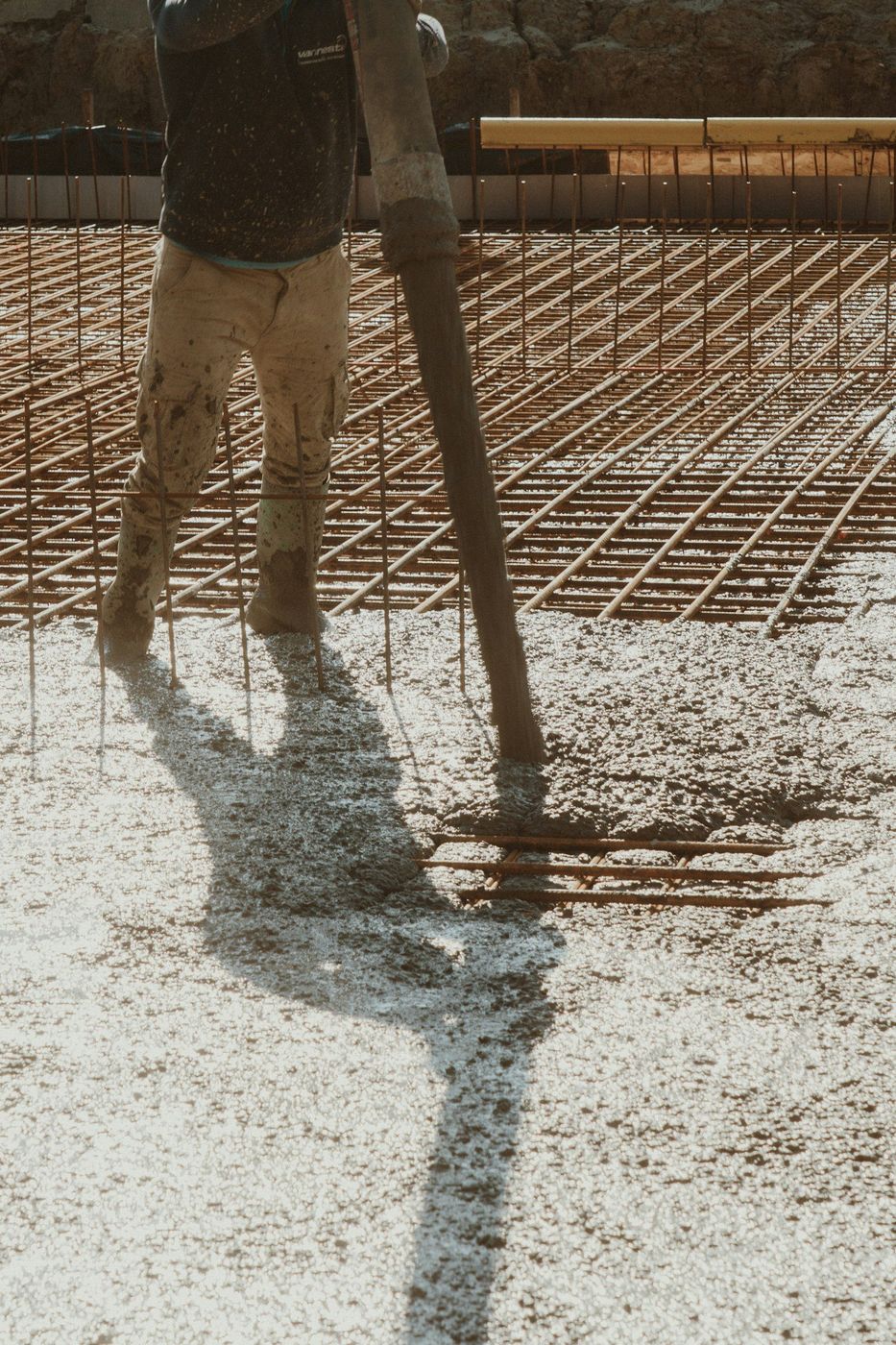
A court is mostly dirt work plus one very flat afternoon of finishing, and that is exactly where the money goes.
People are usually surprised by what a court costs and then surprised again by why. It isn't the concrete. Ready-mix is priced by the yard and a home court doesn't need many of them. What you're paying for is making a rectangle of Colorado yard into one flat plane, holding that plane while a crew finishes several hundred square feet before it sets up on them, and putting a hoop footing in the ground deep enough that a dunk doesn't make the backboard shiver.
Understanding that changes how you spend. A smaller court built properly plays beautifully for twenty years. A big one poured on a rushed grade develops a low spot that holds water, a joint in the wrong place that kills a dribble, and a lip at the edge somebody rolls an ankle on. We would rather build you the smaller one.
First is earthwork. A court has to sit in a single plane, and yards do not come in single planes. If your ground falls two feet across the footprint, somebody is cutting on the high side and building compacted fill on the low side, and fill costs more than cut because it has to be placed in lifts and compacted properly. That one variable can swing a quote more than doubling the square footage would.
Second is finishing labor. Flatness on a court is a real specification, not a preference, because a ball tells on any surface that isn't true. That means more hands on site during the finishing window, a longer screed, and a crew that stays on it while the slab sets. In July that window closes fast and we start early. On a cool October morning it stretches out. Same slab, different amount of labor.
Third is everything that goes in the ground while the forms are up. Hoop footing, conduit for lights, sleeves for fence posts. Individually those are small. Added after the pour, they involve coring or sawing a surface you specifically paid to be perfect.
| Item | Adding it during the pour | Adding it later |
|---|---|---|
| In-ground hoop footing | One extra hole and a few minutes of concrete | Core a finished slab, or set a portable base you'll fight forever |
| Conduit for court lighting | A trench and a sleeve while the ground is already open | Trenching around a finished court and surface-mounting the run |
| Fence post sleeves | Set on layout with the forms | Core drilling on a grid and hoping the pattern lands square |
| Extra apron behind the baseline | A little more base and a bigger pour | A separate pour with a cold joint that never matches |
| Color coating and painted lines | Planned into the finish and the cure schedule | Doable anytime after cure, and genuinely fine to defer |
We'll shoot grades across the space and show you the honest footprint before you commit to a size.
The court has to drain, and it has to do it without ever going out of plane. So we build in one continuous fall in a single direction, usually around one percent, and we never crown it or create valleys. A ball crossing a valley checks up. A ball crossing a uniform one percent slope does not, and nobody playing can tell the court isn't level.
Joints are the other thing players feel. Concrete this size needs control joints, so the question is only where they land. We lay them out to fall along the edges of the playing area and away from the key and the top of the arc, since that's where the dribbling actually happens. Joints get sawed the same day, kept tight, and filled later so grit and water stay out.
Then the weather. Summer storms build over the foothills most afternoons and can dump on a fresh pour, so we start early and keep plastic on the truck. Winter is the long test: freeze cycles work on every joint, and whatever you spread for traction ends up on the surface. Sand only, and shovel with a plastic edge rather than scraping steel across a finish you paid for. A court sheds snow fast once the sun hits it, which is the quiet advantage of a dark, flat, south-facing rectangle in a Fort Collins January. Courts around Harmony and Fossil Creek get played on in February.
Still unsure about something?
Call the crew at (303) 569-4046 and we will talk it through.
Get a free, no-obligation estimate from a crew that knows Colorado soil, Colorado weather, and how to finish concrete that lasts.
Accessibility
Adjust the site to fit how you read and browse. Your choices are saved on this device.