
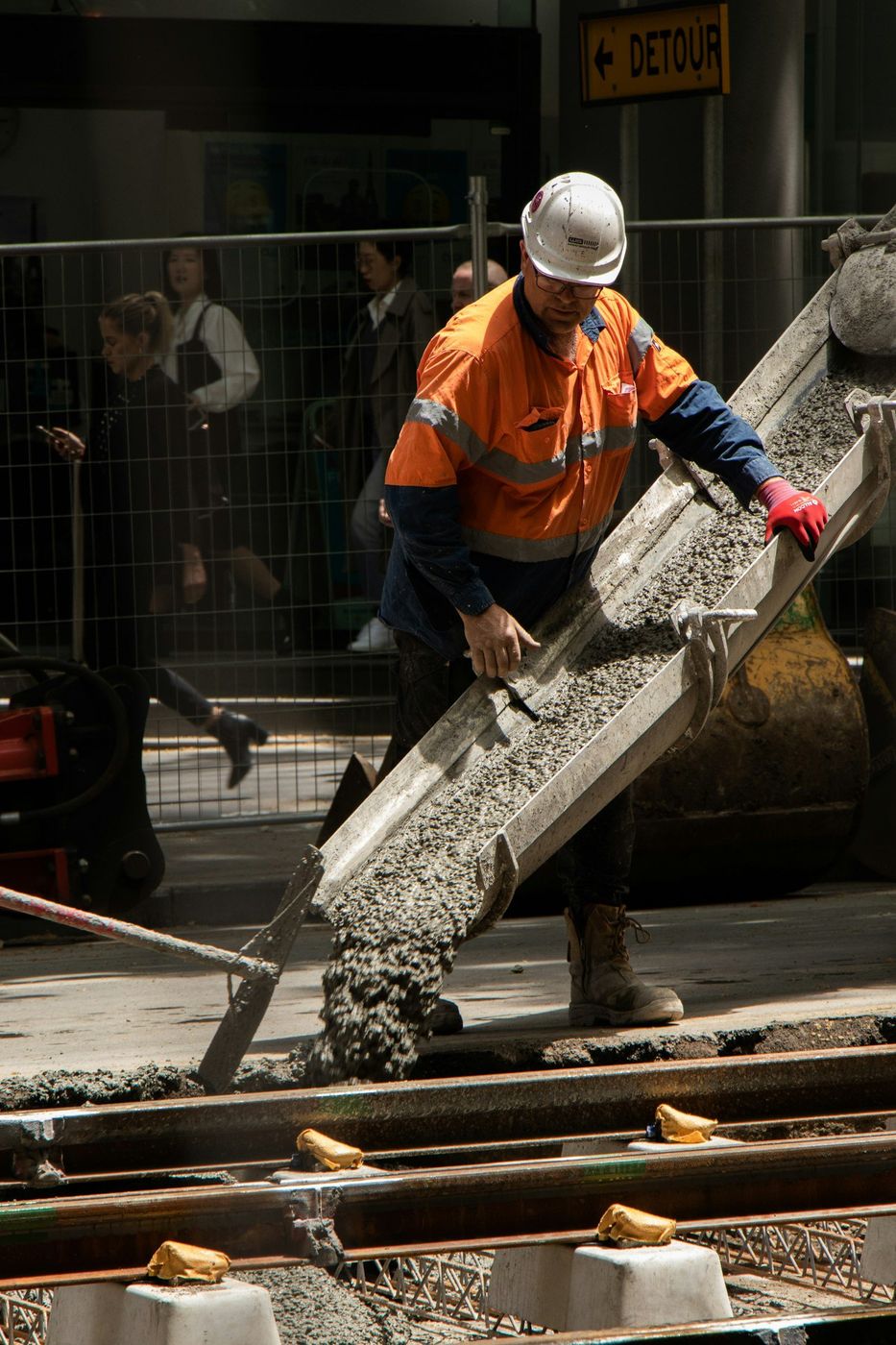
One machine, one morning, and a bed line that stops moving for good.
Curbing day looks nothing like a normal concrete job. No forms go up the day before. No truck backs into the yard and swings a chute. What shows up is a trailer, a small extruding machine that rides along the bed line, and a mix so stiff it holds its shape the second it leaves the hopper. If you've only watched a slab get poured, this will seem like a different trade.
We run curb through yards all over Fort Collins, from compact lots near Old Town where the beds hug the house to the wider landscapes around Fossil Creek and Registry Ridge. The install itself is usually one day. Here's exactly how that day goes, so nothing about it surprises you.
We start with a garden hose. Laid on the ground, it shows the shape of the run better than any drawing, and you can nudge it until the curve reads right from the porch and from the street. That's the moment to speak up. Once the machine starts extruding, the line is set, and changing it means cutting concrete out.
After the hose comes paint, then a sod cutter or trencher opening a narrow strip along the whole run. The soil in that strip gets graded and packed. Curb is heavy enough to need firm ground under it, and narrow enough that a soft spot shows up as a dip within a couple of years. We watch for sprinkler heads and drip line as we go, because irrigation almost always runs exactly where a bed edge belongs.
We'll lay out the run with you, measure the footage, and leave a written number. Nothing gets cut until you like the shape.
| What's in the way | Who deals with it | What it costs to skip |
|---|---|---|
| Mulch, rock, and bed material along the line | You, or us as an add to the quote | The machine can't ride a clean line and the edge wanders |
| Sprinkler heads and drip tube crossing the run | Us, once you point out what you know about | A cut line found by the machine, mid-run, with the mix already batched |
| Low-voltage lighting wire buried at bed depth | You mark it, we sleeve or reroute it | A severed cable that nobody can locate later |
| Old plastic or steel edging | Us, pulled and hauled with the spoil | New curb set over buried edging, which never sits flat |
| Gate width and the path from the driveway | You, by unlatching and clearing it | A machine that can't reach the back yard on the day we're scheduled |
People watch the hopper and get nervous. The material coming out looks like damp sand rather than the soupy gray they expect, and that's the point: a curb has nothing holding its shape but itself, so the mix has to stand up the instant the machine passes. Same cement, same aggregate, far less water. It also dries fast on a hot windy afternoon, which is why curing compound goes on right behind the crew instead of at the end of the day.
Joints matter more here than on most flatwork. A curb is a long, thin, unreinforced ribbon, and at the north end of the range the freeze and thaw swings work on it hard all winter. So we tool contraction joints every few feet. The run will shrink and it will move, and those joints give it seams to do it along. A run with no joints cracks anyway, randomly, and those cracks widen every season.
Then it's yours. Keep sprinklers off it for a day, hold the rock and mulch back until we say go, and let nobody drive across it for a week. Season-wise, April into October works, with fall a favorite because beds are cut back and the machine has clean sight lines. We stop once the ground quits taking compaction, since frozen subgrade under a narrow curb is a run that lifts by March.
The runs we get called out to fix are almost never cracked from cold. They failed where somebody skipped the trench and set curb on loose topsoil. Ten minutes of compaction per section is the whole trick.Straight from the crew
Still unsure about something?
Call the crew at (303) 569-4046 and we will talk it through.

Get a free, no-obligation estimate from a crew that knows Colorado soil, Colorado weather, and how to finish concrete that lasts.
Accessibility
Adjust the site to fit how you read and browse. Your choices are saved on this device.