
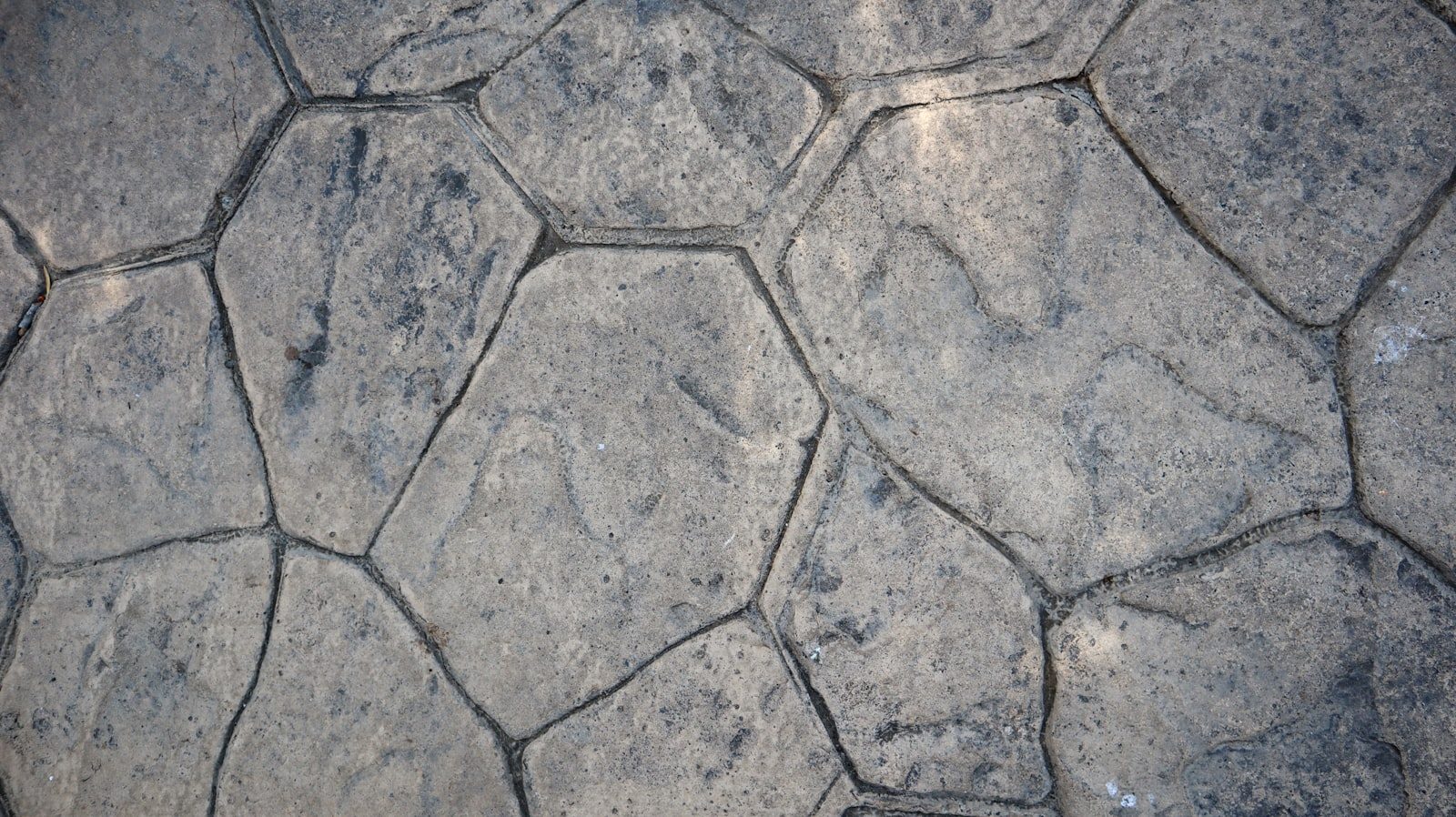
The mats come off the trailer in the order they go down, and that one habit decides how the whole slab reads.
The mats come off the trailer in the order they go down. Sounds like housekeeping. It isn't. Once the surface is ready to take an imprint there's no pausing to sort tools, so a crew that has to hunt for the next mat ends up with a pattern that drifts at the third row and never squares back up. We lay the whole run out on the grass first and walk it heel to toe.
Stamp work is the one pour where the schedule belongs to the concrete. Color hardener goes on before the surface tightens. Release goes on before the mats. Mats go down before the slab gets away from us. And on an Englewood lot, where the side yard is often narrow enough that two people can't pass with a wheelbarrow, we add a step nobody thinks about: figuring out where five sets of boots are going to stand.
Access sets the plan. In Northwest Englewood the houses sit close, the side yards are skinny, and half the time the only route to the backyard runs past a gas meter and a mature lilac somebody's grandmother planted. We buggy the mix by hand or we pump it. Either way the crew size goes up, because hand-carrying concrete on a clock means more bodies moving faster, not fewer bodies working longer.
Broadway Estates gives us a little more room, and Cherry Hills Vista usually gives us a driveway wide enough to back a truck partway down. Bigger yard, easier day, and the pattern choices open up because a big open slab carries a wide ashlar without looking chopped. On a narrow patio we steer people toward a tighter repeat, since a large-scale stamp on a small slab shows its seams from the back door.
| Release choice | What stays in the pattern | When we reach for it |
|---|---|---|
| Powder release, contrasting color | Settles into the grout lines and low spots and survives the wash, which is where the aged, layered look comes from | Our default on anything meant to read like stone |
| Powder release, matching color | Same lubrication, almost no accent left after rinsing, so the slab reads as one clean tone | Modern patterns, wood plank, anywhere a second color would look busy |
| Liquid release | Evaporates. Nothing left in the joints and no secondary color at all | Interior stamped work and any job where a single flat color is the whole point |
| Antiquing applied after cure | Color brushed and rinsed days later, with far more control than a pour-day powder gives | Touch-ups, repairs, and changing the tone on stamped work that's already down |
| Nothing at all | The mat grabs, the imprint tears, and the surface lifts with the tool | Never. This is how a good pour turns into a demo job |
Send a photo and a rough size. We'll tell you whether it suits your slab or whether the scale is going to fight you. Call (303) 569-4046.
At 5,371 feet the air is thin and dry, and that shortens everything. A fifteen mile an hour breeze across a fresh slab pulls surface moisture faster than direct sun does, and once the top skins over, the mats stop imprinting cleanly and start skating. So we watch wind harder than temperature. Windbreaks go up on exposed sides. On a hot afternoon we schedule the truck early, run an evaporation retarder, and put more people on the slab so the stamping keeps pace with the set.
Late spring through early fall is the honest season, and September is the best of it: warm middays, cool nights, and runway to cure before the first hard freeze. Summer works if we start at daybreak and watch what builds over the foothills by two.
Winter stamping happens, and it happens carefully. Heated mix water, non-chloride accelerator, blankets down the same evening. We won't place on frozen ground, ever, and we won't stamp in a wind that's stealing the surface faster than the crew can work. When the calendar is against us, we build forms and prep base in the cold and hold the pour for a clear stretch.
People think the pattern is the hard part. It isn't. It's reading the slab, knowing you have twenty minutes left instead of forty, and moving the crew before anybody else sees a reason to.
From the crew lead on these jobs
Still unsure about something?
Call the crew at (303) 569-4046 and we will talk it through.
Get a free, no-obligation estimate from a crew that knows Colorado soil, Colorado weather, and how to finish concrete that lasts.
Accessibility
Adjust the site to fit how you read and browse. Your choices are saved on this device.