
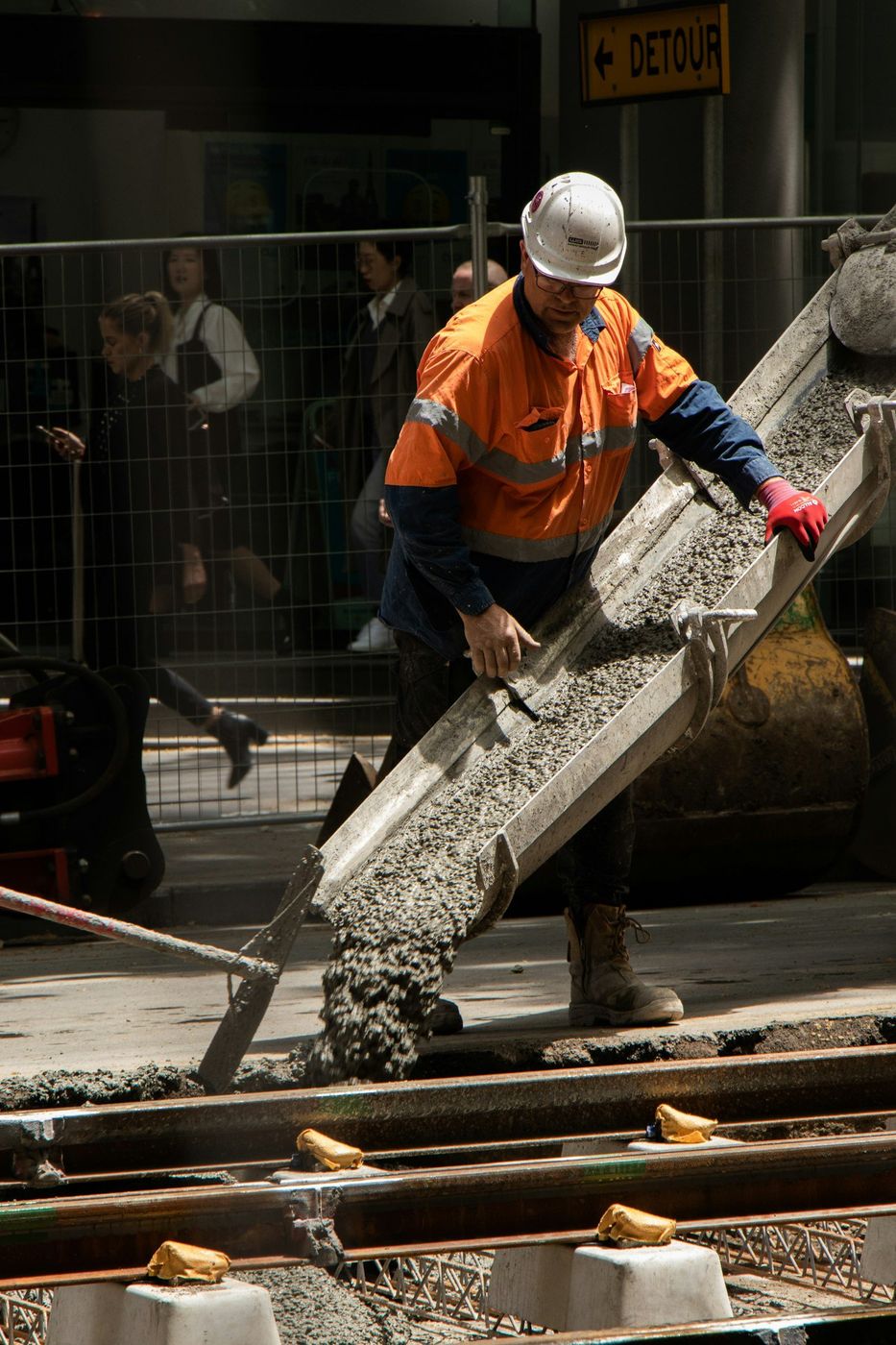
A dock is the one place on a property where you dig a hole against the building and then ask the water to leave.
Think about the geometry for a second. A depressed dock is a pit dug tight against a building, sloped downhill toward the wall, with a trailer parked over it several times a day. Every gallon that lands in it has to be caught by a drain and carried somewhere, because gravity is not going to help. Nothing else on a commercial property is arranged that way on purpose.
Centennial is not a warehouse market and we will not pretend otherwise. What we work on is receiving at grocery and retail centers near Southglenn and Homestead, restaurant back doors, single-dock flex buildings, and kitchen deliveries at schools. Small dock counts, heavy repetition, almost always a rebuild. What follows is what sits under that concrete, because at a dock the ground is the story.
When the building went up, somebody excavated for footings and foundation walls, then backfilled the trench once the structure was in. That backfill went in against a wall in a narrow space, often late in the job, and however well it got compacted it was never the undisturbed soil beside it. A dock approach sits directly on that band.
Then utilities crossed it. Sanitary, storm, sometimes gas or electric, each in its own trench running under or alongside the approach. Every one of those is another zone of placed material settling at a different rate than what surrounds it. So when a slab tips toward the building or cracks in a straight line ten feet out from the wall, the crack is not random. It is tracing a trench.
Add water. The pit collects it, the drain clogs, and the backfill soaks. That saturated zone freezes and thaws all winter, and the surface lifts and drops a little each cycle. Two or three seasons of it and the leveler no longer meets the trailer bed the way it was set to.
We take the drain seriously before we take the concrete seriously. Where does the pit drain go, does the line still flow, has the sump ever been cleaned, and does the pit floor still fall toward the inlet or has it settled away from it. It is common to find a drain buried under sediment for years while everyone assumed the puddle was just a puddle.
The pit floor gets built back with real fall toward the drain. The approach gets sloped so runoff never reaches the well at all, since the cheapest gallon to handle is the one that never comes down the ramp. Where the ground is bad we dig it out and replace it with clean base compacted in lifts, rather than working wet material that will never take compaction. And we isolate the slab from the building and the pit walls so those can move without dragging cracks through the field.
Timing works in your favor if you plan ahead. Late April through early October is the clean window at this elevation, and a dock rebuild goes best in a stretch with dry ground, since the excavation is deep and an open hole full of rain sets everything back. We do winter work with heated water, accelerator, and blankets when receiving cannot wait. Frozen subgrade is where we stop, because the ice under a slab melts eventually and leaves a void exactly where the trailer parks.
| What is under there | How it got that way | What it changes |
|---|---|---|
| Loose foundation backfill | Placed in a tight trench when the building went up | Excavate and replace with compacted base, wider than the slab |
| A utility trench crossing the approach | Later work that was backfilled and never fully compacted | Bridge it with thicker concrete and heavier steel across the line |
| Saturated soil with no drainage path | A blocked pit drain that nobody has ever cleaned out | Drain repair or replacement, plus a sump the property can maintain |
| A void under the slab | Fines washed out through cracks over several seasons | Full removal. Nothing gets patched over an unsupported slab. |
| Sound base and a slab that is simply too thin | Built for a different vehicle than the one using it now | Keep the base, pour back thicker and reinforced for real loads |
That is usually concrete, not equipment. We will look at the approach, the pit, and the drain, and tell you which one is moving.
Every dock we tear out, somebody tells me the concrete was bad. It usually was not. It cracked because the dirt under one corner left, and the dirt left because water had a way in and no way out.From the crew lead on these jobs
Still unsure about something?
Call the crew at (303) 569-4046 and we will talk it through.

Get a free, no-obligation estimate from a crew that knows Colorado soil, Colorado weather, and how to finish concrete that lasts.
Accessibility
Adjust the site to fit how you read and browse. Your choices are saved on this device.