
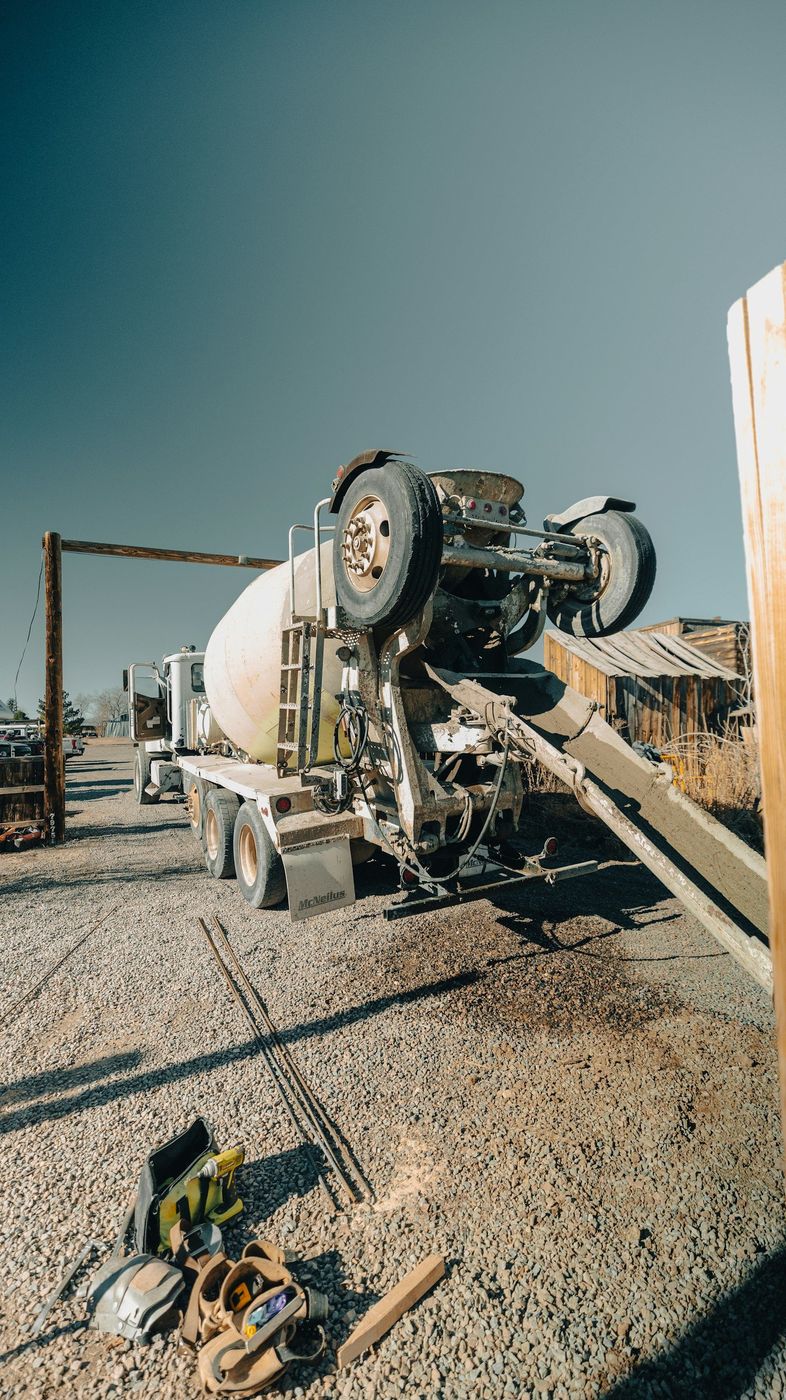
Almost nobody here is paving raw ground. The real question is what to do with the lot you inherited.
Very little of our lot work in Centennial starts with bare dirt. The commercial ground here got built out long ago, so what lands on our desk is a surface with a history: patched, sealed, overlaid at least once, and failing in the same four or five places it has failed for a decade. The owner has a number in the capital plan and a decision to make.
That decision is rarely all concrete or nothing. Concrete belongs where loads and standing water concentrate, and asphalt does fine across a field of stalls that sees a car for eight hours and nothing else. Getting the split right is worth more than any argument about mix design. So this is about where the concrete earns its cost, and where spending it would waste a budget cycle.
Look at your lot in July and again in February and the same handful of spots are in trouble. The trash truck's stopping point, pushed up into a wave. The drive aisle where every delivery van turns, rutted along one arc. The entrance apron off the public street, cracked into a mosaic. The low corner near the inlet where water sits after every storm.
Those spots share a cause. Asphalt is flexible, it softens in summer heat, and it moves under concentrated load. A loaded truck stopping in the same tire prints twice a week finds that softness every August. Put four inches of hot mix over a base that was never rebuilt and you are patching that spot forever. Concrete is rigid, it spreads load across a wide footprint, and it does not care how hot the surface gets.
The stall field is a different story. Cars are light, they park and leave, and a maintained asphalt field can serve a property near Southglenn or the office frontage around Willow Creek for years on crack sealing alone. Owners who convert everything at once tend to spend the budget on the easiest ground while the hard spots wait.
| Approach | When it is the right call | What you are accepting |
|---|---|---|
| Concrete only at the load zones, asphalt stays elsewhere | The stall field is sound and the same few spots keep failing | Two surfaces to maintain, and joints where they meet that need attention |
| Full concrete rebuild of the whole lot | Base is failing broadly, or the property is being repositioned | The largest single check, the longest disruption, the lowest cost per year after |
| Mill and overlay the asphalt | Surface is worn but the base underneath still holds up | A cosmetic reset. The load zones will fail again on the same schedule. |
| Crack seal, patch, and seal coat | Money is thin this cycle and nothing is a hazard yet | Cheapest today, and the failures continue underneath while looking tidier |
| Fix the drainage first, resurface later | Water is clearly the cause and the budget cannot cover both | A year of an ugly lot, and a much better outcome when the surface work happens |
Send us your site plan and a few photos of the bad spots. We will mark what needs concrete, what can wait, and what only needs water sent somewhere else.
An occupied lot never fully closes, so we build phase lines on joint lines and keep an entrance and a workable block of stalls live at every stage. Accessible stalls and the route to the door get planned first, ahead of everything else, because losing those is not an inconvenience. It is a problem.
Tell us the hours that matter. Restaurant lunch, clinic appointment blocks, the church that needs Sunday morning, the delivery windows that cannot slide. We draw the phases around them and put the schedule in writing so property management can answer tenant emails without calling us.
Season sets the outer bounds. Placement runs comfortably from late April through early October at this elevation, and pours in late September cure at an unhurried pace. Cold weather work happens with heated water, a non-chloride accelerator, and blankets, but a lot poured in November meets plow blades and deicer with no age on it. Frozen subgrade stops us outright. Summer has its own trap: a dry, windy afternoon crusts the surface while the concrete underneath is still soft, so we start early and mist.
Still unsure about something?
Call the crew at (303) 569-4046 and we will talk it through.
Get a free, no-obligation estimate from a crew that knows Colorado soil, Colorado weather, and how to finish concrete that lasts.
Accessibility
Adjust the site to fit how you read and browse. Your choices are saved on this device.