
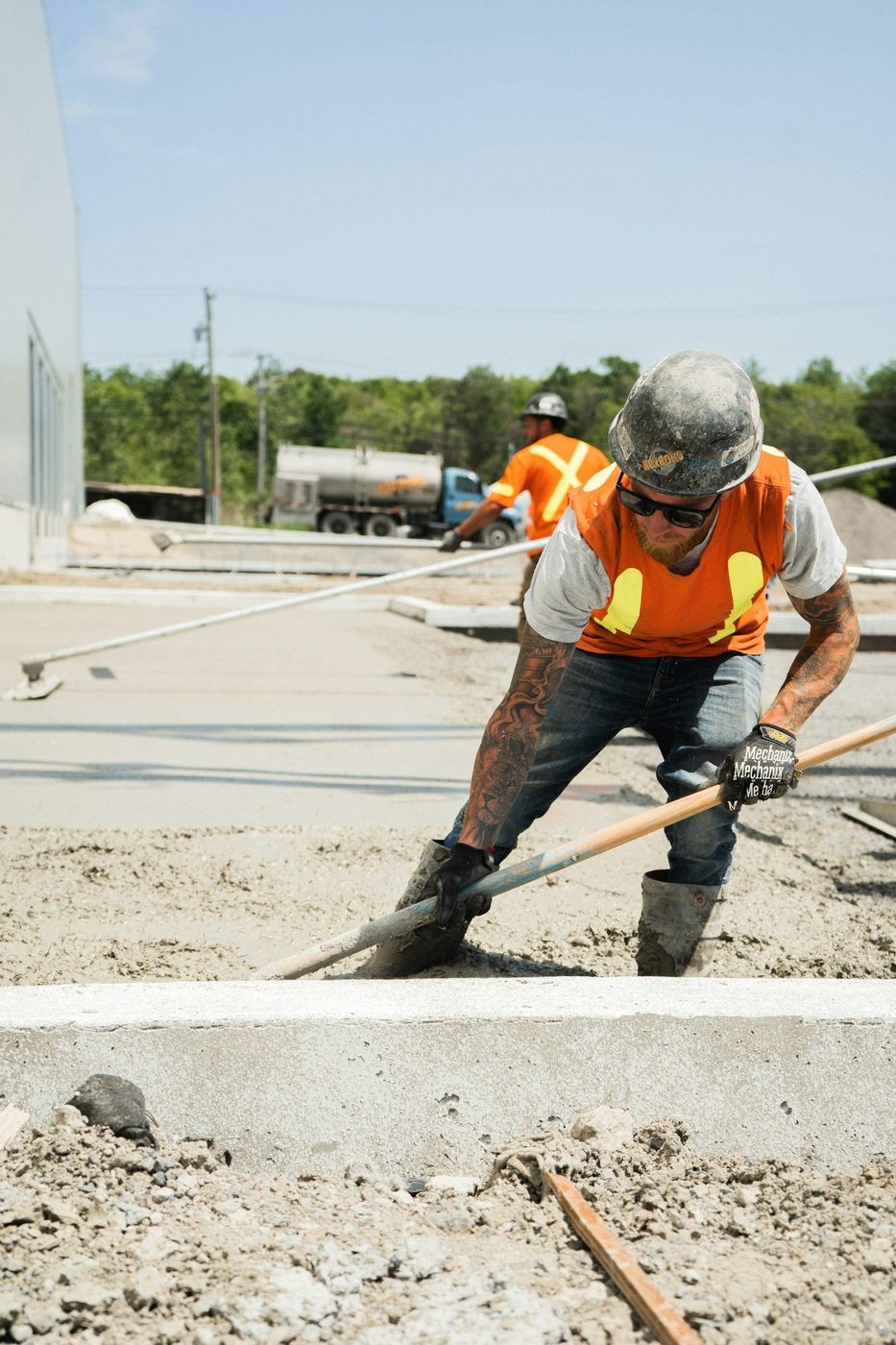
Every serious thing that goes wrong on a resurfacing job goes wrong in a five-gallon bucket.
Resurfacing day is a mixing operation with a slab attached. That sounds dismissive and it isn't meant to be. Every serious thing that goes wrong on one of these jobs goes wrong in a five-gallon bucket: too much water in one batch, a paddle that never reached the bottom, a bag opened while the last batch was already stiffening on the ground.
So the crew is organized around the mixing station instead of the slab. One person mixes and does nothing else, measuring water the same way every time. Everybody else places, spreads, and textures on a clock that won't negotiate. This page is about that morning.
Cementitious resurfacers are engineered products and they are ruthless about water. A little extra makes the material spread easier, and it also weakens the film, lightens the color, and invites shrinkage cracking weeks down the road. Batches mixed by feel come out in slightly different shades, and across a driveway that means visible bands where one batch met the next.
So we measure. Same ratio, same paddle, same mixing time, same bucket, one person owning it from the first bag to the last. Temperature gets a vote too, since warm water speeds the set and cold water drags it out, and on a hot day we'll ice the water rather than watch material skin over in the wheelbarrow. None of this is interesting to watch. It's also the whole difference between a surface that looks poured and one that looks assembled.
Material goes out in ribbons and gets pulled with a squeegee, always working from a wet edge, never stopping mid-panel. Joints get honored, which means we tape or cut them so the new surface doesn't bridge something the slab intends to move at anyway. Then texture, the part with the shortest fuse. A broom finish has to land while the surface is still open. A knockdown gets sprayed, then flattened at the point where it's set enough to take a trowel and not so far along that it tears.
Anybody who has done this in a Front Range June knows the feeling of material tightening faster than a crew can move. Big driveways get broken at joint lines and finished section by section, because pretending one crew can hold a wet edge across a whole drive at eleven in the morning is how you get a lap line you'll study for years.
| What we check | Where we want it | What happens outside that |
|---|---|---|
| Air temperature | Above freezing overnight, mild through the day | Cold drags the set out until the surface can't be finished. Heat closes the window early |
| Slab temperature | Cooler than the air, and out of direct sun when we can manage it | A baking slab pulls water out through the bottom and ruins the bond |
| Direct sun on the work | Shaded, or we bring the shade with us | Sun sets the top before the bottom, which is how a fresh surface crazes |
| Wind | Light. A steady breeze is harder on us than heat | It strips surface moisture and leaves a dusty face that scuffs off |
| Rain in the forecast | Nothing the rest of the day, preferably nothing overnight | Rain on green material pits the surface and can wash the texture out |
| Slab moisture | Damp all the way through, no puddles anywhere | A dry slab drinks the mix water. A wet one floats the material off |
We'd rather move your date than place into a bad afternoon. Free estimates. Call (303) 569-4046.
Homeowners always ask why we spent three hours blasting and cleaning before anybody opened a bag. Then they watch how fast the placing goes, and it clicks.What the crew sees on site
Straight talk about limits. A resurfacer renews the top. It does not lift a settled panel, it does not stop a crack that opens and closes with the seasons, and it adds no strength to a slab failing from the base upward. Around Willow Creek and Foxridge the tell is a corner that's dropped where roof runoff has been undermining it. Put a beautiful new face on that and you own a beautiful new face on a moving slab.
When the concrete underneath is sound, this is one of the better values in the trade. We place from late April into early October, favoring the shoulder weeks. Afterward the surface stays off limits to vehicles for several days and to deicing chemicals for its whole first winter.
Still unsure about something?
Call the crew at (303) 569-4046 and we will talk it through.

Get a free, no-obligation estimate from a crew that knows Colorado soil, Colorado weather, and how to finish concrete that lasts.
Accessibility
Adjust the site to fit how you read and browse. Your choices are saved on this device.