
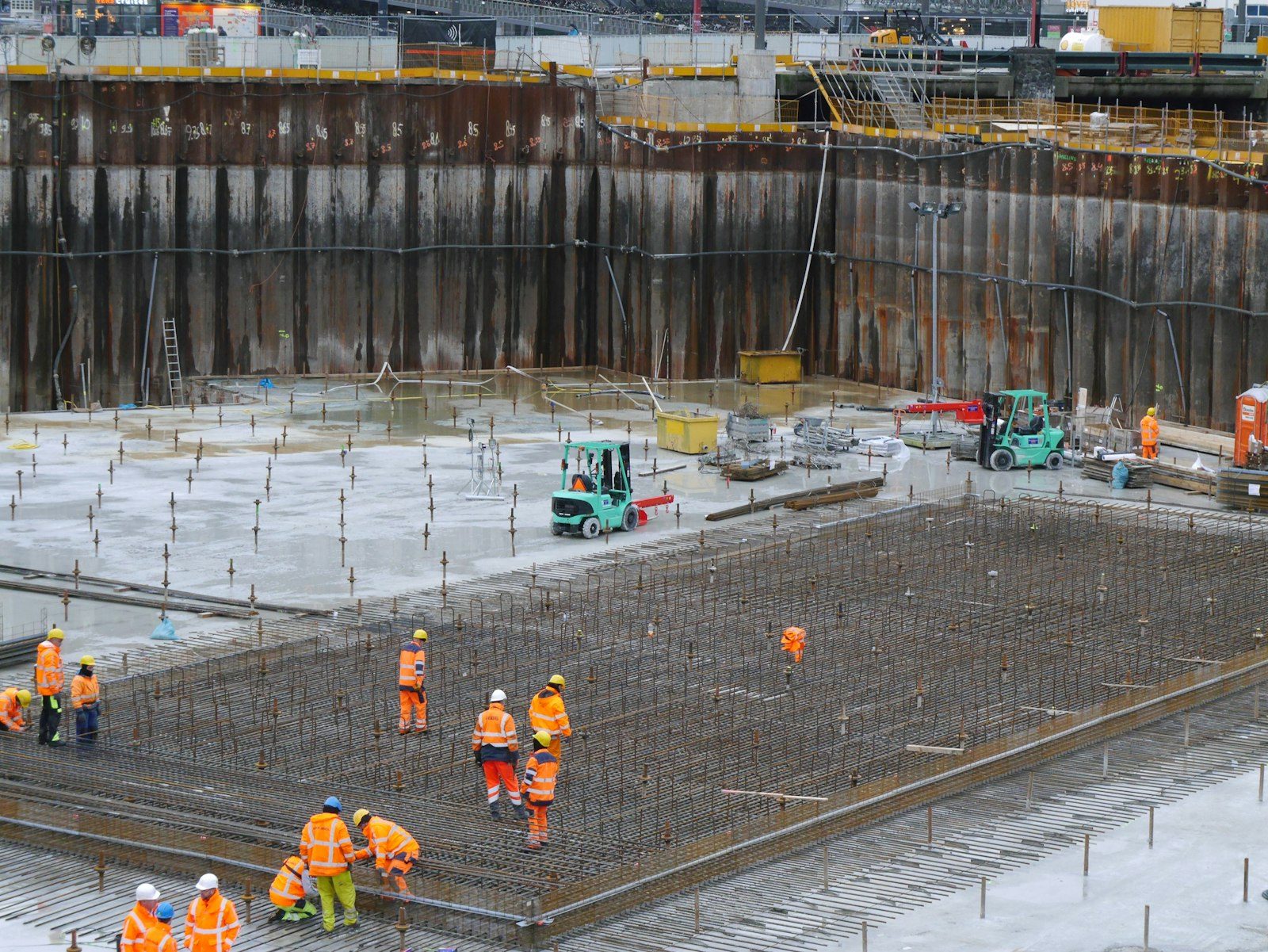
A cement slurry pumped under a sunken slab, pushing it back to grade in an afternoon.
Wait for the next real August downpour, then go outside about ten minutes after it quits. The water tells you everything. Wherever a slab has dropped, a puddle sits there in a shape that never moves, and the joint beside it has a lip you can feel with the toe of a boot. Dry weather hides all of that. A hard rain draws you a map.
Mudjacking is how we fix what the map shows. We drill a pattern of small holes through the sunken concrete, pump a heavy sand-and-cement slurry into the void under it, and let hydraulic pressure raise the slab back where it belongs. No demolition, no forms, no new concrete curing in your driveway for a month. The panel you already own goes back to level and you walk on it the same day.
The material is not mud in any romantic sense. It's a pumpable grout of screened sand, portland cement, and water, mixed thick enough to carry load and thin enough to travel sideways into every corner of a void. Once it sets it becomes a solid pad under your concrete, and it stays there.
That weight is the honest trade-off, and any contractor who won't discuss it isn't giving you the whole picture. Slurry is heavy. Pumped under a walkway sitting on decent soil, that's fine, because you're filling a hole that washed out and the ground below is happy to hold it. Pumped under a slab that dropped because the soil under it is genuinely weak, you've added load to something already struggling. So the first thing we do is figure out which of those two situations you have. Void from erosion, mudjacking is the right call all day. Soft native soil under a heavy structure, we'll point you somewhere else, and we've talked plenty of people out of a lift they were ready to buy.
| Spot | Usual cause | What a lift does |
|---|---|---|
| Walk between the drive and the front door | Backfill along the foundation that was never compacted | Restores the walking plane and stops water from running back at the house |
| Garage apron dropping away from the slab | Trench for utilities settling under the apron | Closes the step at the door and takes the bump out of the tire path |
| Patio panel next to the downspout | Roof water dumped in one place for years, washing fines out | Lifts the panel and re-pitches it away, though the downspout still needs extending |
| Hillside walk on a stepped lot | Slope creep and runoff undercutting the low edge | Recovers grade, but only after we look at where the water is coming from |
| Pool or hot tub surround edge | Compaction shadow left by the original excavation | Levels the transition and closes the trip lip at the coping |
We'll come measure the drop and tell you whether lifting fixes it. Free, and no one leaves a sales folder on your counter.
We pump from thaw through late fall, and the busiest stretch runs from June into October. Autumn is the smart booking. Getting a slab back to grade before winter means snowmelt drains off it instead of pooling, freezing, and prying the joint open a little wider every night. A lip that's a nuisance in October is an ice patch in January.
Cold shuts the work down eventually. Slurry needs above-freezing ground to cure properly, and frozen soil won't let a panel move anyway, so a December call usually turns into a March appointment. Rain matters less than it does for a pour, since almost everything cures under the slab, but we still hold off during a soaking day. Saturated ground under a settled panel is unpredictable, and we'd rather lift into stable soil and hand you a result that stays put.
One more note specific to this town. Plenty of homes in The Village at Castle Pines and up around BellaMesa sit on graded hillside pads, and on those lots the settlement is almost always downhill of something. Fixing the slab without fixing where the water goes just resets the clock.
Still unsure about something?
Call the crew at (303) 569-4046 and we will talk it through.
Get a free, no-obligation estimate from a crew that knows Colorado soil, Colorado weather, and how to finish concrete that lasts.
Accessibility
Adjust the site to fit how you read and browse. Your choices are saved on this device.