
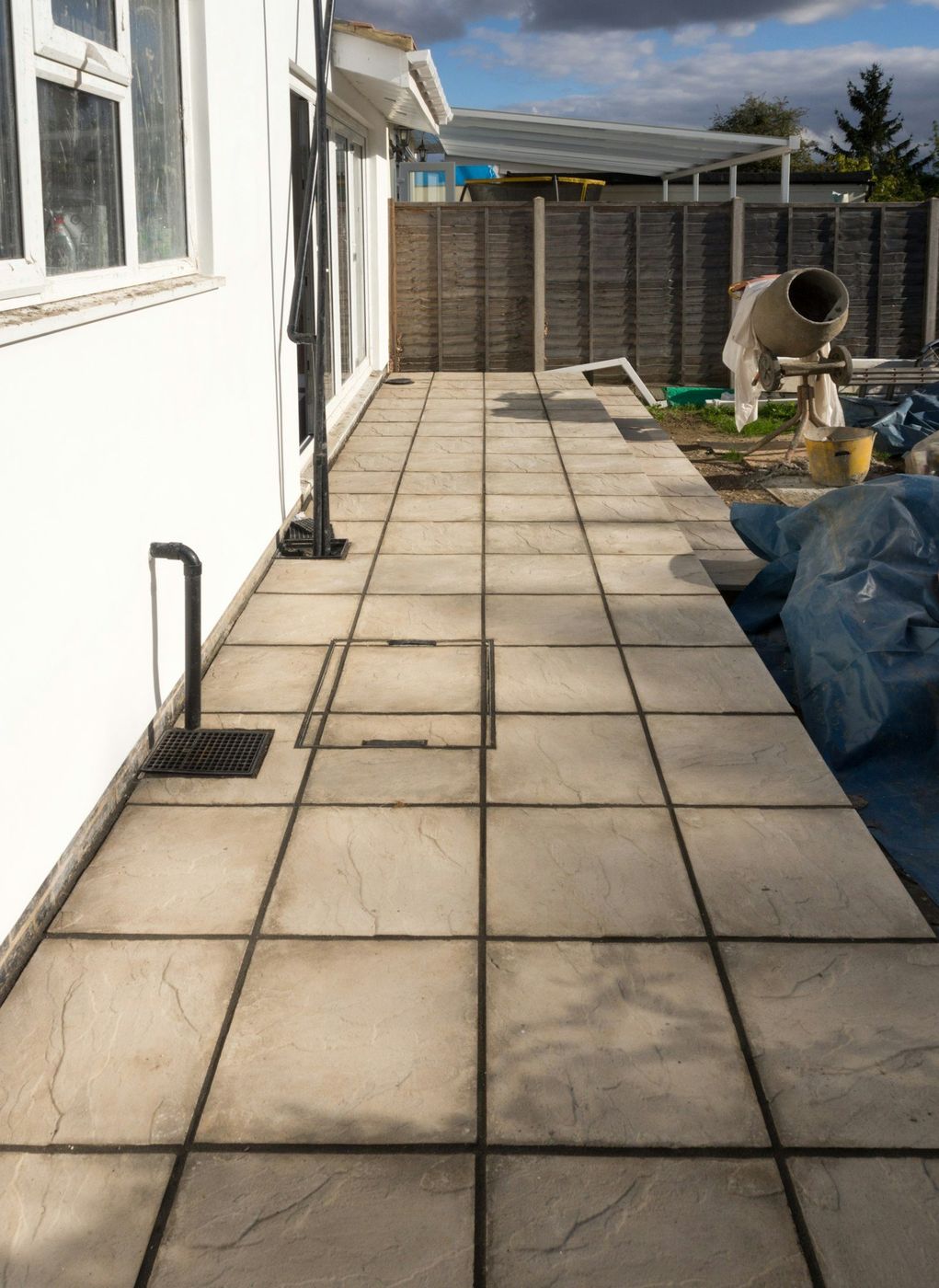
A bonded topping is only as good as the slab under it and the way you use it after.
An overlay is a thin layer of engineered cement material bonded onto concrete you already own. Done on the right slab it saves you a tear-out, a dumpster, and a week of your driveway being a dirt pit. Done on the wrong slab it's money spread a quarter inch thick over a problem that never went away.
What decides which one you get isn't the product. It's the slab underneath and, honestly, how the finished surface is going to be used. A covered entry that sees shoes and a doormat asks almost nothing of a topping. A back patio in Daniels Gate that hosts a grill, a fire table, two dogs, and a snow shovel every January is a different assignment entirely, and we spec it differently.
Here's what actually happens to these surfaces. Patio chairs get dragged, not lifted. Somebody sets a hot grill grate down. A planter sits in one spot for four years and leaves a ring. Dogs come off the trail with wet paws and gravel between their toes. Kids ride bikes across it. In February the shovel scrapes it twice a week, and whoever's holding the shovel is not thinking about your finish.
All of that is survivable, and we plan for it. Thicker systems handle abuse better than thin ones, so we won't put a microtopping on a high-traffic patio just because it photographs well. Texture matters too: a lightly broomed or knock-down overlay hides scuffs that a smooth trowel finish would show. And the sealer is the sacrificial layer. It takes the grill grease and the chair legs so the topping doesn't.
| System | Thickness | What it handles |
|---|---|---|
| Microtopping | 1/16 inch to 1/8 inch | Interior floors and covered porches; a color and texture change, nothing structural |
| Self-leveling topping | 1/4 inch to 1 inch | Interior slabs that are out of level; pours flat on its own and takes polish or dye afterward |
| Spray-down knock-down | About 1/8 inch | Pool decks and walks that need grip; texture comes from the spray pattern |
| Stampable overlay | 1/4 inch to 3/4 inch | Patios and drives that want a stone or plank pattern without tearing out sound concrete |
| Full-depth replacement | 4 inches and up | Everything above fails here; when the slab is moving, no topping is the answer |
Nothing about an overlay works if it doesn't grab. So we open the existing surface mechanically, either shot blasting or diamond grinding, until the slab has a profile you can feel with a fingertip. Any sealer, any curing compound, any oil stain has to come out, because a topping laid over a sealed slab will lift in sheets the first cold snap.
Then we deal with the cracks. This is the part people skip and regret. A crack in the base slab is a hinge, and a hinge telegraphs straight up through a quarter inch of topping within a year or two. Static hairlines we fill and move past. Cracks that have moved get treated honestly: either we cut a joint in the overlay directly above them so the movement has a designed place to go, or we tell you the slab isn't a candidate. Both answers are better than a pretty surface with a fresh crack running through it next April.
Text us photos of the worst cracks and the edges. We'll tell you overlay or tear-out before anyone drives out to measure.
Toppings are thin, and thin material at 6,450 feet lives a hard life. Water that gets under an overlay through an unsealed edge and freezes is the classic failure, which is why we detail edges and terminations carefully and keep drainage running away from the house on these hillside lots. The note we give every client is the same: keep it sealed and keep chloride deicers off it, forever, not just the first winter.
Placement season runs from about mid-May into early October. We need the slab itself at 50 degrees or better and staying there, during placement and right through the cure, and a spring morning that starts at 38 doesn't count just because the afternoon looks fine. Interior overlays run year round.
Around town the work splits by age. Older slabs in Castle Pines North, and in the first sections built at The Village at Castle Pines, usually have a solid base under a tired surface. Ideal candidates. Lagae Ranch and BellaMesa are newer, so those calls are usually about a builder-standard patio that's structurally fine and visually forgettable.
The question I get on every estimate is how long an overlay lasts. Wrong question. Ask how long the slab under it has left. Put a topping on good concrete and you'll forget it's an overlay. Put one on concrete that's already giving up, and you bought yourself two summers.Our crew lead, after the walkthrough
Still unsure about something?
Call the crew at (303) 569-4046 and we will talk it through.
Get a free, no-obligation estimate from a crew that knows Colorado soil, Colorado weather, and how to finish concrete that lasts.
Accessibility
Adjust the site to fit how you read and browse. Your choices are saved on this device.