
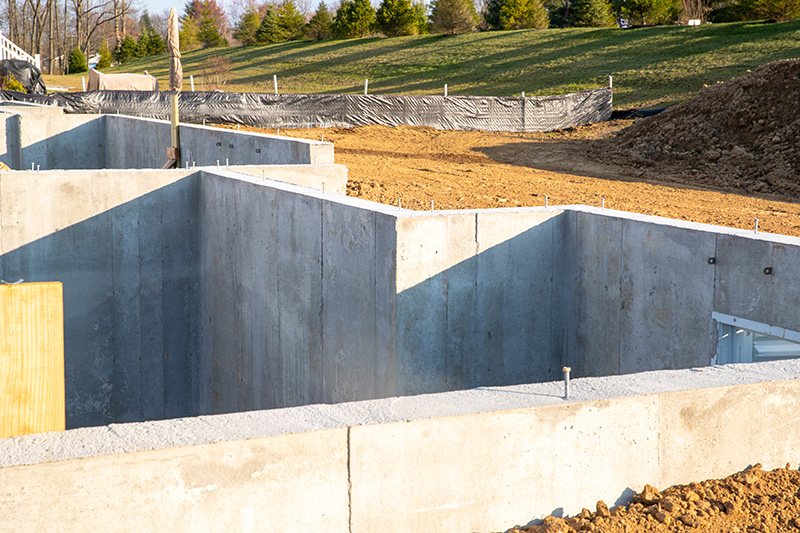
Diamonds, a chemical hardener, and the slab you already own. Nothing gets added on top.
Aurora is a city of buildings with good slabs hiding under bad floors. Walkout basements carpeted in whatever was cheap the year the house sold. Three-car garages doing duty as gyms and woodshops. Storefront suites and small warehouse bays where somebody rolled gray paint over the concrete and it's been flaking ever since. Every one of those is a candidate, and none of them needs a new floor poured.
Polishing means cutting into the concrete itself with progressively finer diamond tooling until the surface closes up and starts throwing light back at the room. Mid-sequence, a chemical densifier soaks in and reacts inside the pores, so the hardness lives in the slab rather than above it. What you get is a floor with nothing to chip, nothing to yellow, and no seams.
The first passes use metal bonded tooling, and those are the passes that decide everything. Coatings, adhesive, paint, and the high spots all come off here, and whatever imperfection survives this stage is permanent. Crews that rush the opening cut are the reason some polished floors look great from standing height and terrible from a low angle.
Once the surface is flat and clean, the densifier goes down. It's a liquid silicate that penetrates and reacts with free lime inside the concrete, filling the pore structure with hardened material. That reaction is why a polished floor keeps its shine under traffic instead of buffing dull in a year. Apply it too early, before the surface is open, and it sits on top doing nothing. Apply it too late, after the pores are already closed by fine grinding, and it can't get in. Timing inside the sequence is the whole trick.
After that, resin bonded tooling in rising grit takes over, each step erasing the scratch pattern the last one left. You stop wherever the look you want lives, from flat matte through satin to a deep reflection. A guard treatment burnished in at the end adds stain resistance.
| Option | What it really is | How it ends |
|---|---|---|
| Mechanical polish | The slab itself, ground and chemically hardened | It wears very slowly and gets re-burnished. There is nothing to peel |
| Epoxy or urethane coating | A separate plastic layer bonded to the surface | Chips at impact points, yellows under any daylight, and lifts if moisture pushes up |
| Roll-on garage paint | Thin coating over concrete that usually got no real prep | Flakes off in tire paths inside a couple of winters |
| Bare sealed slab | Concrete with a penetrating product and nothing else | Fine, honestly. It stays a plain slab and keeps releasing fine dust |
| Vinyl plank over concrete | A floating floor with underlayment between it and the slab | Seams open, water finds them, and what gets under stays under |
One close photo usually tells us whether your slab will polish well. No charge for the opinion.
The disqualifier is water coming up from below. Plenty of slabs went down without a vapor barrier under them, and if ground moisture is wicking through, it will haze the finish or push a guard coat loose months after we've gone. We tape plastic down overnight and look for condensation underneath before we quote anything. If it reads wet, we say so and talk about a different plan.
Cracks we can work with, as long as they've stopped moving. A stable crack gets routed and filled with a semi-rigid material that grinds flush and reads as a line in the floor rather than damage. Still moving, and polishing is the wrong next step, because the crack will telegraph right through the shine.
Outdoors we almost always decline. A closed, tight surface gives water nowhere to go, and a February morning turns it into an ice rink. Repeated freezing also works moisture into that hardened top layer until it pops. Garages sit in between and work well, since they're covered and the traffic is rubber. We do add grit to the guard coat inside the door, because a car dripping snowmelt onto glossy concrete is a fall waiting to happen.
Scheduling is the pleasant surprise. No pour, no cure, so winter works fine, and winter is when our exterior calendar has room. The only cold-month requirement is airflow during the wet stages: a cracked window and a fan.
Still unsure about something?
Call the crew at (303) 569-4046 and we will talk it through.
Get a free, no-obligation estimate from a crew that knows Colorado soil, Colorado weather, and how to finish concrete that lasts.
Accessibility
Adjust the site to fit how you read and browse. Your choices are saved on this device.