
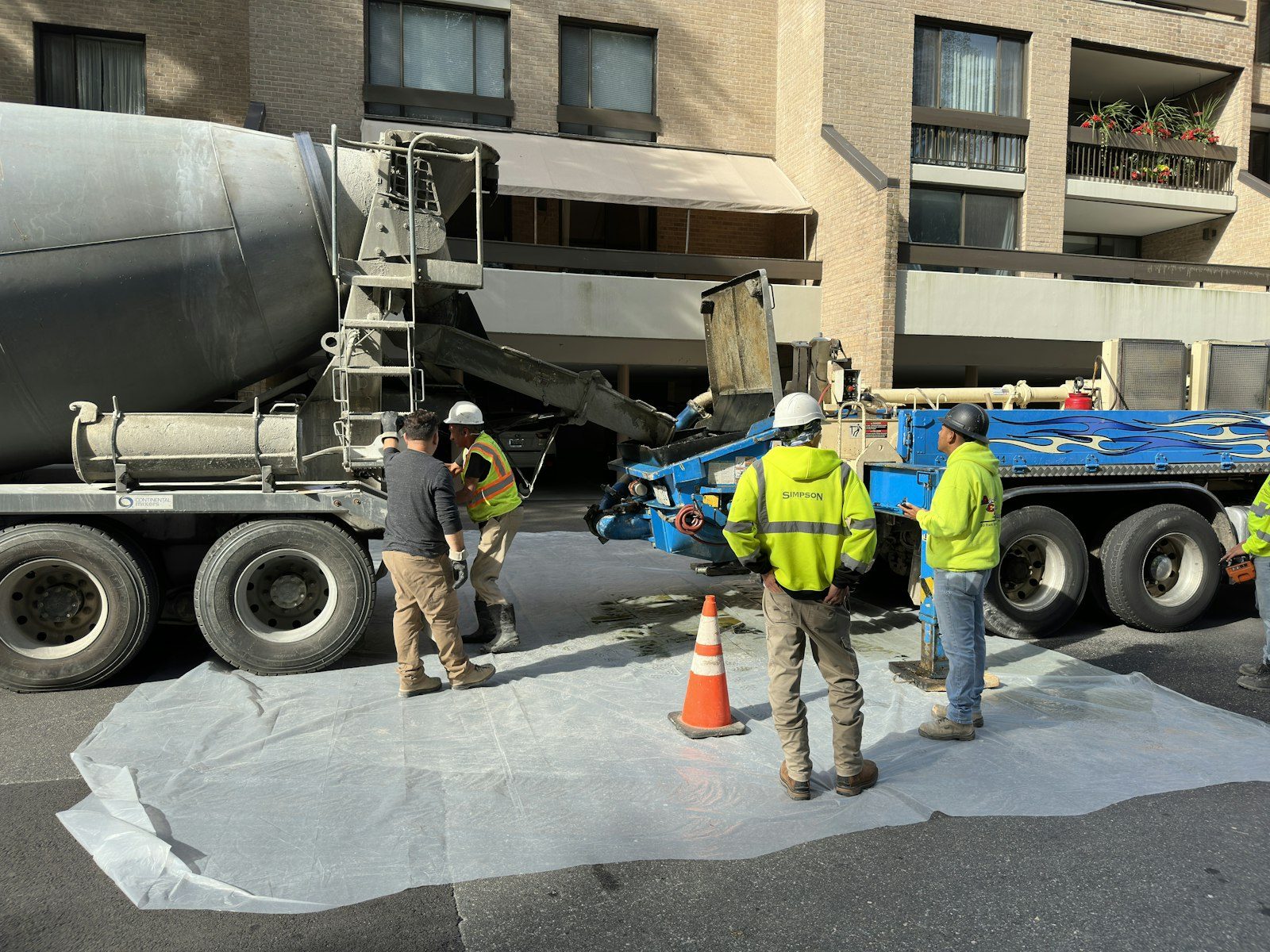
A section of lot goes from barricades to open stalls in about ten days, and only one morning of that involves concrete.
Property managers rarely ask us technical questions about a lot. They ask when the barricades go up, how many stalls disappear, and which morning the noise happens. Fair questions, because a lot rebuild is a scheduling problem that happens to involve concrete.
So here's the day itself, laid out the way we'd walk a manager through it on site. We build and rebuild concrete lots and lot sections for retail centers, office and flex buildings, and association properties around Westminster, from the older commercial pockets near Quail Creek out to the newer streets by Bradburn. Most of what we do is not a full lot. It's a failing drive aisle, a trash truck route, or the twenty feet inside an entrance that nobody built for the weight that ended up crossing it.
Crew shows up before the sun clears the buildings. First thing is a walk of the barricade line, because something is always parked inside it. Then grade stakes get checked against what we set the day before, forms get a final look, and steel gets tied off the ground on chairs where it belongs. Nobody orders a truck until the string reads right.
First mixer usually lands mid morning. We place from the far edge back toward the access point so the trucks never have to cross fresh work. Concrete goes in, gets pulled to grade with a screed, and a bull float knocks the surface down while it's still wet. Then we wait. Finishing too early traps bleed water in the top and gives you a slab that dusts under the first winter.
Once the sheen leaves, the crew edges, floats, and drags a broom across it perpendicular to traffic. Saw cuts happen the same day, often after dark, and the timing is a judgment call the crew makes on site: too early and the blade ravels the edge, too late and the slab has already picked its own crack.
| Stage | How long it holds the section | What your tenants still have |
|---|---|---|
| Mobilize, barricade, notice | Half a day | Everything but the marked stalls |
| Saw cut and demolition | One to two days | Adjacent aisles, with noise and dust nearby |
| Excavate and haul off | One day | Same, plus truck traffic through one entrance |
| Base, compaction, proof roll | One day | Quietest stretch of the whole job |
| Forms, steel, layout | Half a day | No change, and no heavy equipment running |
| Placement and finishing | One morning into the afternoon | Keep the access route clear, that's all we ask |
| Saw joints and cure | Seven days, no exceptions | Everything except the poured section |
| Barricades down, striping | One short visit | The section back, freshly marked |
Tell us your busiest days and your delivery windows. We'll build the schedule backward from those.
Everything above assumes the sky cooperates, and here it often doesn't. A July afternoon can build a cell over the foothills and drop it on the north metro within the hour. Rain on concrete that's already hard is nothing. Rain on a slab we're still finishing washes cement paste out of the surface and leaves you a lot that dusts and scales. So we place early on storm days, we keep plastic and squeegees in the truck, and if the radar looks wrong at ten in the morning, we cancel the trucks and eat the day.
Heat is the other one. At 5,384 feet with low humidity and steady wind, a slab loses surface water fast, which means less working time than the same mix would give you at sea level. Summer pours start early. Fall is the friendliest season we get: cool mornings, long finishing windows, and a slab that isn't racing the crew.
Cold work is possible. Heated water, a non chloride accelerator, blankets over everything, and a strength check before we let a wheel on it. But frozen subgrade is a hard stop, and no schedule pressure moves that.
The lot pours that go sideways are almost never about concrete. It's the box truck somebody left inside the barricades overnight, and we burn the first hour of placement day tracking down a driver.
Straight from the crew
Still unsure about something?
Call the crew at (303) 569-4046 and we will talk it through.
Get a free, no-obligation estimate from a crew that knows Colorado soil, Colorado weather, and how to finish concrete that lasts.
Accessibility
Adjust the site to fit how you read and browse. Your choices are saved on this device.