
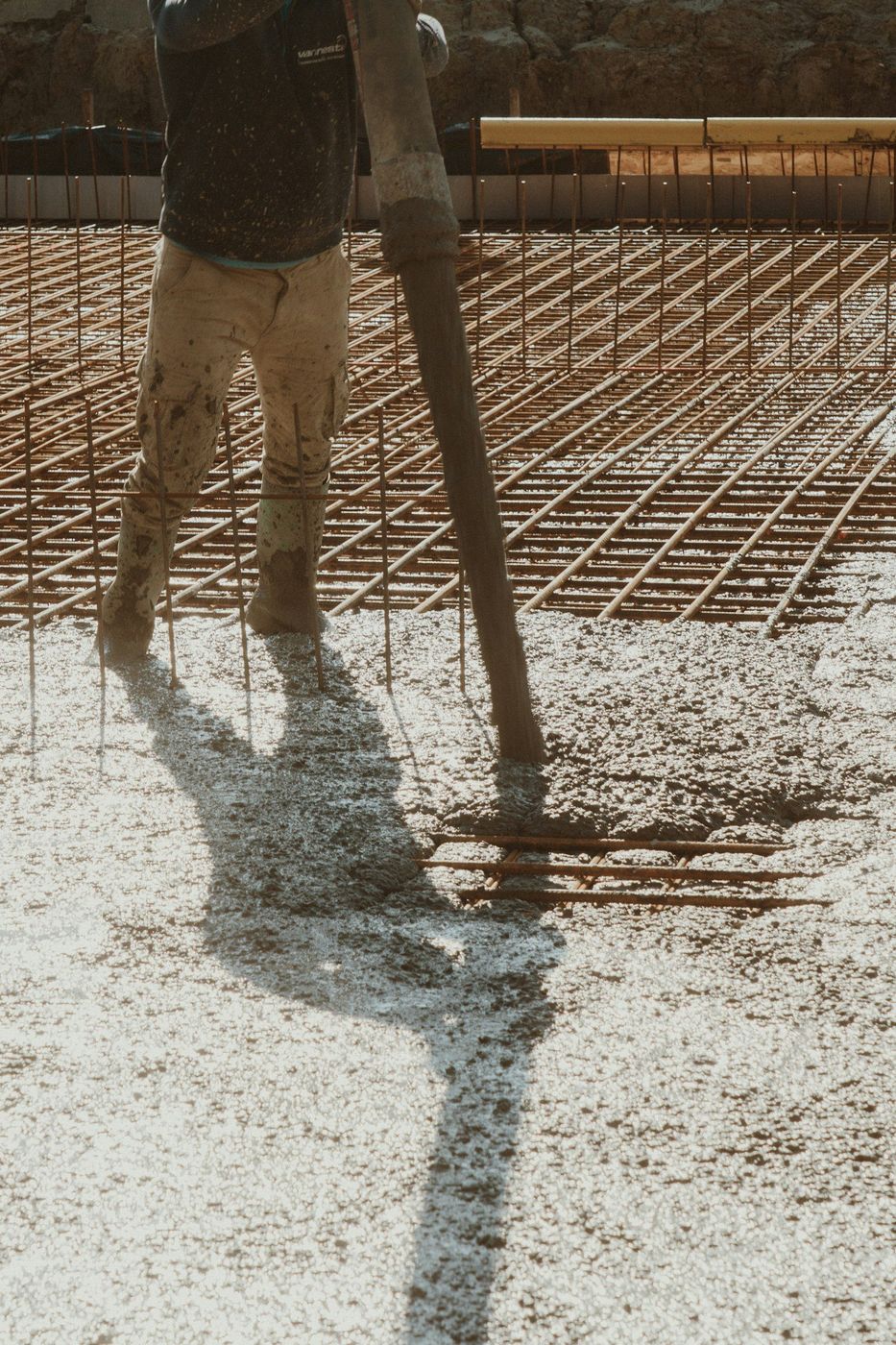
The finish is a small line on the estimate and the only part of the slab you'll touch every day.
Ask what a slab costs and the answer is mostly buried where you'll never see it. Excavation, hauling out what came off the ground, road base placed and compacted in lifts, steel tied and chaired, forms, the concrete itself, and a crew standing around a truck for a couple of hours. All of that happens before anybody picks up a broom.
The finish sits on top of that pile, and depending on which one you choose it either adds a rounding error or it adds a whole day of skilled labor and a return trip. That's the real spread. Knowing which side of it you're standing on is how you decide what's worth buying and what isn't.
Base and steel are the expensive, invisible half, and they're also the half that decides whether the slab is still flat in twenty years. Nobody has ever admired a compacted subgrade. It's still the best money on the invoice.
Finish is the part you can shop. A broom finish is one person making one pass at the right moment, and it adds almost nothing to the total, which is exactly why it's on most of the flatwork in town. Move up to a washed or stamped surface and you're buying crew hours, product, a window that has to be hit precisely, and a return visit for rinse or sealer. Those are real costs, and they're honest ones. What they buy is appearance and traction, not durability. A stamped slab on a bad base fails at exactly the same rate as a broomed one on a bad base, just more expensively.
| Finish | What it adds on pour day | What it asks of you later | Where the value lands |
|---|---|---|---|
| Broom | Almost nothing. One pass, one person, at the right moment | Optional sealer, a hose, and a plastic shovel | The best value on the board for drives, walks, and utility slabs |
| Float | A bit more than a broom, far less than a trowel | Same as broom, with slightly more attention to sealing | Patios that want a softer look without paying for decorative |
| Hard trowel | Real time on the slab and a crew waiting on it to be ready | Nothing, provided it stays indoors where it belongs | Garages and interior slabs, where it pays back in how easily it cleans |
| Exposed aggregate | Retarder, a crew standing by, a wash, and a rinse trip later | Sealer every couple of years and no steel shovel blades | Grip and looks on slopes, patios, and anywhere bare feet go |
| Stamped | The longest finish day there is, plus color and two coats of sealer | A reseal clock you actually have to keep | Appearance. That's what you're buying, and there's nothing wrong with that |
| Salt finish | A small addition on pour day, honestly | It parks water in every pocket through every freeze | Rarely worth it at this altitude. We usually point people elsewhere |
We spec finishes by location, not by preference. A north-facing front walk holds ice into March, so it gets broom lines running across the direction of travel, never with it. A south-facing driveway takes the full ultraviolet load all year, which is an argument against a film-forming sealer and for keeping the texture simple. Backyard patios in Bradburn and Legacy Ridge are where the decorative money makes sense, because you're standing on them barefoot in July and looking at them from the kitchen window the rest of the year.
Garages are the one place we'll hard trowel. Dense, closed surface, easy to sweep, takes a densifier and a coating well. Put that same finish outdoors and you've built a skating rink that also scales, because a burnished surface sheds air entrainment right where it needs it most.
Season runs late April into October, and September gives the best finishing weather of the year. Slab temperature is the whole story: a July afternoon closes the window early and a cool October morning stretches it out for hours. Winter pours get heated water, non-chloride accelerator, and blankets, and the decorative options mostly come off the table until spring.
Same base, same steel, same concrete. See what the texture actually costs before you choose. Call (303) 569-4046.
People spend three weeks picking a texture and thirty seconds on the base. We'd flip that. Give us a properly compacted subgrade and a broom, and I'll take that slab over a stamped one on soft ground every day of the week.The crew lead's read on it
Still unsure about something?
Call the crew at (303) 569-4046 and we will talk it through.

Get a free, no-obligation estimate from a crew that knows Colorado soil, Colorado weather, and how to finish concrete that lasts.
Accessibility
Adjust the site to fit how you read and browse. Your choices are saved on this device.