
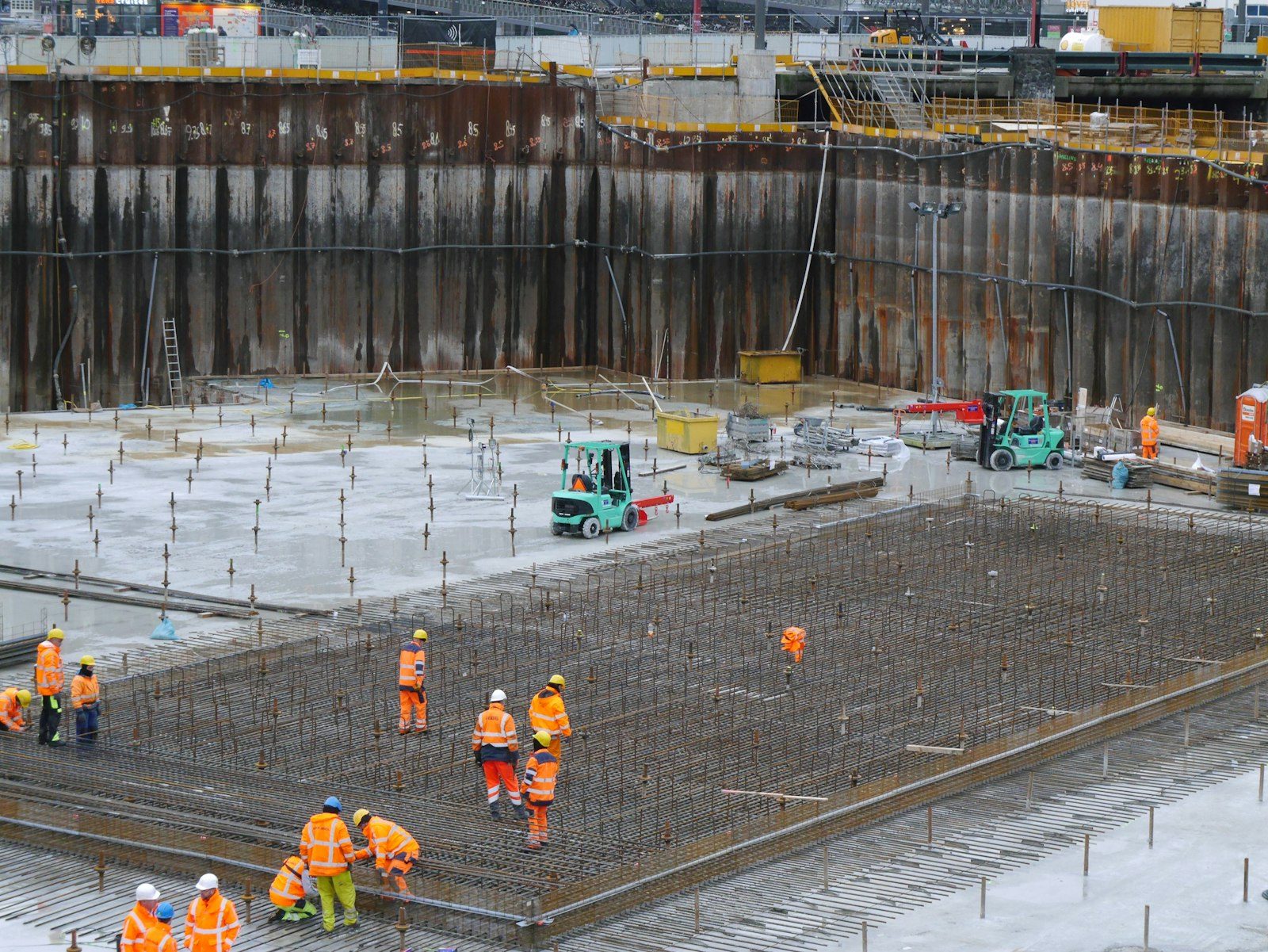
The part of a lot that decides its lifespan is the part nobody ever sees you build.
Ask three contractors for a parking lot number and you'll get three prices for the same thickness of concrete. What separates them is everything below the forms: how much soft ground gets dug out, how many lifts of base go in, whether anybody proof rolls it, and what happens to water once it hits the pavement. That work doesn't photograph well and it doesn't show up in a marketing shot. It's the whole job.
We build and rebuild concrete lots for retail centers, medical and office buildings, churches, self-storage sites, and multifamily properties around Parker. Owners call us for the surface. We spend the first two days on the dirt, because a lot that heaves, ruts, or ponds got that way underneath long before it looked bad on top.
Soils out here move with moisture, and a parking lot is a giant lid that changes how moisture behaves. You cover several acres of ground, cut off evaporation, then funnel every roof and every storm into a few concentrated paths. The dirt under the middle of the lot and the dirt at the inlet live completely different lives.
So we start with what the geotechnical report says, and if there isn't one on a large rebuild, we push for it. Borings tell us whether we're dealing with material that needs moisture conditioning, partial removal and replacement, or stabilization before anything gets paved. Guessing costs more than testing, every time.
Then we proof roll. A loaded truck rolls the subgrade while we watch for pumping, the soft rolling wave that means saturated material. Those spots get dug out and rebuilt rather than covered up. It slows a Tuesday down. It also prevents the sunken drive aisle you'd otherwise patch in year four, which is the most common repair call we take on lots serving the Stonegate and Stroh Ranch side of town.
| Area of the lot | How we build it | The reason |
|---|---|---|
| Standard passenger stalls | Five inches on compacted base, fiber and joint control | Static loads, low repetition. Overbuilding here wastes budget |
| Main drive aisles | Six to seven inches, bar reinforcement, tighter joints | Every vehicle on the property crosses this ground daily |
| Delivery truck route and dock approach | Seven inches plus, thickened edges, doweled joints | Axle loads and braking forces concentrate in a narrow lane |
| Trash enclosure approach | Thickest section on the property, heavy bar | A front-load truck puts its whole load on two points |
| Accessible stalls and access aisles | Standard thickness, grade shot and verified | Slope tolerance matters more than strength here |
Drainage is not a finishing touch you add at the end. It's the layout. We set the high points and the flowlines first, then fit the striping plan around them, because a beautifully striped lot that ponds at the entrance is a lot you'll be grinding and patching for its whole life.
A few rules we hold. Water gets to an inlet without crossing an accessible route if we can help it. Roof drainage gets carried, not dumped onto pavement where it freezes into a sheet every February morning. Curb flowlines run continuous, with no flat spots where silt collects. Joints don't sit in the bottom of a swale.
Freeze-thaw punishes anything that holds water, which is why we specify air-entrained mix on every exterior pour and why we argue over a percent of slope that looks trivial on paper. Ponded water at 5,869 feet freezes overnight in shoulder season, thaws by noon, and does it again tomorrow.
Get us in during design, not at bid time. Drainage and phasing decisions made early are the ones that save real money.
You can tell which lots got proof rolled just by driving them at ten years old. The ones that didn't have a wavy drive aisle and everything else looks fine. That wave was in the dirt the day it was paved. Concrete never fixed a soft spot. It only spans it for a while.What our crew lead tells homeowners
Still unsure about something?
Call the crew at (303) 569-4046 and we will talk it through.
Get a free, no-obligation estimate from a crew that knows Colorado soil, Colorado weather, and how to finish concrete that lasts.
Accessibility
Adjust the site to fit how you read and browse. Your choices are saved on this device.