
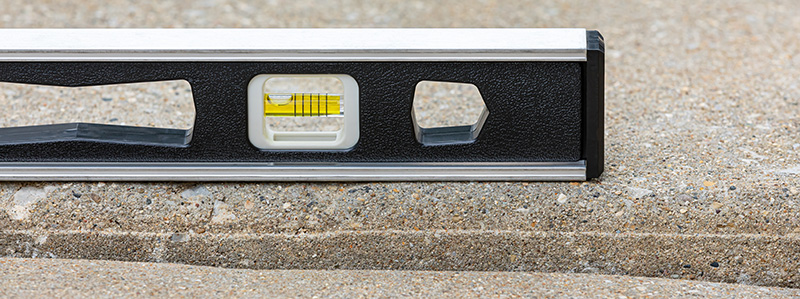
Small, solid pads that keep equipment level and quiet.
Air conditioners, standby generators, heat pumps, and pool or irrigation pumps all need one thing to run right: a flat, stable base that does not move. A small pad sounds like a simple thing to pour, and it is the kind of job that gets thrown in as an afterthought. But when an equipment pad settles even a half inch, the whole unit goes out of level. That stresses refrigerant lines and electrical conduit, adds a hum and rattle you can feel through the house, and on a generator it can throw the engine and fuel connections out of alignment.
On the Front Range, the soil under that pad is usually the problem. Expansive clay swells when it gets wet and shrinks when it dries, and a pad set on loose dirt rides that movement up and down. We pour small, precise equipment pads on a compacted base, pitched to drain, so your AC condenser or generator sits level and stays level. Get the base right and a pad this size will outlast the equipment sitting on it.
Steep, rocky ground makes grading and drainage the heart of the job. We plan both before we form. For ac & generator pads, that local knowledge is exactly what protects your investment. We plan the base, drainage, reinforcement, and finish around the conditions on your Morrison property, not a generic detail.
We serve every part of Morrison and the surrounding area, including Willow Springs, Friendly Hills, Red Rocks area. Wherever you are in Jefferson County, the crew shows up with the same standard.
At roughly 5,764 feet, Morrison gets intense high-altitude sun and a freeze and thaw cycle that is hard on any concrete poured without care. For equipment pads, that means air-entrained mixes, deliberate curing, control joints cut on time, and a base prepared for the expansive clay under your property. It is the difference between work that holds for decades and work that starts failing by the first or second spring.
The honest concern with any equipment pad is settling, because a small slab on bad ground is exactly what tilts a few years in. When an AC condenser leans, the compressor runs at an angle it was not designed for, and over time that wears it out faster. A tilted pad pulls on the copper line set and the conduit, and those connections do not like being stretched. On a standby generator the stakes are higher, because an out-of-level engine affects oil distribution and the fuel feed. The fix is not a thicker slab on top of loose fill. It is what goes underneath. We strip the organic topsoil, compact the subgrade, and build a base that does not ride the clay. That is the part nobody sees and the part that keeps the pad flat.
A pad is only as stable as the ground it sits on, and around here that ground moves. Front Range clay swells when water soaks in and pulls back when it dries out, and a pad set straight on disturbed dirt rides that cycle. We dig down past the loose surface soil, lay and compact a road-base layer, and pour onto something that holds. Water is the other half of the problem, so we pitch the pad to shed runoff away from the unit and away from the foundation instead of letting it pool against the slab. For air-conditioner and generator pads we use an air-entrained mix and proper control of the pour so the small slab cures dense and resists the freeze-thaw scaling that chews up cheap pads over a few winters.
The difference between a pad that just holds weight and one that works is in the details set before the concrete goes down. A standby generator has to be bolted to its pad, so anchor placement has to match the unit's footprint exactly. We coordinate that ahead of the pour and set anchors or sleeve the pad so your installer is not drilling into green concrete or fighting a layout that does not line up. The same goes for electrical conduit and, on a generator, the gas line. We can sleeve those through the pad so the connections come up clean where they belong. We also size the pad with the clearances the manufacturer and code call for around an AC condenser or generator, so the unit breathes and the technician has room to service it.
An equipment pad is not a guess at a square of concrete. We size it to the actual unit going on top, with enough margin around the edges that the equipment is fully supported and not hanging off a corner. A condenser pad, a generator pad, and a pump pad each carry different loads and need different footprints, and we pour each one for its job rather than a one-size slab. Pitch matters as much as size. A pad that holds water against the base of an AC unit or a generator enclosure invites rust and ice, so we build in a slight slope that carries water off the surface and away. Small slab, but every dimension on it is there for a reason.
Every Morrison job starts with a free, written estimate and a structural engineer on staff for the work that needs one. Licensed, bonded, and insured, with finishes from a clean broom texture to stamped, colored, and sealed.
You always know what is happening and what it costs before we mix a single yard. Here is the path from first call to final walkthrough.
We visit the site, measure, check drainage and soil, and hand you a clear written quote. No charge, no pressure.
We set the grade, thickness, reinforcement, and finish. Structural work gets engineered and permitted.
Forms, rebar, and a clean pour. We screed, float, and finish to the texture you picked, then cut control joints.
You can walk it in 24 to 48 hours. We walk the job with you and explain how to care for it through the first winter.
Still unsure about something?
Call the crew at (303) 569-4046 and we will talk it through.

Get a free, no-obligation estimate from a crew that knows Colorado soil, Colorado weather, and how to finish concrete that lasts.
Accessibility
Adjust the site to fit how you read and browse. Your choices are saved on this device.