
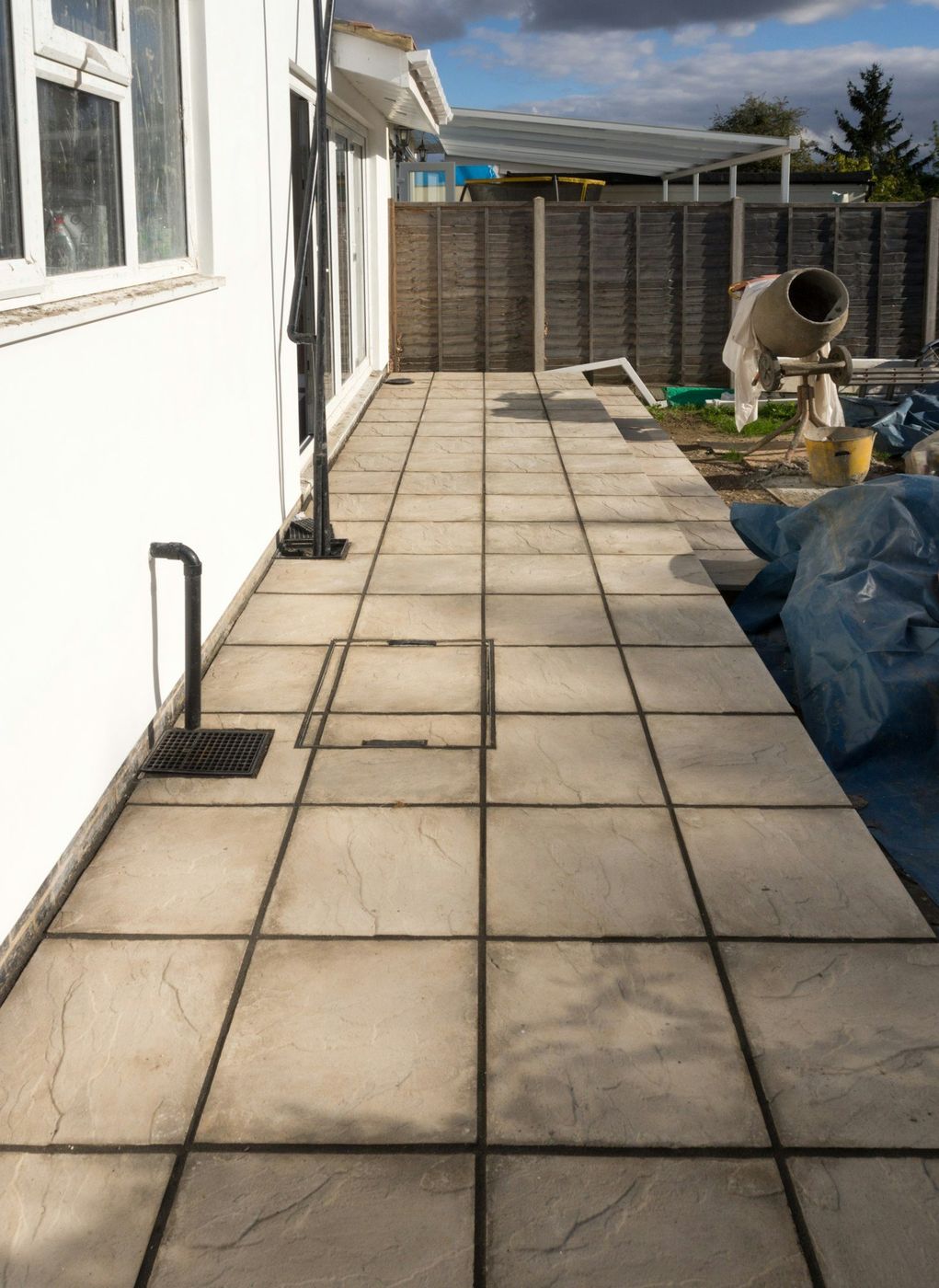
A resurfaced slab has to get used, not admired. That's the standard we build to.
Chairs dragged out every evening and shoved back after dinner. A grill that spits. Firewood stacked in the same corner from October to April and dropped there hard. Dogs going in and out a hundred times a day, and a shovel scraping across the whole thing all winter.
That's what a resurfaced patio has to live through, and it's the standard we hold the work to, because a new surface that only looks right in photographs isn't worth what it costs. Ours get bonded properly, placed thick enough for the use, and sealed on a schedule so ordinary life doesn't show on them.
The new surface goes down in a day on most residential slabs. You stay off it entirely for the first twenty-four hours, and after that you can walk it. Furniture waits a few more days, mostly so nothing scuffs a surface that's still gaining strength. Vehicles on a resurfaced drive wait a full week. None of that is us being cautious for the sake of it; a topping reaches usable strength quickly and full strength slowly, like the concrete underneath it.
Sealer is the step people forget, and it's the one that decides how the surface looks in year three. We seal once the topping has cured, then again on a cycle of roughly every two to three years up here. Between those, the slab wants almost nothing: sweep it, rinse it, keep water from pooling on it. That's the entire maintenance program.
| What happens on it | How the new surface handles it | What we ask |
|---|---|---|
| Metal chair legs dragged in and out | Concrete shrugs. The sealer is what takes the scratches. | Glide pads on the legs the same week it's finished |
| Grill grease and dripped oil | Sealer holds it off a while, then oil finds the paste | Wipe it while it's fresh, and put a mat under the grill |
| Snow shoveled off it all winter | No harm at all from a plastic blade or a rubber edge | No steel blades, and no chipping at bonded ice |
| Ice melt scattered at the door | This is the one thing that ends a topping early | Sand only. Skip magnesium chloride permanently. |
| Planters sitting in one spot | Trapped damp darkens the surface and lifts sealer | Put them on feet and move them a couple of times a year |
| Firewood stacked in a corner | Bark, tannin, and constant moisture will stain through | Use a rack with air underneath it |
Resurfacing rebuilds the top of a slab. That's the whole scope, and being clear about it saves everybody money. Worn, dusting concrete: yes. Light scaling and a pitted surface: yes. Old broom texture that's gone smooth in the traffic lanes, discoloration, small spalls, a finish somebody rushed twenty years ago: all yes.
Then the other list. A slab that has settled and now catches your shoe at a joint has a base problem, and putting a new face on it just gives you a smooth surface with the same trip hazard. Cracks that open and close through the year are moving, and movement telegraphs up through anything you bond over it. Concrete that's crumbling deep, where you can dig into it with a screwdriver, is past saving. We'd rather tell you that on the first visit than sell you a topping that fails in two winters.
If the surface flakes but the slab underneath is hard, you're a good candidate. (303) 569-4046.
Older houses give us the most of this work. Perry Park and Sage Port have plenty of flatwork that has been through decades of sun, snowmelt off a roof, and whatever got thrown down for traction, and the surfaces are tired while the slabs beneath them are still fine. Those are the good ones. Bear Dance calls are usually different: newer builder flatwork that has a scaled spot at the drip line or a garage apron that took deicer off a car before anybody thought about it.
Season limits this more than most work. A cementitious topping needs surface temperatures comfortably above freezing while it goes down and for several days afterward, so exterior resurfacing runs late May into early October here, with September being the safest bet. We will not place a topping when a hard freeze is in the forecast, because a surface that freezes before it cures is a surface you pay for twice. Garage and shop floors we do all winter.
The screwdriver test settles most arguments. If it skates across and the flaking is just the top skin, we can give you a new surface. If it digs in and keeps going, that slab is done and no topping is going to save it.What the crew sees on site
Still unsure about something?
Call the crew at (303) 569-4046 and we will talk it through.

Get a free, no-obligation estimate from a crew that knows Colorado soil, Colorado weather, and how to finish concrete that lasts.
Accessibility
Adjust the site to fit how you read and browse. Your choices are saved on this device.