
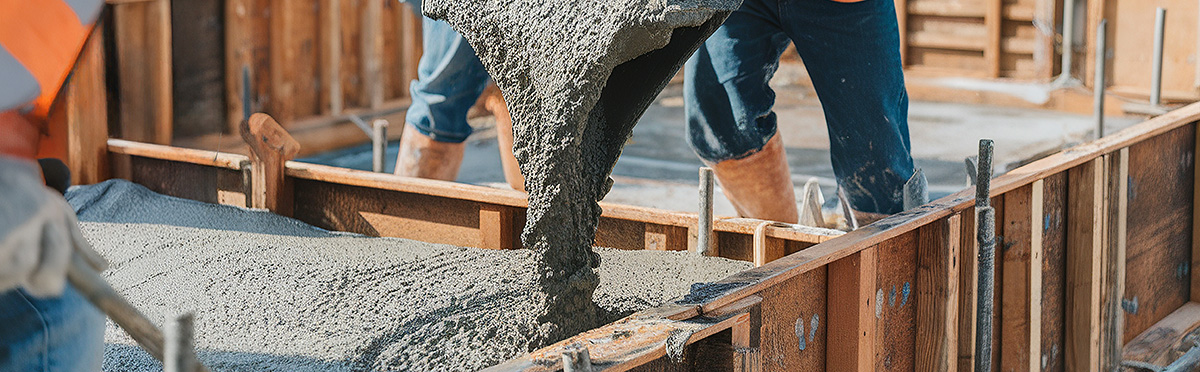
Heavy pads that take the abuse of haulers.
A dumpster pad lives the hardest life of any slab on a commercial property. A loaded bin can weigh several tons, and the hauler truck drops it back down with real force every single pickup. Add the front wheels of a heavy truck riding up onto the same corner week after week, plus the constant grinding and turning of steel casters, and you have a recipe that destroys an ordinary parking-grade slab in a hurry. We pour dumpster pads and trash enclosure slabs that are built for that punishment from the base up.
For Front Range properties, the abuse from above meets a challenge from below. Expansive clay soil swells and shrinks with moisture, and the freeze-thaw cycle works on any water that collects under or around the pad. A pad that was poured thin, on a poor base, with no real reinforcement will crack, sink, and pond water fast. We build the base, the steel, the thickness, and the drainage to handle both the load and the ground it sits on, and we pour to meet local code for waste enclosures.
Acreage drives and pads need real base and drainage planning. We build them to carry the load and shed the water. For dumpster pads & enclosures, that local knowledge is exactly what protects your investment. We plan the base, drainage, reinforcement, and finish around the conditions on your Elizabeth property, not a generic detail.
We serve every part of Elizabeth and the surrounding area, including Gold Creek Valley, Sun Country, Spring Valley Ranch. Wherever you are in Elbert County, the crew shows up with the same standard.
At roughly 6,500 feet, Elizabeth gets intense high-altitude sun and a freeze and thaw cycle that is hard on any concrete poured without care. For dumpster pads, that means air-entrained mixes, deliberate curing, control joints cut on time, and a base prepared for the expansive clay under your property. It is the difference between work that holds for decades and work that starts failing by the first or second spring.
The forces on a dumpster pad are different from anything a driveway sees. When a truck sets a full bin down, the impact lands on the casters in a few small contact points, so the pad has to resist both the dead weight and the shock. Then the truck itself rolls partway onto the slab to lift and dump, putting axle loads right at the edge where slabs are weakest. We design for that by pouring a thicker section than standard flatwork, laying in rebar instead of relying on mesh alone, and thickening the edges where the truck wheels and bin casters concentrate the load. The goal is a pad that does not flex, spall, or break apart at the corners after a season of pickups.
This is the honest concern with this service, so here it is straight. Most dumpster pads crack because they were treated like a parking stall instead of a heavy-duty slab. The two usual failures are a thin or skipped base and not enough steel, and on the Front Range a third one piles on: water sitting under a pad on clay soil. We attack all three. We compact a proper base so the slab has uniform support, place reinforcement sized to the load, and use an air-entrained mix that stands up to freeze and thaw. We also saw control joints at planned spacing so the slab cracks where we tell it to, in a straight tooled line, not in a random web across the field. A pad built this way will still get the hairline shrinkage cracks all concrete gets, but it holds its shape and keeps carrying the load.
A dumpster pad rarely stands alone. Most municipalities and property owners want the bins screened, so the pad ties into a trash enclosure with masonry or steel walls. We pour the enclosure footings and the slab as a coordinated unit so the walls have a solid base and the floor drains the way it should. We also set bollard footings to protect the enclosure walls and gates from being clipped by trucks and bins, and we form the apron or approach so the hauler has a smooth transition from the drive lane onto the pad. Getting the footings, bollards, and slab planned together up front saves cutting into fresh concrete later.
Waste enclosures come with rules, and a lot of jurisdictions on the Front Range require the pad to be sloped and contained so wash water and runoff do not carry waste into the storm drain. We grade the pad to drain to where the code wants it, whether that is a contained low point or a sanitary connection, and we keep the slope steep enough to actually move water but flat enough to set bins on. When a permit is required for the pad or the enclosure, we pull and manage it, and we pour to the spec so the work passes inspection. Good drainage also protects the slab itself, because standing water on clay is exactly what drives heaving and freeze damage here.
Every Elizabeth job starts with a free, written estimate and a structural engineer on staff for the work that needs one. Licensed, bonded, and insured, with finishes from a clean broom texture to stamped, colored, and sealed.
You always know what is happening and what it costs before we mix a single yard. Here is the path from first call to final walkthrough.
We visit the site, measure, check drainage and soil, and hand you a clear written quote. No charge, no pressure.
We set the grade, thickness, reinforcement, and finish. Structural work gets engineered and permitted.
Forms, rebar, and a clean pour. We screed, float, and finish to the texture you picked, then cut control joints.
You can walk it in 24 to 48 hours. We walk the job with you and explain how to care for it through the first winter.
Still unsure about something?
Call the crew at (303) 569-4046 and we will talk it through.

Get a free, no-obligation estimate from a crew that knows Colorado soil, Colorado weather, and how to finish concrete that lasts.
Accessibility
Adjust the site to fit how you read and browse. Your choices are saved on this device.