
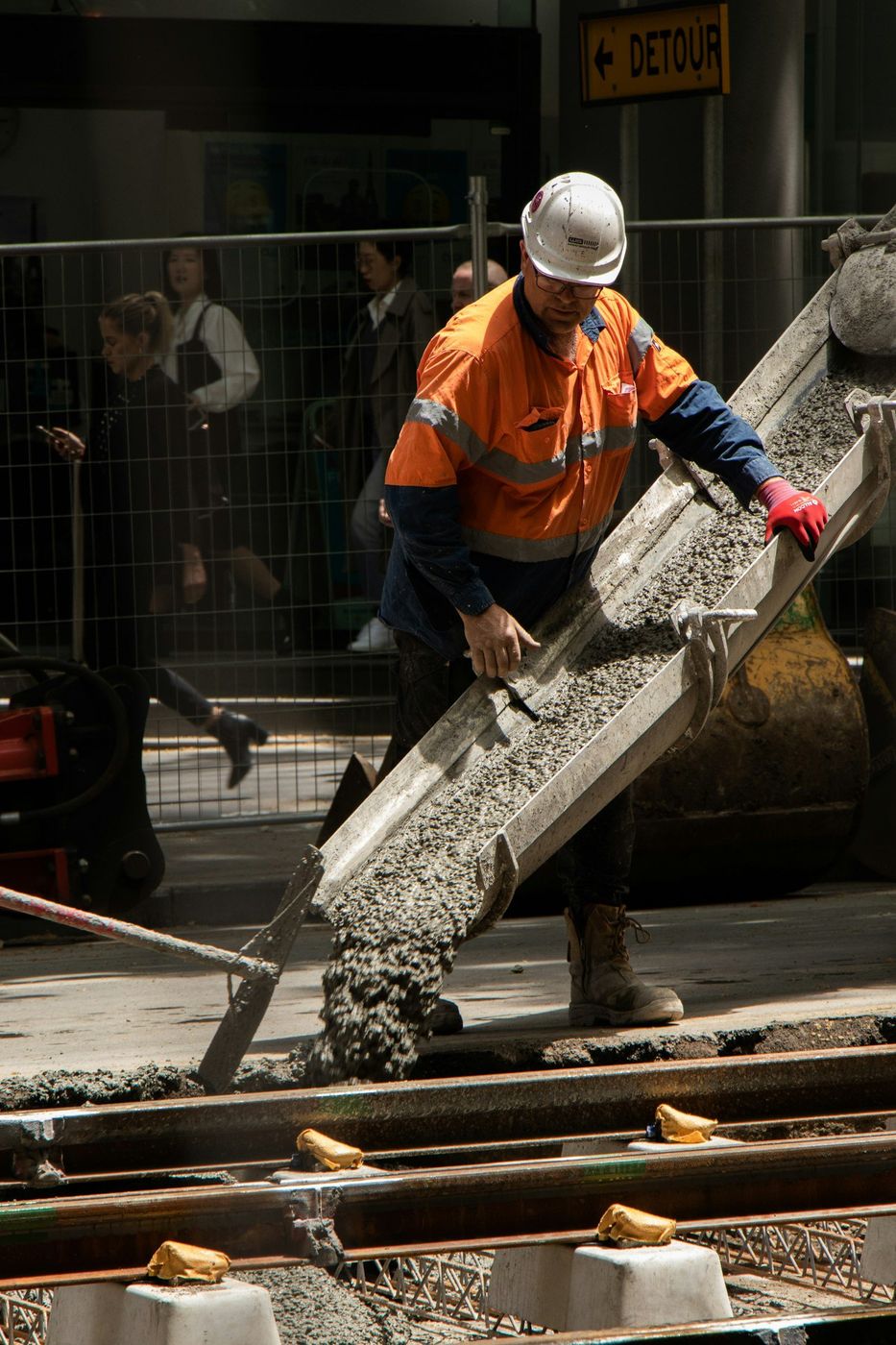
You can grade a trash enclosure from the drive aisle in about four seconds, and so can every tenant touring your property.
Drive past a commercial property and glance at the trash enclosure. Sunken pad, asphalt sagging at the approach, gates that won't latch because the posts moved, a dark stain running toward the aisle. Four-second read, and it tells a prospective tenant more about how a building gets maintained than the lobby does.
We build and rebuild dumpster pads and enclosure slabs for retail centers, apartment communities, restaurants, and industrial buildings around Denver. Older properties in the Highlands and Park Hill often have containers sitting straight on asphalt, which was never going to hold. Newer developments near Central Park got a pad, just not a thick one. Both look the same from the curb after a few years. Both are fixable.
Start with the low spot. A container leaning back toward the wall means the pad settled at the rear, usually because the enclosure was built on fill nobody compacted. Then look where the pad meets the drive. A lip there, or a bowl of crumbling asphalt, means the truck's front wheels drop off the pad edge on every pickup.
Then the stains. Leachate and cooking grease soak into unsealed concrete and creep outward with every wash-down, and once freeze-thaw has scaled the surface the stain has thousands of new places to go. Finally, the gates. Posts set into a slab that's moving rack out of square, which is why so many enclosures are propped open with a cinder block. None of it is cosmetic. Each one is telling you about the ground underneath.
| What you see | What it's telling you | What it takes to fix |
|---|---|---|
| Container leaning toward the back wall | Rear of the pad has settled into uncompacted fill | Full removal, rebuild the base, replace the slab. Lifting alone rarely holds here. |
| Broken lip where the pad meets the drive | The truck's front axle is landing off the pad on every lift | Extend the pad out with a reinforced approach apron so the whole truck is supported |
| Cracks radiating from the middle of the slab | Too thin for the load, or steel that never made it to mid-slab | Replace at proper thickness with #4 bar on chairs. A patch will crack the same way. |
| Dark staining spreading toward the aisle | Surface scaled, unsealed, and now absorbing leachate | Correct the slope, replace the damaged surface, seal it, and give wash water somewhere to go |
| Gates racked and hard to latch | Post footings are moving with the slab | Reset the posts on independent footings below frost depth, tied to nothing that flexes |
| Grooves worn where the container rolls | Steel wheels dragging on soft or worn surface paste | A properly finished, air-entrained slab at full thickness holds up to this without wear tracks |
Text us a photo taken from the drive aisle. We'll tell you whether it's a pad problem, a base problem, or just a slope problem.
A dumpster pad carries more concentrated weight than almost anything on a commercial site, and it does it in short violent bursts. A front-load truck rolls in, drops its forks, and lifts a loaded container over the cab. For that moment nearly the whole vehicle plus the container rides on the front axle, planted in the same footprint every week. That's not a parking load.
Which is why we won't build these thin, and why we skip welded wire mesh here. Mesh has to sit at mid-depth to work, and on a pad this size it gets walked into the base during placement almost every time. Rebar on chairs. Tied. That's the whole argument. Add our freeze-thaw swings and the water these enclosures hold, and the steel is working every winter, not just on pickup day.
Pads are small, fast pours, so the constraint is rarely weather. It's trash. We coordinate with your hauler to pull the container, set a temporary staging spot, and get the slab in and cured before it returns. Demo one day, base and steel the next, place on day three.
Best pouring stretch is late spring through October, and early fall is ideal because a cool night lets a small slab cure without the surface drying ahead of the body. Winter placements work with heated water, an accelerator, and blankets, and we hold traffic off longer. What we won't do is let a loaded truck onto a pad before 28 days. That first pickup is the heaviest thing the slab will ever feel.
Still unsure about something?
Call the crew at (303) 569-4046 and we will talk it through.

Get a free, no-obligation estimate from a crew that knows Colorado soil, Colorado weather, and how to finish concrete that lasts.
Accessibility
Adjust the site to fit how you read and browse. Your choices are saved on this device.