
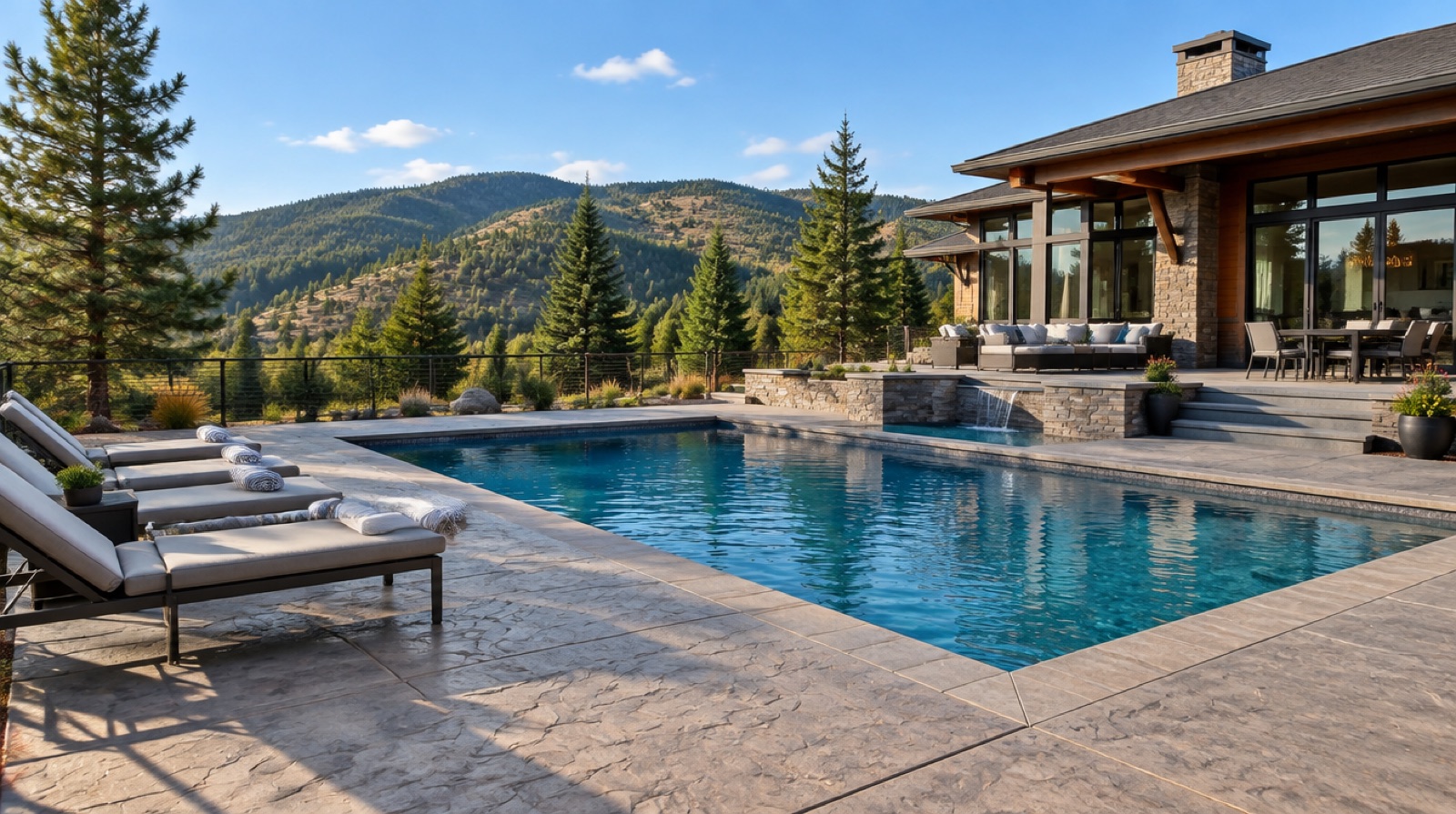
Cool, slip-aware surfaces around the water.
A pool deck is the part of the backyard your bare feet actually live on all summer. It has to be safe when it is wet, easy on the soles when the Colorado sun has been beating on it, and tough enough to take splash-out, chlorine, and a hard freeze every winter. We pour and resurface decks around in-ground and above-ground pools with textured, slip-aware finishes that pitch water away from the water, not toward it, and read like a finished outdoor room instead of a gray apron.
On the Front Range, the deck around your pool sees more abuse than almost any other slab on the property. High-altitude UV bakes the surface, daytime heat swings to cold nights, and the expansive clay underneath moves with every wet and dry cycle. A deck poured without a compacted base, real drainage, and proper jointing will lip up at the coping, pond near the steps, and scale at the edges within a few seasons. We build for that from the ground up so the deck stays flat, drains clean, and grips underfoot for the long haul.
Estate lots bring grading, drainage, and design complexity. We plan the whole site so the concrete performs and looks the part. For pool decks, that local knowledge is exactly what protects your investment. We plan the base, drainage, reinforcement, and finish around the conditions on your Cherry Hills Village property, not a generic detail.
We serve every part of Cherry Hills Village and the surrounding area, including Cherry Hills Park, Old Cherry Hills, Buell Mansion, Devonshire Heights. Wherever you are in Arapahoe County, the crew shows up with the same standard.
At roughly 5,400 feet, Cherry Hills Village gets intense high-altitude sun and a freeze and thaw cycle that is hard on any concrete poured without care. For pool decks, that means air-entrained mixes, deliberate curing, control joints cut on time, and a base prepared for the expansive clay under your property. It is the difference between work that holds for decades and work that starts failing by the first or second spring.
This is the honest concern with any pool deck, and it deserves a straight answer. A smooth troweled surface looks sharp dry and turns dangerous the second it gets wet, especially with a film of sunscreen and chlorine on it. We do not finish pool decks slick. The standard here is a fine broom finish or an exposed aggregate surface, both of which give your feet something to bite into when water is everywhere. Stamped and decorative decks get a textured release and a sealer chosen for traction, not just shine. Where you want a little more grip, like the steps and the wet zone right at the coping, we can add a non-slip additive to the sealer. The goal is a surface that is comfortable to walk on dry and still safe soaking wet.
Standing water is the enemy of a pool deck. It makes the surface slick, it freezes into a hazard in the shoulder seasons, and it works into the slab where our freeze-thaw cycle can scale and pit the concrete. We grade every deck to shed water away from the pool and away from the house, usually a gentle and consistent pitch you barely notice walking on it. On tight sites or sunken patios we plan deck drains, channel drains, or a slot at the coping so water has a clear path out instead of pooling at the low spot. Getting the slope right during the pour is the whole game. Once concrete is cured, a flat or back-pitched deck is expensive to fix, so we set it right the first time.
At altitude the sun is intense, and a dark, dense deck can get hot enough to make you hop to the towel. Two things help. First, color: lighter integral colors and lighter aggregates reflect more heat and stay cooler than charcoal or deep tones. Second, texture and finish: exposed aggregate and broom finishes hold less heat than a tight smooth trowel and feel better on bare feet. We talk through your sun exposure, how much shade the deck gets, and how the family uses the space, then steer the color and finish toward something you can actually stand on at noon in July. It is a small decision at design time that you feel every single swim day.
The joint where the deck meets the pool coping is where decks fail first if it is rushed. The deck and the pool structure move at slightly different rates with temperature and soil, so we never bond them rigidly. We hold a clean expansion joint at the coping, fill it with a flexible sealant that takes the movement, and detail the edge so water runs off the deck rather than down behind the coping. Done right, that joint flexes through the seasons without cracking the deck or lifting the coping. We coordinate with the coping and waterline so the transition looks intentional and the elevations match, which matters a lot on a surface people are walking on wet and barefoot.
Every Cherry Hills Village job starts with a free, written estimate and a structural engineer on staff for the work that needs one. Licensed, bonded, and insured, with finishes from a clean broom texture to stamped, colored, and sealed.
You always know what is happening and what it costs before we mix a single yard. Here is the path from first call to final walkthrough.
We visit the site, measure, check drainage and soil, and hand you a clear written quote. No charge, no pressure.
We set the grade, thickness, reinforcement, and finish. Structural work gets engineered and permitted.
Forms, rebar, and a clean pour. We screed, float, and finish to the texture you picked, then cut control joints.
You can walk it in 24 to 48 hours. We walk the job with you and explain how to care for it through the first winter.
Still unsure about something?
Call the crew at (303) 569-4046 and we will talk it through.

Get a free, no-obligation estimate from a crew that knows Colorado soil, Colorado weather, and how to finish concrete that lasts.
Accessibility
Adjust the site to fit how you read and browse. Your choices are saved on this device.