
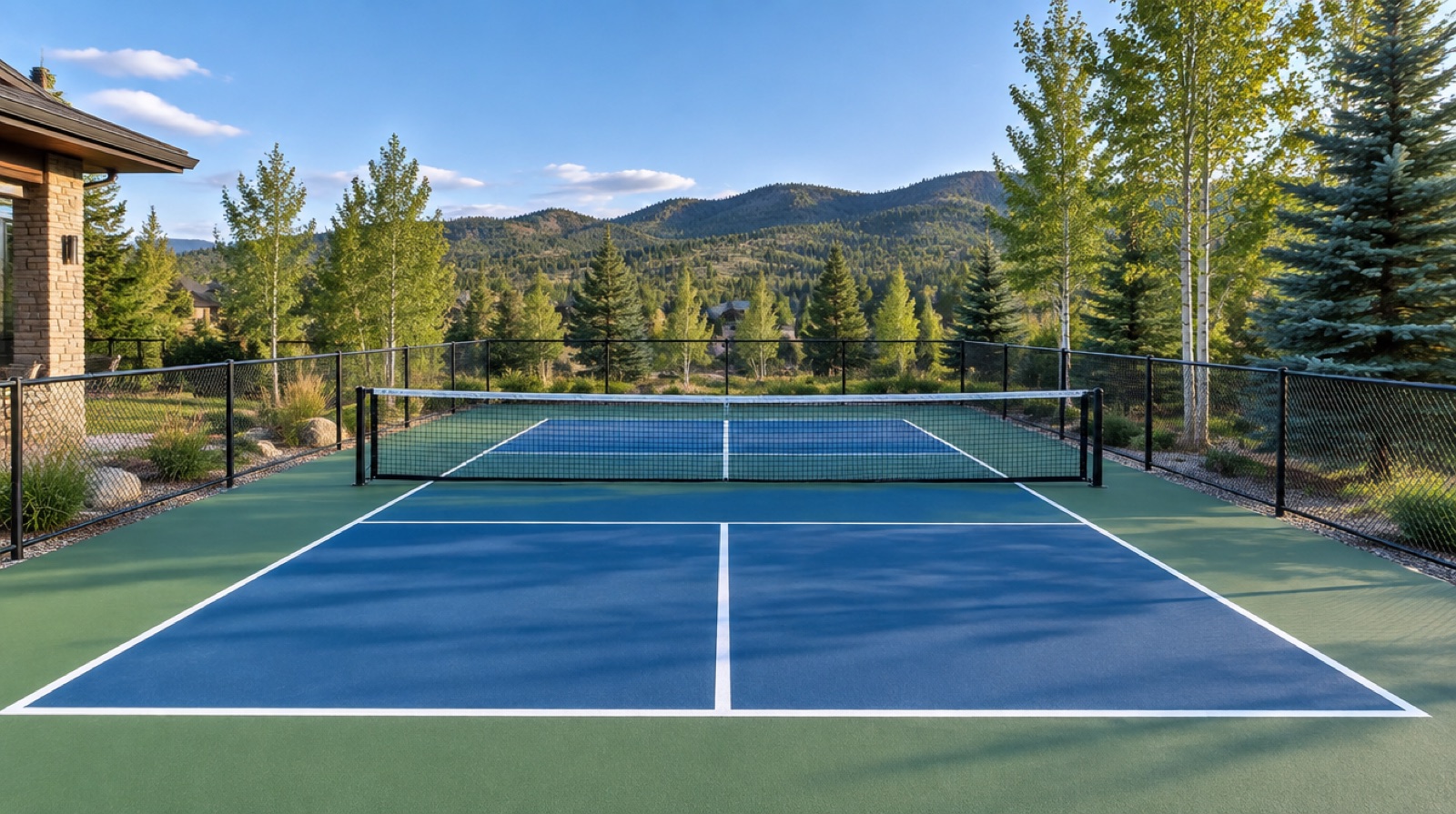
Regulation-flat slabs for the fastest-growing sport.
Pickleball went from a niche backyard game to the thing everyone wants in their yard, at their HOA, and on their community grounds. Underneath every good court is the part nobody sees once the color coating goes down: a flat, well-drained concrete slab. The game is fast and low to the ground, so the surface has to be true. A wave in the slab gives you dead spots and bad bounces, and standing water after a storm shuts the court down for hours. We pour the slab the surfacing system depends on, sized to the dimensions the game needs and finished flat enough to coat.
On the Front Range, the slab has more to fight than flatness alone. Our expansive clay swells and shrinks with moisture, and the freeze-thaw cycle works on concrete all winter. A court slab is big and unbroken, which is exactly the kind of pour that cracks when the base, reinforcement, jointing, and drainage are not handled together. We build the slab to carry that load quietly so the court above it plays true for years.
Estate lots bring grading, drainage, and design complexity. We plan the whole site so the concrete performs and looks the part. For pickleball courts, that local knowledge is exactly what protects your investment. We plan the base, drainage, reinforcement, and finish around the conditions on your Cherry Hills Village property, not a generic detail.
We serve every part of Cherry Hills Village and the surrounding area, including Cherry Hills Park, Old Cherry Hills, Buell Mansion, Devonshire Heights. Wherever you are in Arapahoe County, the crew shows up with the same standard.
At roughly 5,400 feet, Cherry Hills Village gets intense high-altitude sun and a freeze and thaw cycle that is hard on any concrete poured without care. For pickleball courts, that means air-entrained mixes, deliberate curing, control joints cut on time, and a base prepared for the expansive clay under your property. It is the difference between work that holds for decades and work that starts failing by the first or second spring.
A pickleball court lives or dies on how flat the slab is. The acrylic surfacing that goes over it is thin, so it copies whatever shape the concrete underneath has. A high spot or a dip telegraphs straight through to the playing surface, and on a court that small the players feel it on every bounce. We screed and finish the slab to a tight tolerance, check it as we go, and pour with the pitch built in rather than fought against later. The goal is a slab that drains in one direction yet still reads dead-flat to a ball and a paddle. Get that right and the surfacing crew has an easy job, and the court plays the way the game is supposed to.
Water is the enemy of a court two ways: it pools on the surface and stops play, and it soaks the soil under the slab and drives movement. So we build in a slope that carries water off the playing surface to one side, usually a consistent gentle pitch the eye barely notices but the game still respects. Around and under the slab, we handle the base and grading so snowmelt and rain move away from the pad instead of collecting beneath it. On our clay that second part matters as much as the first, because water that sits under a slab is what feeds heaving and settlement. A court that sheds water dries fast after a Colorado storm and stays stable through the wet spring.
This is the real worry with a court, so here it is straight. A pickleball slab is a large, unbroken pour, and concrete that big will move as it cures and as the seasons swing. The question is never whether it wants to crack, it is whether you control where. We control it. We compact a proper base, place reinforcement to hold the slab together, and cut control joints on a planned layout so any shrinkage cracking follows the joint instead of wandering across the court. We use air-entrained mix for our freeze-thaw climate and cure it for real, so you walk on it in 24 to 48 hours and it keeps gaining strength toward full cure around 28 days. A surfacing system can bridge tight, controlled joints. What it cannot fix is a random crack from a skipped base, so we do not skip it.
A court is more than a rectangle of concrete. We set net post sleeves in the right spots during the pour so the posts drop in plumb and solid later, with no drilling into a cured slab and hoping it holds. We finish the surface to what the coating system wants, which is a clean, consistent texture that the acrylic can grip without fighting a slick troweled face or a rough broom drag. If you are tying the court into a patio, a sport court, or a fence line, we plan those edges and transitions while the slab is still on paper. The result is a pad that hands off cleanly to whoever lays the color and lines, with the hard part already done right underneath.
Every Cherry Hills Village job starts with a free, written estimate and a structural engineer on staff for the work that needs one. Licensed, bonded, and insured, with finishes from a clean broom texture to stamped, colored, and sealed.
You always know what is happening and what it costs before we mix a single yard. Here is the path from first call to final walkthrough.
We visit the site, measure, check drainage and soil, and hand you a clear written quote. No charge, no pressure.
We set the grade, thickness, reinforcement, and finish. Structural work gets engineered and permitted.
Forms, rebar, and a clean pour. We screed, float, and finish to the texture you picked, then cut control joints.
You can walk it in 24 to 48 hours. We walk the job with you and explain how to care for it through the first winter.
Still unsure about something?
Call the crew at (303) 569-4046 and we will talk it through.

Get a free, no-obligation estimate from a crew that knows Colorado soil, Colorado weather, and how to finish concrete that lasts.
Accessibility
Adjust the site to fit how you read and browse. Your choices are saved on this device.